 Universe Today
The Solar System's icy moons are a focal point in our search for habitability and life. Among them are Europa, Ganymede, and Callisto, all Galilean moons of Jupiter. Their environmental conditions play a big role in potential habitability, but so does chemistry. Without the right molecular building blocks, life can't get started.
New research shows that complex organic molecules (COM), which are critical chemical precursors to life, were present when the Galilean moons formed and were incorporated into them at the time of their formation. This boosts the prospect for simple life colonizing their under-ice oceans.
Two new studies present the evidence.
One is "Formation and Survival of Complex Organic Molecules in the Jovian Circumplanetary Disk," in The Planetary Science Journal. The lead author is Olivier Mousis from the Southwest Research Institute’s Solar System Science and Exploration Division.
The other is "Delivery of complex organic molecules to the system of Jupiter," and it's published in Monthly Notices of the Royal Astronomical Society. The lead author is Tom Couzinou from Aix – Marseille Universite,´ CNRS, CNES, Institut Origines. Olivier Mousis is also a co-author.
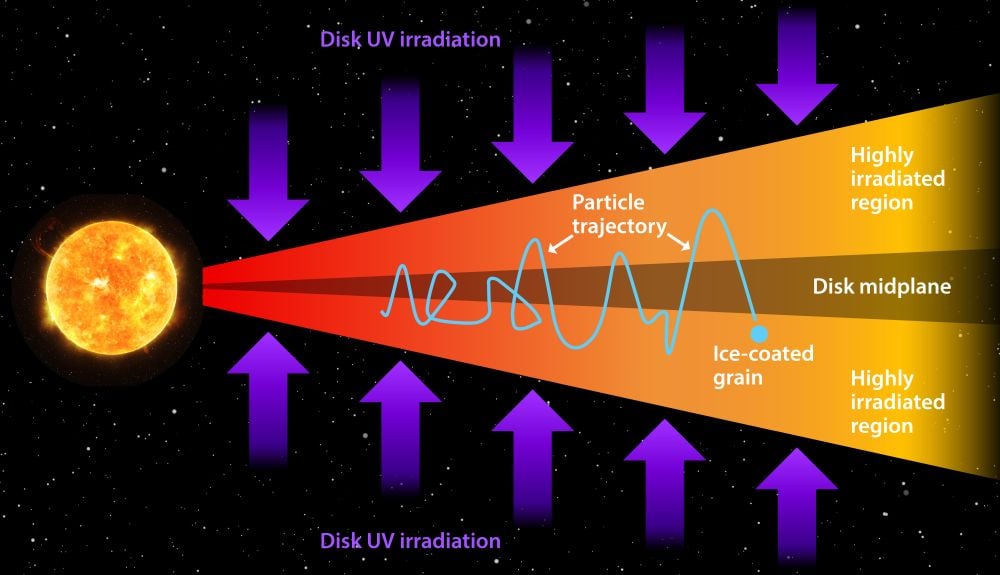
We know that life can't exist without COMs. We also know from laboratory experiments that some COMs can form on tiny icy grains in protoplanetary disks. The energy source for their formation is UV starlight or heat from movement in the disk itself. Once these COMs are available in a disk, they become available to forming planets.
But what about a circumplanetary disk, the torus of material that surrounds an individual planet? Can those same COMs be formed there, and can they find their way into moons that form in-situ around their planets?
“By combining disk evolution with particle transport models, we could precisely quantify the radiation and thermal conditions the icy grains experienced,” lead author Mousis said in a press release. “Then we directly compared our simulations with other laboratory experiments that produce COMs under realistic astrophysical conditions. The results showed that COM formation is possible in both the protosolar nebula environment and Jupiter’s circumplanetary disk.”
In their work, the researchers created two detailed models. One was for the evolution of the protosolar nebula, which is slightly different than a protoplanetary disk but closely related. It's basically an earlier stage of development than what we call a protoplanetary disk. The term is more concerned with the bulk composition and the chemical conditions in this early reservoir of material.
The second model they developed is for Jupiter and its circumplanetary disk. Both circumplanetary disks and the protosolar nebulae form bodies, but circumplanetary disks don't have stars in their centers, so they don't have the same energy available. It's a critical difference.
The researchers then took both models and coupled them with the mechanics of icy grain movement through the disk. This allowed them to essentially recreate the conditions in the disk, and the physical and chemical histories of the materials that eventually formed the Jovian moons. Their effort is focused on the Galilean moons, the gas giant's four largest natural satellites: Europa, Ganymede, Callisto, and Io.
Europa is a strong candidate to have an under-ice ocean that could be habitable, and Ganymede may have one too, sandwiched between layers of ice. There's some evidence that Callisto has one, though it's not as strong as for Europa and Ganymede. Io is totally volcanic and has no chance of harbouring life, regardless of how many COMs it formed with.
The team simulated multiple scenarios, and some of the results show that a significant amount of icy grains from the protosolar nebula acquired COMs, and that they were efficiently transported to the region in Jupiter's circumplanetary disk where the Galilean moons formed. In some of the scenarios, about 50% of the icy grains delivered COMs to the right location.
"Assuming that the Galilean moons formed in a cold circumplanetary disc around Jupiter, the nitrogen-bearing species potentially present in their interiors could have originated from the formation of complex organic molecules in the protosolar nebula," the researchers write.
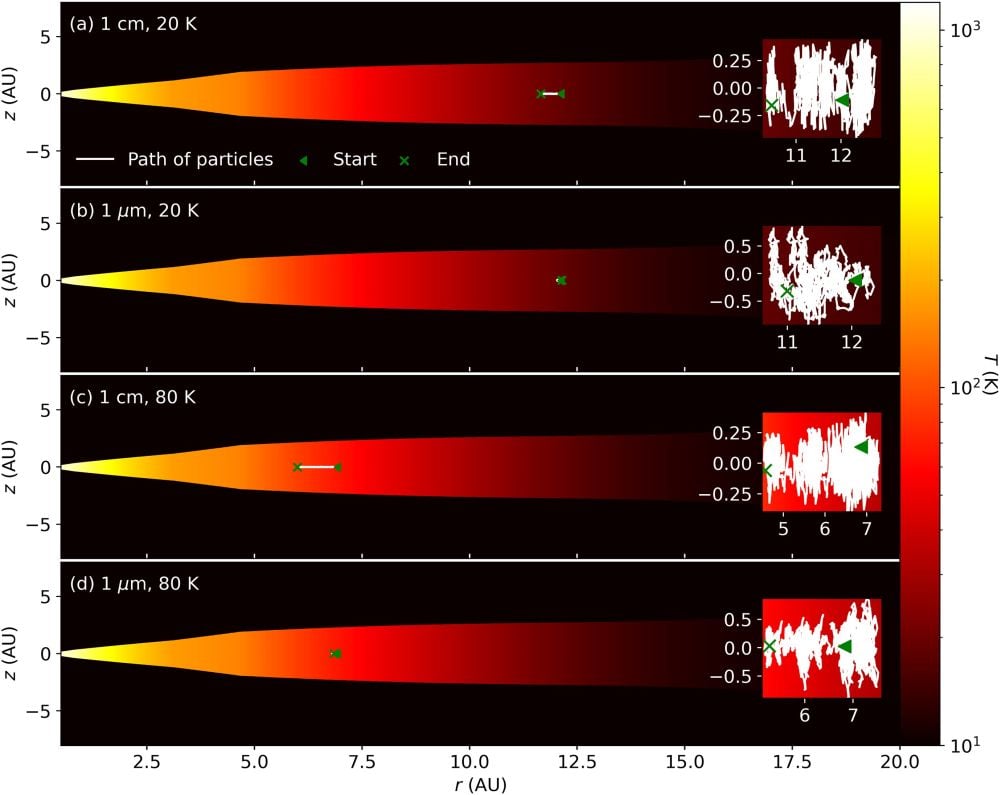 This figure is a two-dimensional temperature map of the protoplanetary disc after 280 kyr of evolution. It shows how two sizes of particles at two initial disk temperatures can move through the disk. "The panels present the trajectories of particles with sizes of 1 cm and 1 micrometer, released at initial disc temperatures of 20 K (panels a and b) and 80 K (panels c and d). The triangles indicate the initial positions of the particles, while the crosses mark their final positions. In each panel, the detailed trajectory of an individual particle is highlighted within the square on the right," the authors write. Image Credit: Couzinou et al. 2026. MNRAS
But the results showed something even more interesting. There was enough heat in Jupiter's circumplanetary disk for COMs to form, making it even more likely that they found their way to where the moons formed. So, according to this research, there are two different sources for COMs to make their way to the moons, and hopefully, into their oceans.
"Overall, our simulations suggest that particles of varying sizes, released at different points during the evolution of the CPD, pass through regions where temperatures are high enough to thermally process ices, particularly NH3:CO2 ices, into complex COMs," the researchers write.
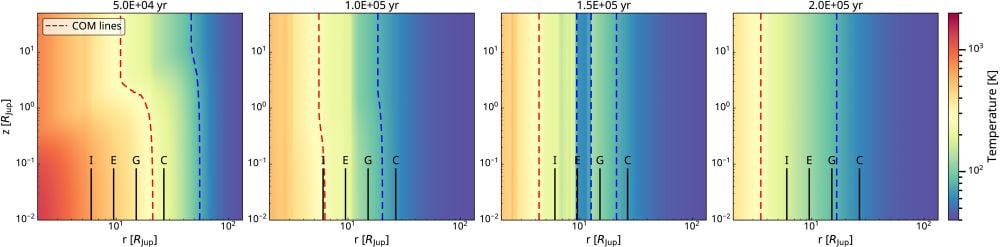 This figure shows how COMs can form in a certain temperature range, and how the temperature changed over time in the Jovian circumplanetary disk. It shows the temperature profiles of the CPD at t = 50, 100, 150, and 200 kyr of its evolution. The formation of COMs by thermal processing occurs in the temperature range from 80 K (blue dashed line) to 260 K (red dashed line). At 150 kyr of evolution, a cold region appears in the model, with temperatures too low to support COM formation by thermal processing. Image Credit: Mousis et al. 2026. PSJ
That would mean that these oceans, especially Europa's, could have not only the conditions for life—water, energy, protection from dangerous radiation—but also some of the chemical building blocks of life.
“Our findings suggest that Jupiter’s moons did not form as chemically pristine worlds,” Mousis said. “Instead, they may have accreted, or accumulated, a significant inventory of COMs at birth, providing a chemical foundation that could later interact with the liquid water in their interiors.”
“Establishing credible pathways for COMs formation and delivery provides scientists with a critical framework for interpreting upcoming measurements of Jupiter’s surface and subsurface chemistry,” Mousis said. “By linking laboratory chemistry, disk physics and particle transport models, our work may highlight how habitable conditions are rooted in the earliest stages of planetary formation.”
Research like this is important in light of the two missions that are on their way to study the Jovian moons: NASA's Europa Clipper and the ESA's Jupiter Icy Moons Explorer. Those missions are going to reveal missing information about these moons and their compositions and structures. Studies like these can provide important context for understanding the results of those missions.
“Establishing credible pathways for COMs formation and delivery provides scientists with a critical framework for interpreting upcoming measurements of Jupiter’s surface and subsurface chemistry,” Mousis said. “By linking laboratory chemistry, disk physics and particle transport models, our work may highlight how habitable conditions are rooted in the earliest stages of planetary formation.”

