Universe Today
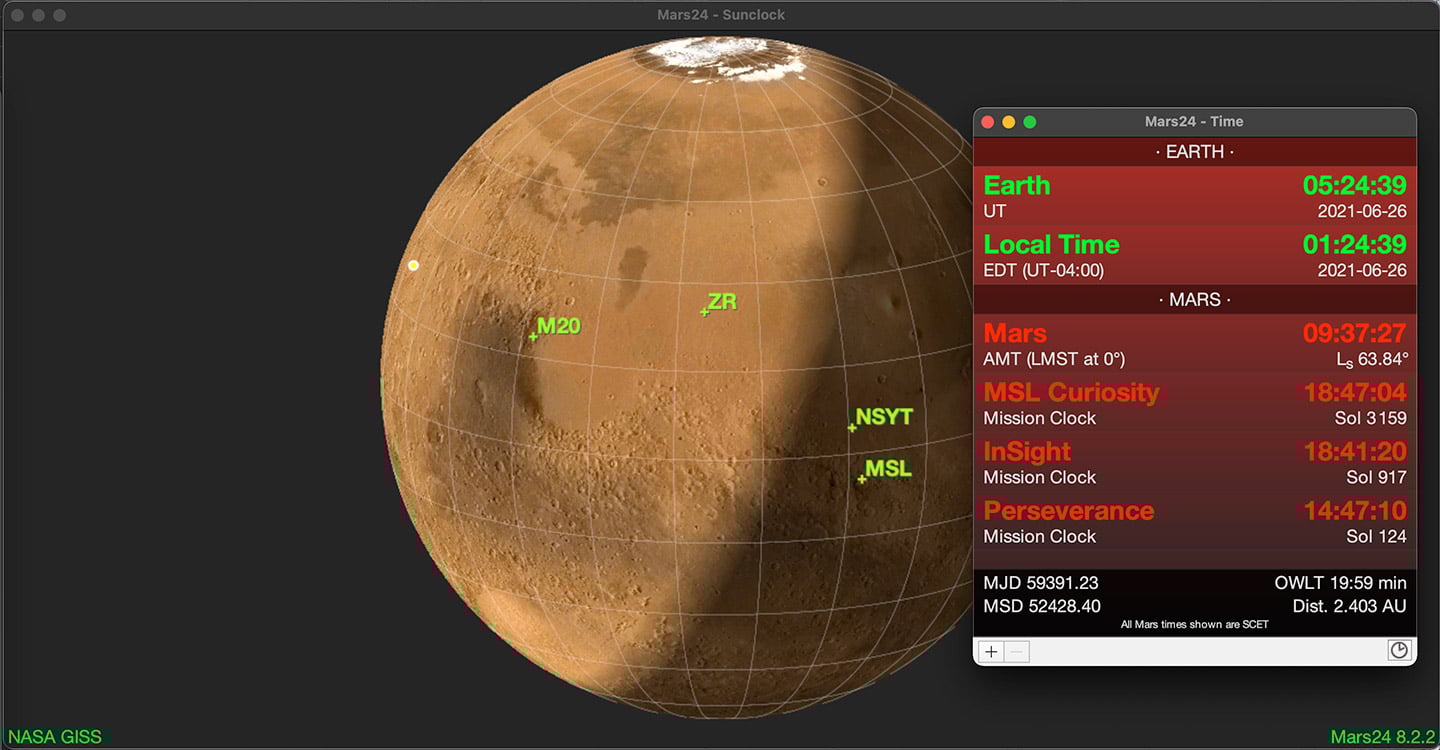
Do you know what time it is? It's an easy question, right? Just look at your phone or watch. But is that really the exact time? Oh, well, for that you can look to Coordinated Universal Time, or UTC. It's what your phone clock is synced to, give or take, but you can get a more accurate measure of UTC with a device that can pick up the UTC radio time signal. Of course, UTC is only an agreed-upon standard that tries to stay in sync with Earth's rotation. It, in turn, is based upon International Atomic Time (TAI), which is a weighted average of 450 atomic clocks located all over the world.
Whew!
Knowing the time accurately is hard. But at least it's based on Earth, where we live. But in the future some of you could be living on Mars. So what time would it be then?
In practical terms, the answer is pretty simple. Just as we sync our clocks to solar noon, so can people on Mars. A Martian "sol" is about 37 minutes and 23 seconds longer than an Earth day, so we just can make Martian hours a bit longer so that a sol is 24 hours. We could even use the Darian calendar system, which defines a Martian year (1.88 Earth years) in terms of 24 months, each with 27 or 28 sols.
That system would be fine if you no longer wanted anything to do with Earth but isn't great for interplanetary communication. For Martian lander missions, we usually use what is known as Airy Mean Time (AMT), which is similar to Greenwich Mean Time (GMT). It defines a prime meridian on Mars by the location of a small crater known as Airy-0. But the exact location of the meridian isn't known, so missions keep track of things based on Earth time and count days since mission touchdown. This is why you'll often hear about a rover doing a task on Sol 25, or the 25th day of its mission.
Ideally we would define a Coordinated Mars Time (MTC) and set up atomic clocks all over Mars to create a Mars Atomic Time. But as a recent study shows, that isn't as simple as it seems.
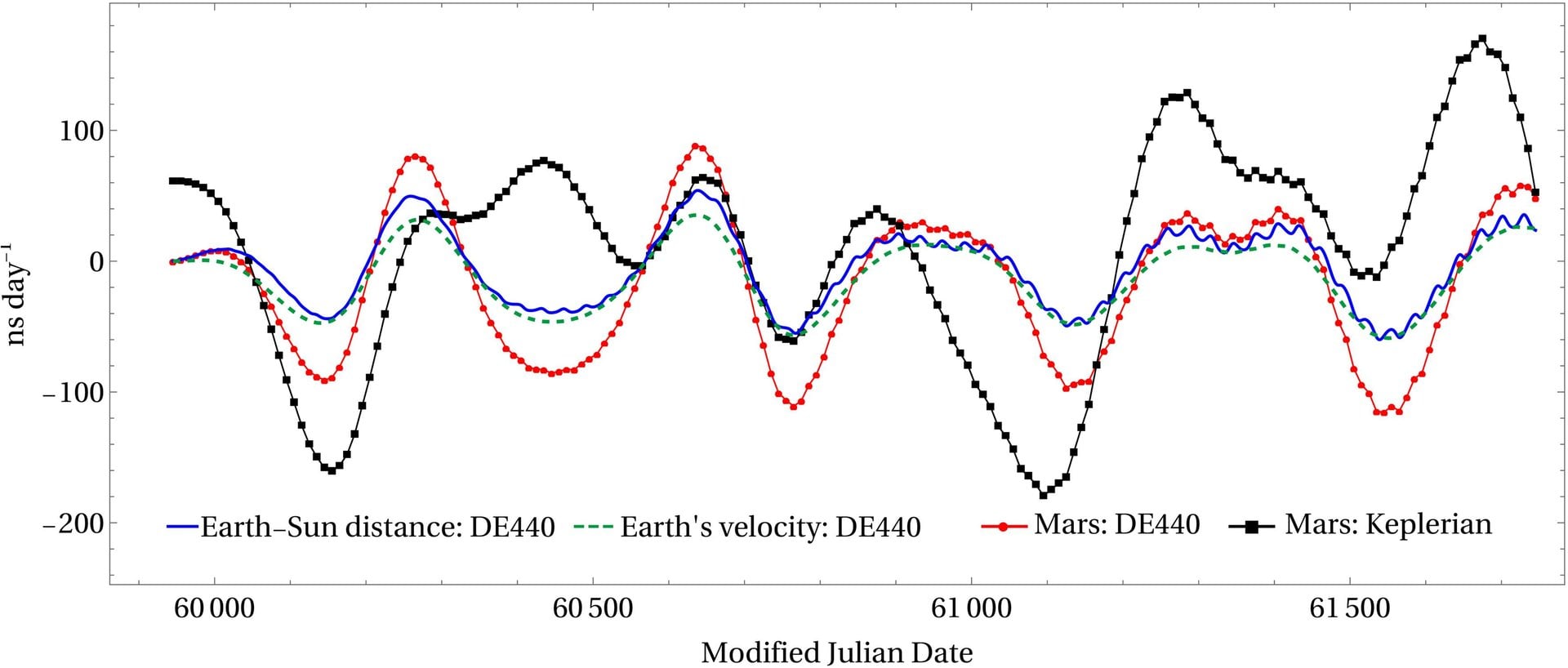 The calculated rate clock offset between Mars and Earth. Credit: Ashby and Patla
To begin with, the rate of time is affected by gravity. The stronger your gravitational acceleration, the slower your clocks. Since the surface gravity of Earth is about 3 times that of Mars, an atomic clock on Mars would tick faster by about 477 microseconds a day. And clocks are also affected by relative motion. Since the speed of Mars relative to Earth varies depending on where Earth and Mars are in their orbits, atomic clocks on Mars would vary by 226 microseconds. And then there is the travel time of light between the two worlds, which varies based on the distance between Earth and Mars.
In this latest study, the authors looked at the challenges of keeping Earth and Mars clocks in sync and what measurements would need to be included to make them accurate. They found that, given our current technology, a time system could be synchronized with reasonable accuracy, but the challenges of an Earth-Mars system are even greater than those of an Earth-Moon system. They found that given current uncertainties with the Earth-Moon system, Mars clocks would still have a daily residual of 100 nanoseconds, give or take.
So we can't make an exact clock system that is perfectly synchronized between Earth, the Moon, and Mars. But given how complex the relativistic nature of "now" really is, it's safe to say that we can sync them close enough.
Reference: Gangale, T. E. "Martian standard time." Journal of the British Interplanetary Society 39.6 (1986): 282-288.
Reference: Ashby, Neil, and Bijunath R. Patla. "A comparative study of time on Mars with lunar and terrestrial clocks." The Astronomical Journal 171.1 (2025): 2.