Universe Today
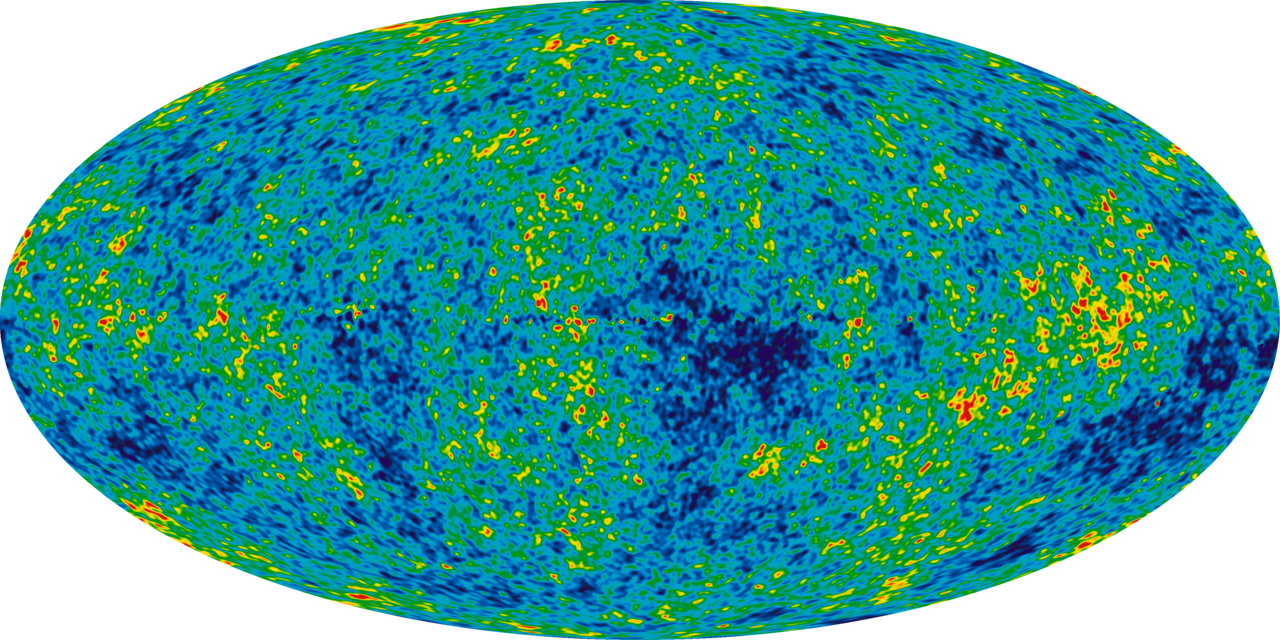
Stand a pencil on its tip and, mathematically speaking, it's perfectly balanced. Every force is accounted for and the equations are satisfied. And yet you already know what happens next, the slightest disturbance and it topples. A solution that exists on paper but can never survive contact with reality. That’s the image Blake Temple, a mathematician at the University of California Davis, uses to describe our best model of the universe. And it's a deeply uncomfortable one.
For nearly thirty years, dark energy has been the cornerstone of modern cosmology. When astronomers discovered in the 1990s that the universe wasn't just expanding but accelerating, getting faster as it grows, they needed an explanation. Dark energy was it, an invisible pressure built into the fabric of space itself, pushing everything apart. Nobody has ever detected it directly, but the maths seemed to demand it, so into the equations it went.
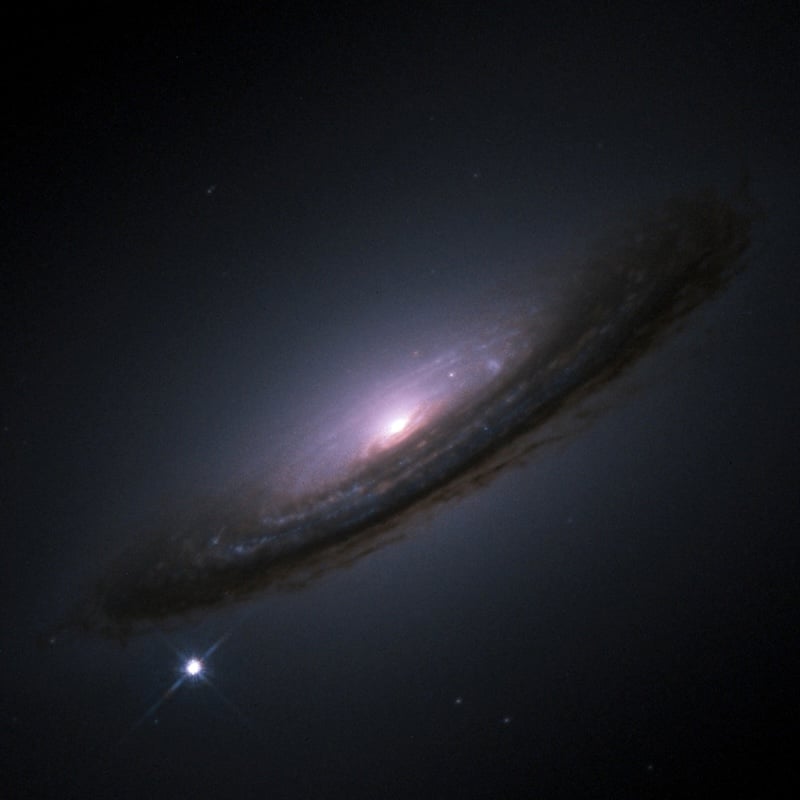 Supernova explosions like this one (bottom left) captured in NGC 4526 revealed the universe was accelerating apart, and dark energy was born to explain why (Credit : NASA/ESA)
Temple and his colleagues aren't so sure. In a new paper published in the Proceedings of the Royal Society, they've produced mathematical proof that the standard model of cosmic expansion, the one built around dark energy, is fundamentally unstable. Not wrong in a small, tweakable way just unstable in the way that pencil is unstable. And in physics, an unstable solution isn't just unlikely, it’s considered unphysical or something you'd never actually observe in nature.
The problem lies with what are called Friedmann spacetimes, the mathematical framework that underlies our standard picture of the Big Bang and everything that followed. The Friedmann model assumes matter is spread evenly throughout space, expanding uniformly in all directions. Elegant, simple, and according to Temple's team, mathematically untenable. Their proof shows these models are unstable at both small and large scales, right back to the Big Bang itself.
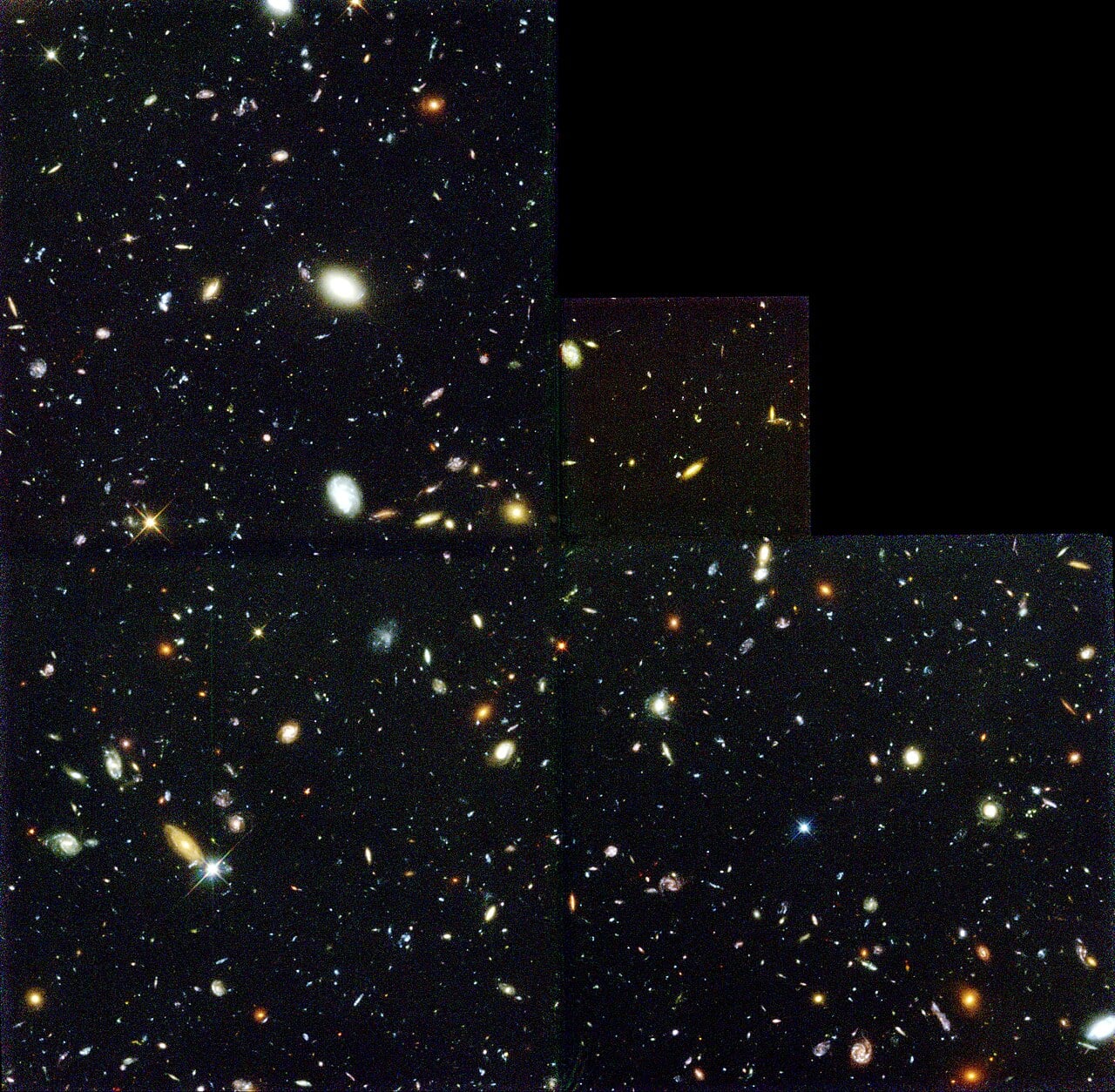 Almost every point of light in this image is an entire galaxy, each hurtling away from us faster than it should be. It was this restless, accelerating universe that forced astronomers to invent dark energy and now the maths says they may never have needed to (Credit : NASA/ESA)
Here's the fascinating part. When you strip away the instability, the acceleration of the universe doesn't disappear, it just finds a different explanation. Temple's team found that accelerating expansion falls naturally out of Einstein's original equations, without any need to bolt dark energy onto the side. The universe accelerates not because of some mysterious invisible force, but because of the inherent mathematics of how space and matter behave in the wake of the Big Bang. There's a further twist to the story. The standard dark energy model and the alternative both have something awkward in common in that they require us to occupy a special position in the universe. That cuts against one of cosmology's most cherished assumptions: the Copernican principle, the idea that we're nothing special, just one unremarkable spot in an unremarkable corner of a vast universe.
Dark energy has never felt entirely comfortable to many scientists. Einstein himself introduced something very like it which he called his cosmological constant then subsequently called it his biggest blunder. It was quietly resurrected in the 1990s when the data demanded it. Now the mathematics might be telling us it was never needed in the first place. The universe, it turns out, may be stranger and simpler than we thought, only both at the same time!