 Universe Today
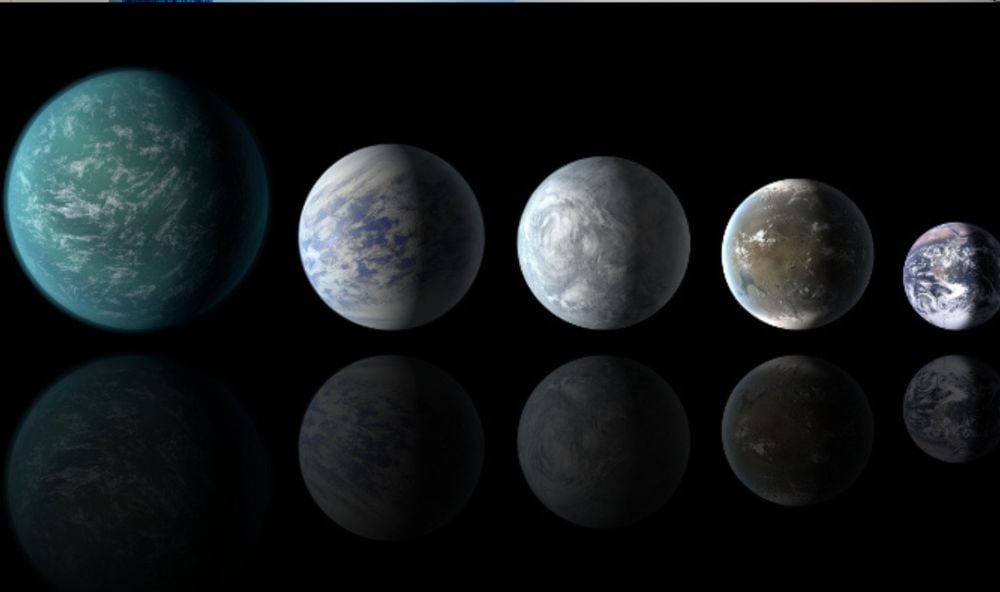
The NASA planet-hunting satellites Kepler and TESS scanned the skies autonomously, searching for the tiny dips in light caused by exoplanets transiting in front of their stars. Their diligent observations uncovered more than 6,000 confirmed exoplanets. As scientists examined the types of planets the spacecraft found, they discovered some patterns that need explanations.
One of those patterns is the radius valley, also known as the Fulton Gap, the small planet radius gap, or the photoevaporation gap. It's a lack of exoplanets within a certain size range. Astronomers have found very few exoplanets between about 1.5 and 2 Earth radii.
The valley exists within the population of small planets that are close to their stars and have orbital periods shorter than 100 days. The valley is bookended by rocky super-Earths and mini-Neptunes. There are very few exoplanets in between them. Scientists think that photoevaporation of atmospheres can create the valley, or core-powered mass loss.
But exoplanet science is tricky. Studying planets around bright stars like our Sun is not as difficult as finding and studying planets around smaller and dimmer M-dwarfs. So even though Sun-like stars are not as abundant as M-dwarfs, our exoplanet observational data could be biased toward them.
New research in The Astronomical Journal is addressing this problem. It's titled "TESS Planet Occurrence Rates Reveal the Disappearance of the Radius Valley around Mid-to-late M Dwarfs," and the lead author is Erik Gillis. Gillis is a PhD student in the Department of Physics and Astronomy at McMaster University in Hamilton, Canada.
"We present the deepest systematic search for planets around mid-to-late M dwarfs to date," the authors write. "We have surveyed 8134 mid-to-late M dwarfs observed by the Transiting Exoplanet Survey Satellite with a custom-built pipeline and recover 77 vetted transiting planet candidates."
The radius valley is well-established around Sun-like F,G, and K stars, and also around early M dwarfs. The valley is also present around mid to late M dwarfs, but it's not as pronounced.
"We measure a cumulative occurrence rate of 1.10 ± 0.16 planets per star with radii >1 R⊕ orbiting within 30 days," the researchers explain. "This value is consistent with the cumulative occurrence rate around early M dwarfs, making M dwarfs collectively the most prolific hosts of small close-in planets."
But while the exoplanet population radius valley around FGK and early M dwarfs is bi-modal, it's unimodal around mid-to-late M dwarfs. That unimodal planet radius distribution peaks at 1.25 ± 0.05 R⊕.
"We additionally find 0.954 ± 0.147 super-Earths and 0.148 ± 0.045 sub-Neptunes per star, with super-Earths outnumbering sub-Neptunes 5.5:1, firmly demonstrating that the radius valley disappears around the lowest-mass stars," the authors write. So mid-to-late M dwarfs host lots of super-Earths, but almost no sub-Neptunes.
"From the distribution plotted in (Figure 10) it is clear that the population of planets around mid-to-late M dwarfs orbiting within 30 days is unimodal without any sign of a radius valley," the authors write.
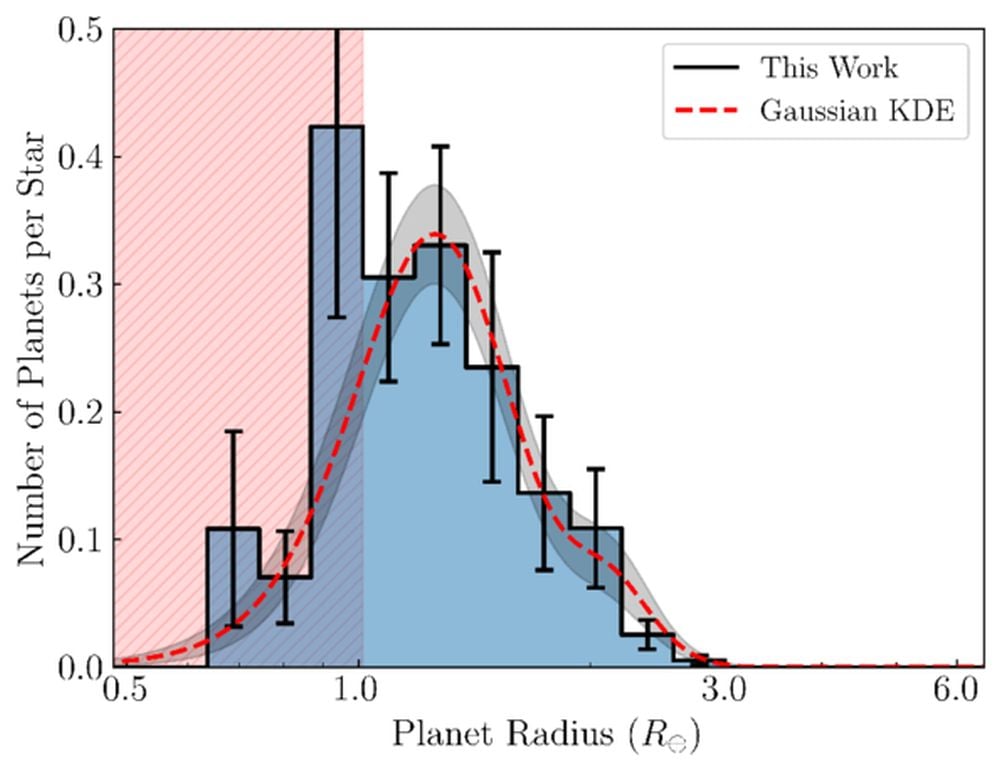 This figure illustrates the research results. The red shaded region marks a region where results are unreliable due to low sensitivity. Gaussian KDE means Gaussian Kernel Density Estimation. It's a statistical tool that helps identify the radius gap. Overall, the figure shows that there's no radius valley in exoplanets in the exoplanet population around mid-to-late M dwarfs orbiting within 30 days. Image Credit: Gillis et al. 2026. AnJ
“We didn’t just refine the picture – we changed it. Around these stars, sub-Neptunes effectively vanish, which means the mechanisms shaping planets here are different,” said lead author Gillis in a press release.
These results aren't totally unexpected because they conform to one of the models that explains how planets form. It's called pebble accretion, and it explains how rocks move throughout a protoplanetary disk and group together to eventually form planets. In this case, the model is the water-rich pebble accretion model. Sub-Neptunes form outside of a solar system's water frost line and migrate inward according to this model, while rocky super-Earths form inside the line.
Around mid-to-late M dwarfs, the frost line is closer than around a Sun-like F,G, or K star because M dwarfs are so much smaller and cooler. This affects the whole architecture of a solar system. Mid-to-late M dwarfs are capable of atmospheric stripping, but that can't really explain the radius valley. Instead of atmospheric stripping by photoevaporation creating the radius valley, it's a question of planets forming on different sides of the frost line. Sub-Neptunes, in this case, should be water-rich rather than shrouded in gaseous atmospheres.
There are neither super-Earths or sub-Neptunes in our Solar System, so this can all seem a little esoteric. But the results get to the heart of how planets form, an important part of Nature. Ultimately, we can't really understand our own Solar System if we study it in isolation.
“Our solar system was once the only example we had. Now, thanks to missions like TESS, we can compare thousands of systems and uncover patterns that rewrite our assumptions,” said co-author Ryan Cloutier, assistant Professor at McMaster who supervised Gillis' work. “Now with this recent work we’re developing a clearer picture of where these super-Earths and sub-Neptunes come from.”

