Universe Today
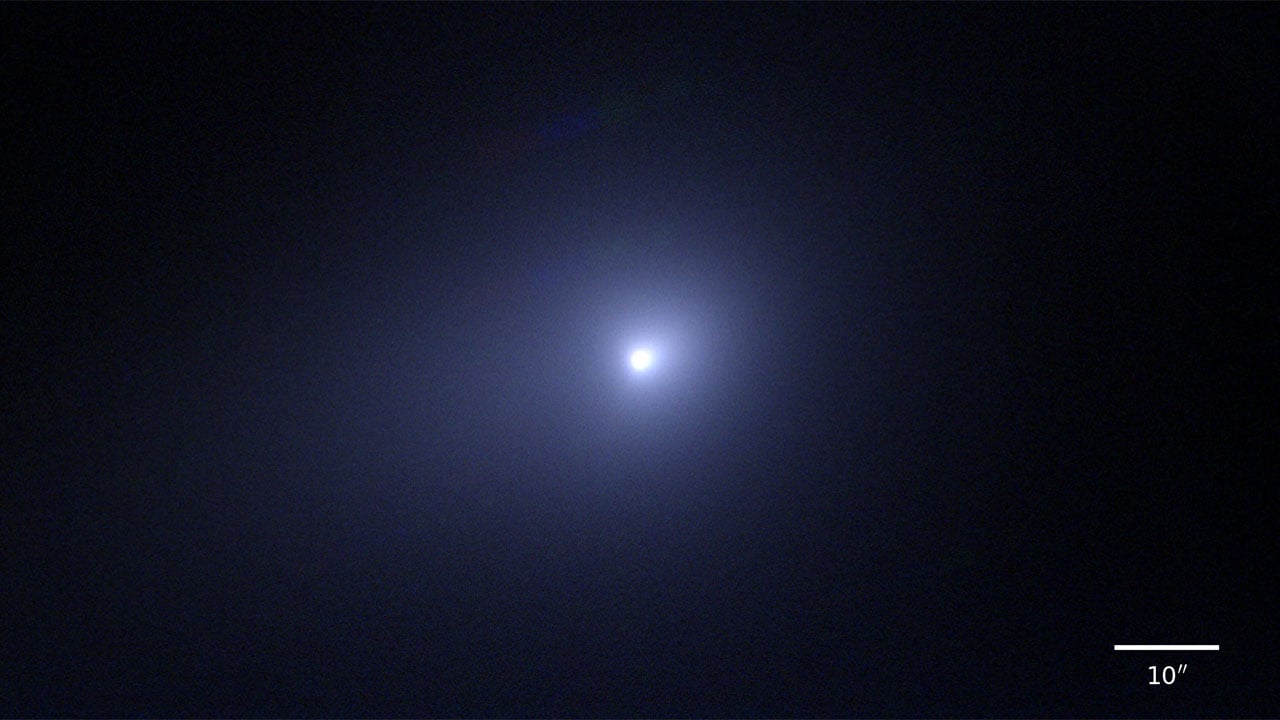
In December 2025, the ESA's Jupiter ICy Moon Explorer (JUICE) and NASA's Europa Clipper both caught a glimpse of interstellar comet 3I/ATLAS after it emerged from behind the Sun. As just the third interstellar object (ISO) detected passing through our Solar System, scientists were eager to gather as much data as they could before it was no longer visible to our instruments. Once it had made its closest pass to the Sun, the comet's coma had become especially bright, thanks to all the material it was outgassing.
Researchers from the Southwest Research Institute (SwRI) served as the science teams for the Ultraviolet Spectrograph (UVS) instruments on both missions, which simultaneously imaged the comet's two hemispheres and detected its ultraviolet emissions. These instruments are part of the two spacecraft's advanced suite of scientific instruments, which are specifically designed to investigate the Jupiter system and some of its largest moons (Europa, Ganymede, and Callisto) for indications of habitability.
In this case, the UVS instruments revealed data on the comet's internal chemical composition. Whereas previous observations revealed the chemical composition of the comet's outer layers, material released after 3I/ATLAS emerged from behind the Sun provided insight into its interior. SwRI researchers informally coordinated efforts between the two missions to obtain unique observations of the interstellar comet as it was revealing the most telling information about its place of origin.
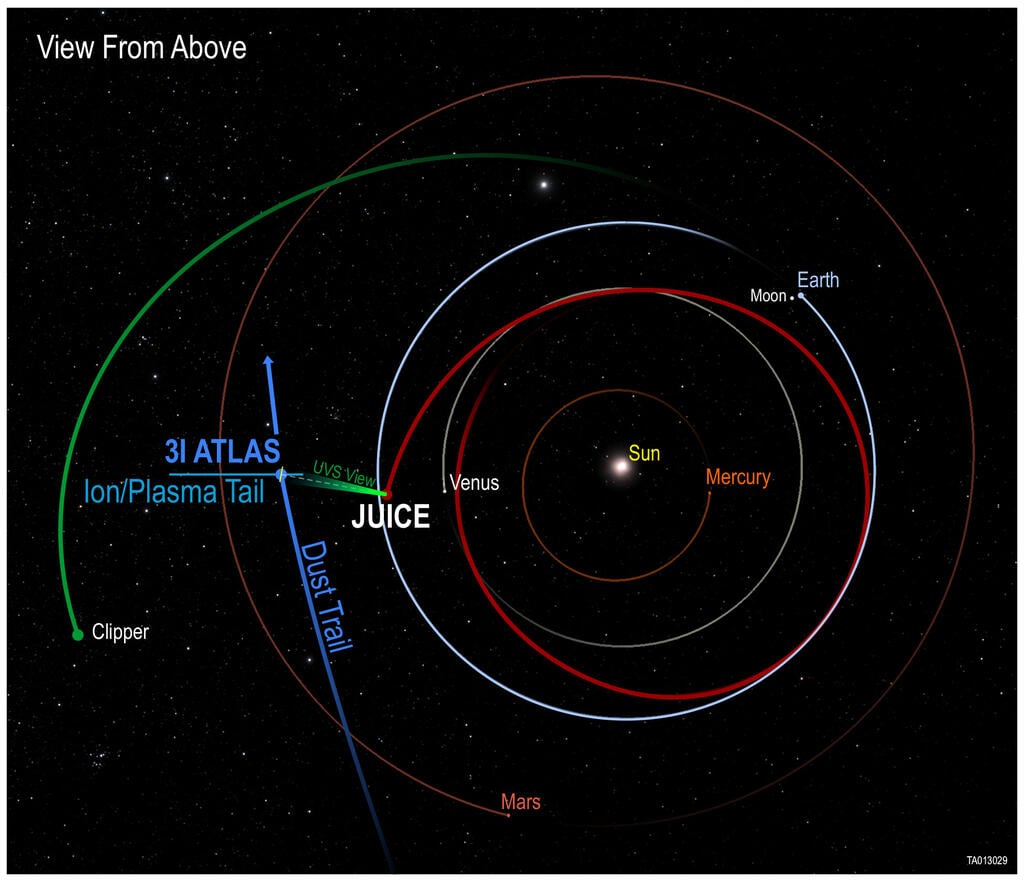 In November 2025, 3I/ATLAS passed between ESA’s Juice and NASA’s Europa Clipper spacecraft. Credit: NASA/ESA/SwRI
As Dr. Kurt Retherford, the principal investigator of Juice-UVS and Europa-UVS, said in a SwRI press release:
As the comet passed between Juice and Europa Clipper, we were able to coordinate observations between the two spacecraft informally. Crucially, we observed hydrogen, oxygen, and carbon emissions. These elements are produced when gases escaping the comet’s nucleus break apart into atoms when exposed to sunlight. I think the coordination with Europa Clipper was a fun and impactful demonstration that showed how the two projects could coordinate observation plans. And because SwRI’s team is involved in both missions, it was a special highlight for us in terms of working together.
The researchers found higher-than-expected carbon emissions from 3I/ATLAS early on (compared with comets observed in our Solar System), confirming earlier findings from other missions. The spacecraft observed the comet's emissions over several days, revealing how the ratios of these molecules shifted and how the comet's composition evolved as it passed through our Solar System. Said SwRI’s Dr. Philippa Molyneux, co-deputy principal investigator for the Juice-UVS instrument:
Observing the interstellar comet was some exciting bonus science. The resulting rare and unique dataset includes gas emissions and scattered dust. This was the first time we’ve had simultaneous direct views of a comet’s coma of escaping gas from two directions. Europa Clipper showed us the night side of the comet, with a great deal of scattered dust, while Juice imaged mostly glowing gas on the day side.
As asteroids and comets are basically material left over from the formation of the Solar System, the study of interstellar objects is a means of exploring what conditions are like in other star systems (without actually having to go there). "By studying the ratio of water ice and dry ice, we can compare the composition of this interstellar comet to comets native to our solar system," Molyneux said. "This helps us understand if the solar system where 3I/ATLAS formed is similar to ours or different."
Further Reading: SwRI