 Universe Today
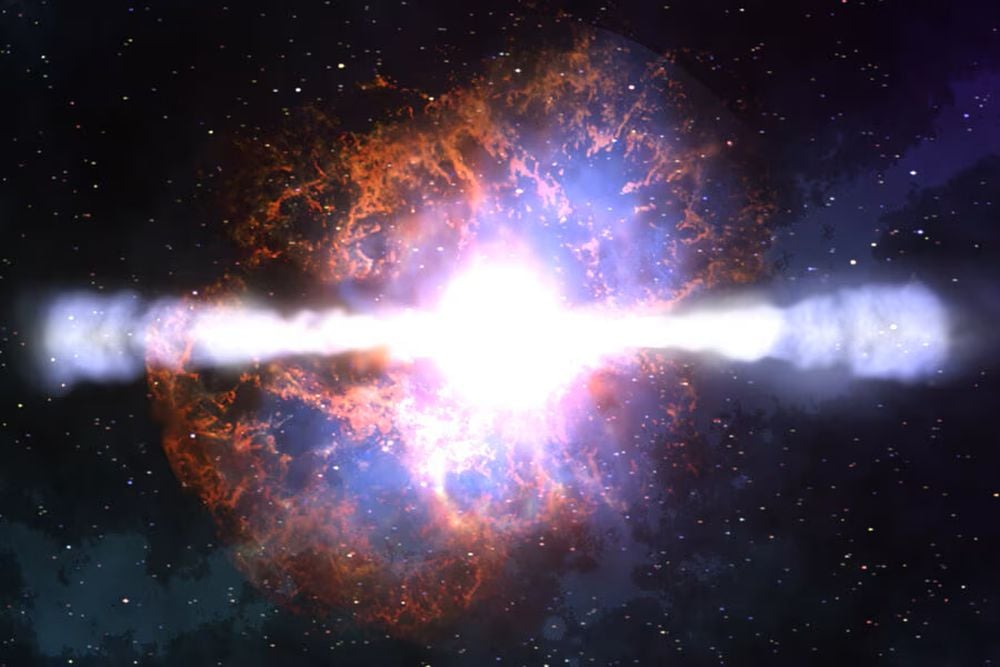
If exploding stars were a fireworks display, then superluminous supernovae (SLSNe) would be the grand finale. They can be 100 times brighter than a regular, core-collapse supernova, which are already bright enough to outshine all the stars in their host galaxy. There are different explanations for the power behind SLSNe, and astronomers would like to figure out which model fits.
To find out which model is accurate, a team of researchers turned to NASA's Fermi Gamma-ray Space Telescope. They examined 6 SLSNe found in Fermi's first 16 years of observations, searching for gamma-rays from the exploding stars. The absence or presence of gamma-rays can help scientists distinguish between the different models for SLSNe. One SLSNe discovered almost ten years ago is at the center of the research.
The team published their work in an article titled "Gamma-ray signature of superluminous supernovae: Fermi-LAT GeV detection of SN 2017egm and evidence of a central engine." It's in the journal Astronomy and Astrophysics, and the lead author is Fabio Acero. Acero is from the French National Centre for Scientific Research (CNRS) and the University of Paris-Saclay.
The two most widely accepted explanations for SLSNe are the magnetar model and the circumstellar material (CSM) interaction model. Detecting gamma rays is key to determining which model is at work.
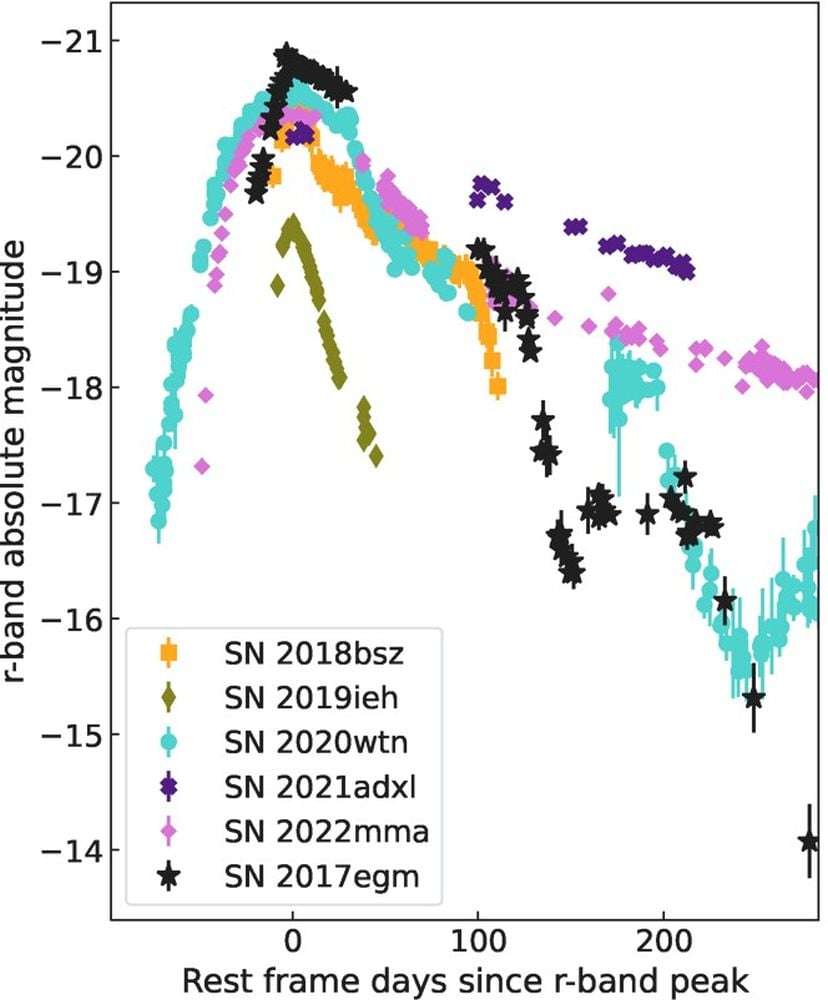 This figure shows the absolute of the r-band for each of the 6 SLSNe in the sample. The r-band is a wavelength range of red light used to measure celestial objects. SN 2017egm is the brightest of the 6. Image Credit: Acero et al. 2026. A&A. https://doi.org/10.1051/0004-6361/202558547
Magnetars are neutron stars with extremely powerful magnetic fields that can be 1,000 times stronger than a typical neutron star. In the magnetar model, a massive star explodes as a supernova and leaves behind a newly-formed magnetar. The magnetar rotates extremely rapidly, several hundred times per second, and emits a powerful outflow of electrons and their antimatter counterparts, positrons. This creates an enormous cloud of energetic particles.
The cloud is called a magnetar wind nebula, and different interactions inside the cloud drive the production and absorption of gamma rays. These gamma rays can't escape the cloud directly and are forced to interact with debris from the supernova. Through interactions, they lose energy and transform down into visible light. And that visible light gives SLSNe an extra boost that other supernovae don't get.
In the CSM model, a massive star suffers a series of mass-loss events prior to exploding as a supernova. These events form a series of concentric shells of gas and dust expanding outward from the star. When the star does eventually explode, supernova ejecta slams into these shells, lighting up the gas and producing the extreme brightness that SLSNe are known for. This model can also produce different peaks in brightness over time, as supernova ejecta slams into shells in sequence.
The authors point out that differentiating between the magnetar wind nebula model and CSM interaction model comes down to gamma-rays. "While the optical properties of SLSNe are extensively studied, their γ-ray signatures remain poorly constrained," they write.
By examining the 6 SLSNe in the Fermi data, the team hoped to further constrain the gamma-ray signatures. "Our objective is to test predictions from CSM and magnetar models," they write. The problem is that even finding these signals is challenging.
“For nearly 20 years, astronomers have searched Fermi data for gamma-ray signals from thousands of supernovae, and while a few intriguing hints have been reported, none were definitive until now,” lead author Acero said in a press release.
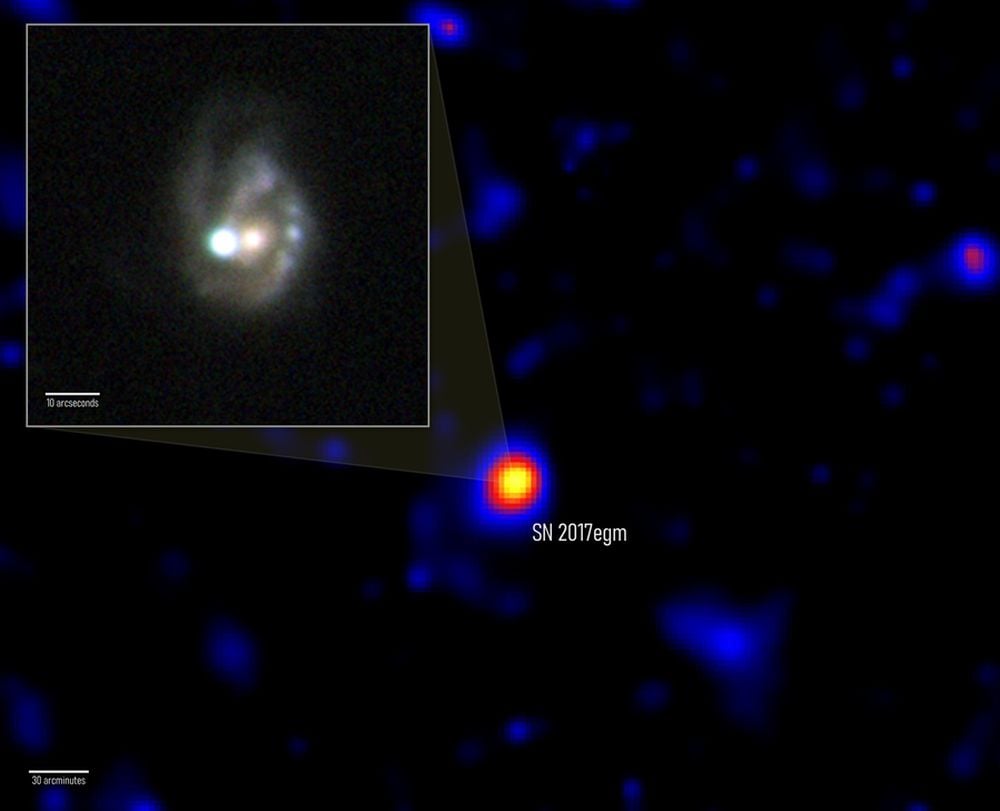 This composite image shows two views of SN 2017egm. The inset image shows it in visible light, and the main image shows it in gamma rays. The optical image shows the supernova — the brightest object in the scene — and its host galaxy on July 1, 2017. The background image shows a wide area of the sky surrounding the supernova. Brighter colors indicate greater statistical likelihood that gamma rays are associated with the explosion. The map includes gamma rays detected by Fermi’s Large Area Telescope from July 5, 2017, to Oct. 25, 2017, or from 43 to 155 days after the supernova was discovered. Image Credit: Background, NASA/DOE/Fermi LAT Collaboration and Acero et. al. 2026; inset, NOT+ALFSOC/Bose et al. 2020
Gamma-rays from SN 2017egm were first discovered in 2024, years after the supernova was first observed. The gamma-rays were transient, appearing about two months after the event and lasting for a few months. The authors of the 2024 paper wrote that the magnetar model explained these observations best. "Both the peak time and the luminosity of the GeV emission are consistent with the magnetar model prediction, suggesting that such a GeV transient is the high-energy counterpart of SN 2017egm and the central engine of this SLSNe is a young magnetar."
This new research supports that conclusion and digs even deeper.
Of the six SLSNe in their sample, only SN 2017egm showed gamma-ray emissions. The researchers examined the SLSNe's optical and gamma emissions and compared them to models. One model was based on a magnetar as a central engine in the SLSNe, and the other model was based on the circumstellar material interaction model.
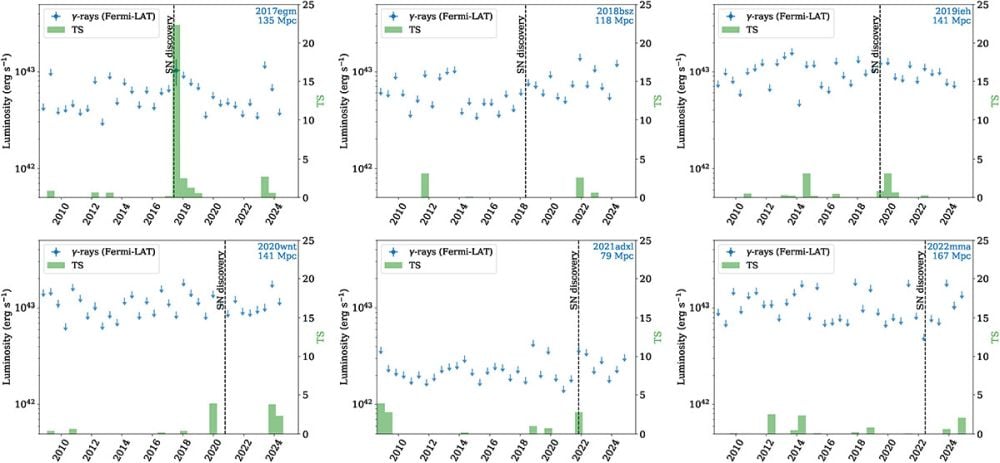 This figure shows the luminosity light curves in the 100 MeV – 100 GeV energy range over 16 yrs for each SN in the sample from the Fermi launch to August 2024. SN 2017egm, in the upper left, is the only one with an observed gamma-ray signal. Image Credit: Acero et al. 2026. A&A. https://doi.org/10.1051/0004-6361/202558547
In the magnetar model, gamma-ray emissions can't escape from the magnetar wind nebula immediately.
“About three months after the collapse, as the supernova debris expands and cools, the gamma rays can begin to leak out,” Acero said. “This magnetar model best reproduces the supernova’s luminosity and the arrival time of its gamma rays during the first months, but we see room for improvement at later times, when the visible light fades quite irregularly.”
"Based on the previous models, we conclude that the γ-ray emission is well described by the magnetar model in order to match both the observed flux and time properties of the γ-ray signal," the authors write in their research article.
Ascribing SN 2017egm's light curve to the magnetar model might not be so simple, though. It fits better than the CSM interaction model, but there might be more going on. "However, the optical light curve shows late-time bumpy structures that could either be the signature of multiple CSM shell interactions or evidence of central engine activity," the researchers write.
"Plausible scenarios are therefore either a hybrid (magnetar+CSM) model or a pure magnetar model whereby both the γ-ray and optical properties are fully explained by a magnetar and an infalling accretion disk," they explain.
Magnetars are among the Universe's most extreme objects. They were first noticed in the late 1970s, or rather their gamma-rays were, as soft gamma repeaters. They were first called magnetars in a 1992 paper, which stated that "There is evidence that the soft gamma repeaters are young magnetars." They were proven correct in 1998.
Astrophysicists want to know more about these extreme stellar remnants, and that depends on more observations. That's a problem because their gamma-rays are absorbed by the atmosphere. But it is possible to detect them observing the flashes of light, or Cherenkov radiation, that they create when they strike the atmosphere. One facility that can potentially do that is the Cherenkov Telescope Array Observatory (CTAO). The array, which will have a total of 64 telescopes, will be the most powerful ground-based gamma-ray observatory. Any SLSNe it detects will likely have a magnetar as its central engine.
"As the tera-electronvolt γ-ray emission in the CSM model is strongly suppressed due to γ − γ absorption, a CTAO detection of a SLSN would strongly favor the magnetar scenario," the authors write. They explain that the CTAO will likely only be able to detect nearby SLSNe, and they also estimated how many it's likely to find. "Given the low number of known nearby SLSNe, a precise rate is hard to estimate but it is likely on the order of a few per decade within ∼140 Mpc," they write.
The Vera Rubin Observatory and its Legacy Survey of Space and Time is set to discover vast numbers of supernovae in the next decade. Scientists expect it to discover between 3 and 4 million supernovae, an incredible number. The science of supernovae, including SLSNe and their magnetars, is about to get a huge boost.
“The magnetar central engine mechanism discussed in this paper builds upon a lot of observational and theoretical advances in magnetars over the last 20 years,” said Judy Racusin, a deputy project scientist for the Fermi mission at NASA’s Goddard Space Flight Center in Greenbelt, Maryland. “Observing gamma rays from supernovae will give us a new way to explore their inner workings.”

