Universe Today
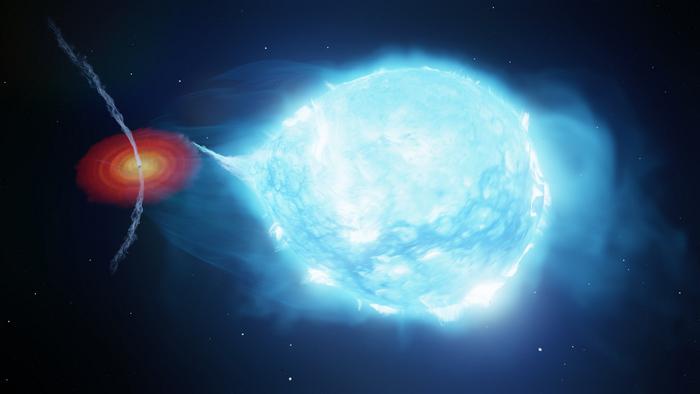
Astronomers have long been fascinated by the powerful jets emanating from black holes. These jets result from gas and dust being pulled into the black hole's gravity well, forming an accretion disk that is accelerated to velocities approaching the speed of light. While most of this material slowly accretes onto the black hole's event horizon, some will spiral away from the poles, creating powerful jets that can be seen many light-years away.
In a recent research study, a team of astrophysicists led by Curtin University used 18 years of high-resolution radio imaging data to study the jets in the Cygnus X-1 system - the first confirmed binary system consisting of a black hole and supergiant star. The images allowed them to measure the immense power of these jets, equivalent to the output of 10,000 Suns. These findings confirm previously held theories on how black holes shape the structure of the Universe.
The team was led by Steve Prabu and James Miller-Jones, an Adjunct Associate Lecturer and a Professor with the International Center for Radio Astronomy Research (ICRAR) at Curtin University. They were joined by researchers from the Institut de Ciències del Cosmos Universitat de Barcelona (ICCUB), the University of Wisconsin-Madison, the University of Lethbridge, and the Institute of Space Science. Their paper, "A jet bent by a stellar wind in the black hole X-ray binary Cygnus X-1," is published in the journal Nature Astronomy.
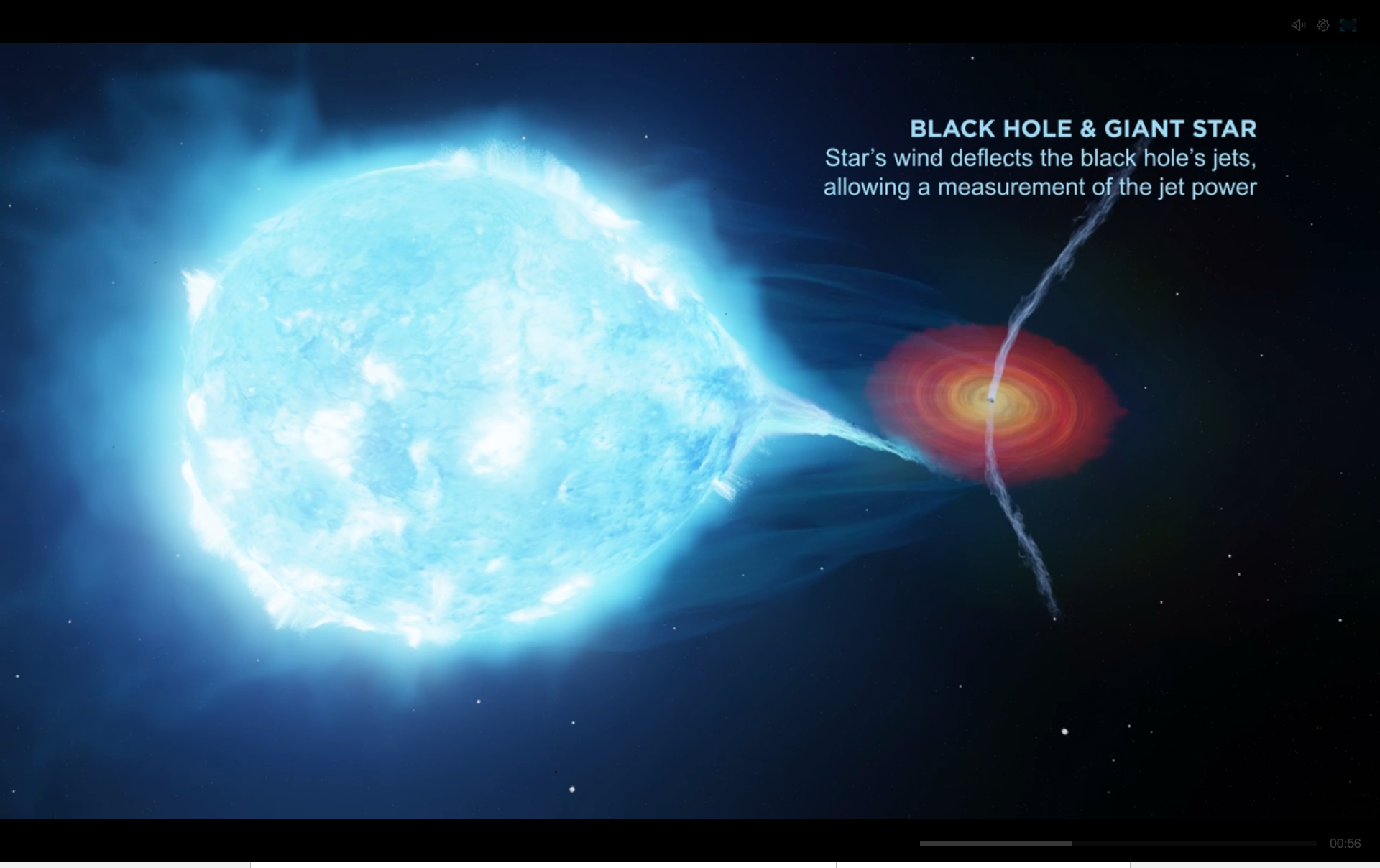 Artist’s impression of the Cygnus X-1 binary system, showing how the wind of the supergiant star bends the black hole's jets away from the star as the objects move in their orbit around one another. Credit: ICRAR
To understand the power of the black hole jets, the team needed to observe how they are perturbed by the solar wind coming from the massive star it co-orbits with. To do this, the team combined radio data from the Very Long Baseline Array (VLBA) and the European VLBI Network (EVN), two networks of telescopes with stations across the world. These combined observations created a more complete picture of the system, a technique known as Very Long Baseline Interferometry (VLBI).
This allowed the team to measure how much the black hole's jets are buffeted as it orbits its stellar companion, thereby yielding (for the first time) estimates of the jets' power. In another first, their calculations also yielded estimates of the speed of the black hole jets, which were roughly 150,000 km/s (93,200 mps), or half the speed of light. These measurements allow scientists to understand how much of the energy released around black holes is likely deposited into the surrounding space, ultimately revealing how black holes shape their environments.
“A key finding from this research is that about 10 percent of the energy released as matter falls in towards the black hole is carried away by the jets,” Dr. Prabu said. “This is what scientists usually assume in large-scale simulated models of the Universe, but it has been hard to confirm by observation until now.” Prof. Miller-Jones added that previous methods could only measure the average jet power over thousands to millions of years, preventing accurate comparisons with X-ray emissions caused by infalling matter:
And because our theories suggest that the physics around black holes is very similar, we can now use this measurement to anchor our understanding of jets, whether they are from black holes 10 or 10 million times the mass of the Sun. With radio telescope projects such as the Square Kilometer Array Observatory currently under construction in Western Australia and South Africa, we expect to detect jets from black holes in millions of distant galaxies, and the anchor point provided by this new measurement will help calibrate their overall power output. Black hole jets provide an important source of feedback to the surrounding environment and are critical to understanding the evolution of galaxies.
Further Reading: Curtin University, Nature Astronomy