Universe Today
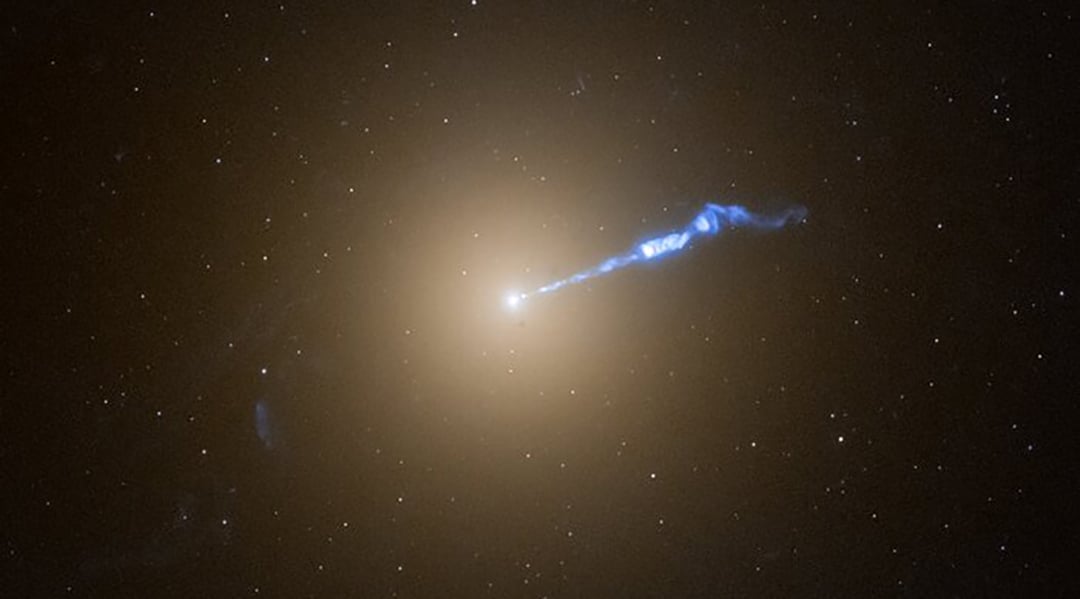
Between 2012 and 2025, NASA's Chandra X-ray Observatory has been monitoring the jet launched by the supermassive black hole (SMBH) at the center of the M87 galaxy. By combining these observations with advanced image-processing techniques, an international team of researchers tracked the evolution of the jet's structures and created the most detailed X-ray view of it to date. Their results were presented at the 248th meeting of the American Astronomical Society held in Pasadena, California, from June 14-18th.
The team was led by Camille Poitras, a Ph.D. student in the Faculty of Science and Engineering at Laval University. She was joined by researchers from the Harvard & Smithsonian Center for Astrophysics (CfA), the International Center for Radio Astronomy Research (ICRAR), and the University of Maryland, Baltimore County. A preprint of their study paper, "Resolving the Temporal Evolution of the M87 Jet with ≲0.1-arcsec Chandra Observations," is also available online.
The M87 galaxy, located about 55 million light-years from Earth, hosts the famous SMBH that was imaged for the first time by the Event Horizon Telescope (EHT) in 2019. Like many SMBHs, infalling matter around the black hole forms an accretion disk that rapidly rotates around its outer edge and is accelerated to near the speed of light. This releases a tremendous amount of radiation across all wavelengths, and some of that energy is expelled from around the poles as particle jets that extend for thousands of light-years.
Until now, scientists have been unable to resolve some of the jet's structures at X-ray wavelengths as clearly as at other wavelengths. Luckily, an image-processing technique known as deconvolution allowed Poitras and her team to reveal much finer details in the Chandra images. The improved X-ray images are now in much closer alignment with optical and infrared observations taken by the Hubble and James Webb Space Telescopes, respectively. As Poitras said in a Chandra press release, this will allow astronomers to track the jet structure's motions more accurately:
We could already see changes in the jet, but never with this level of detail in X-rays. Structures that previously appeared blended together can now be distinguished, allowing us to better follow the jet's evolution over more than a decade of observations.
What was readily apparent from the updated images is that the M87 jet has a more complex and dynamic flow than previously recognized in X-ray observations. While some jet structures appear nearly stationary, others move rapidly, the fastest of which appears to travel at nearly five times the speed of light. Known as "superluminal motion," this is an optical illusion created when materials travel close to the speed of light roughly in Earth's direction. This allows astronomers to observe the structural evolution of this jet on human timescales, though the phenomenon is 55 million light-years away.
In addition, the new X-ray view reveals more detailed variations in motions and brightness, which are helping to improve our understanding of how particles are accelerated to superluminous speeds. What the team observed was consistent with computer models that simulate shocks produced when different parts of flowing material collide (similar to sound waves producing sonic booms). They also noted how magnetic fields surrounding the jet play an important role in determining its structure. Said study co-author Gerrit Schellenberger, an astrophysicist at the CfA:
These results demonstrate how uniquely powerful Chandra remains for tracking the evolution of extreme phenomena over long timescales. They help us better understand how energy released near a supermassive black hole is carried through its jet and deposited into the surrounding galaxy.
Further Reading: Chandra X-ray Observatory, arXiv