 Universe Today
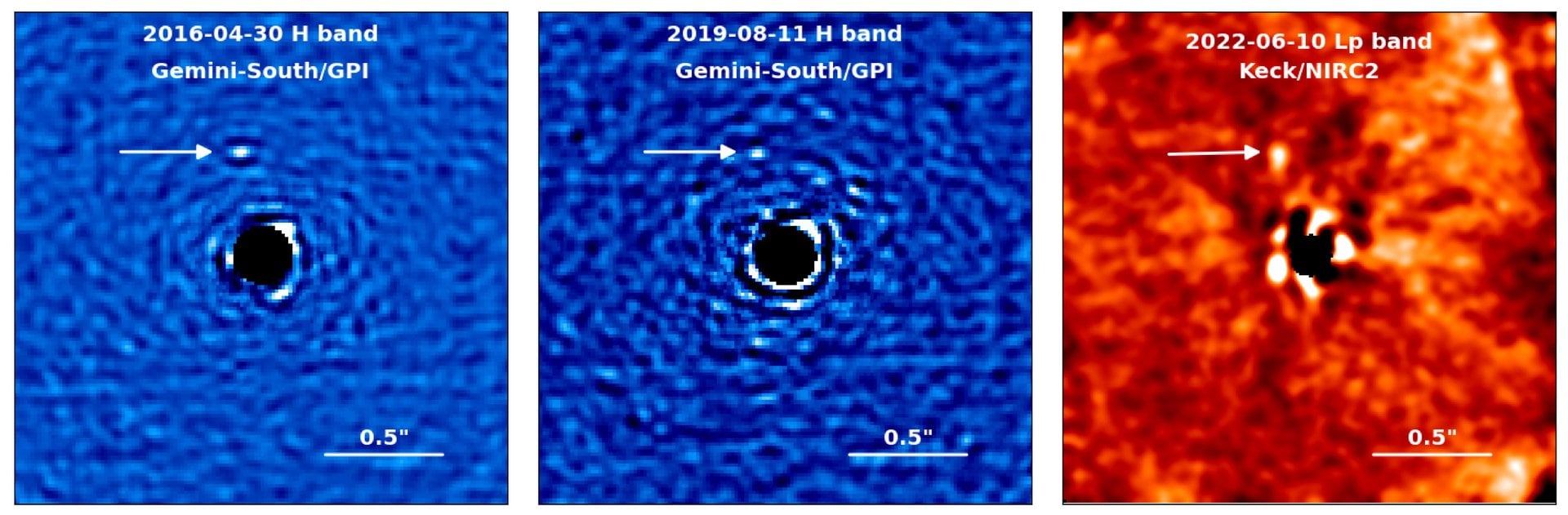
If you read enough articles about planets in binary star systems, you’ll realize almost all of them make some sort of reference to Tatooine, the fictional home of Luke Skywalker (and Darth Vader) in the Star War saga. Since that obligatory reference is now out of the way, we can talk about the new “super-Jupiter” that researchers from two separate research teams, including one at Northwestern University and one at the University of Exeter, simultaneously found in old data from the Gemini Planet Imager (GPI).
Why did two separate research groups find a new planet in old data at almost precisely the same time? It would appear that both were inspired by the fact that the GPI recently completed its run at the Gemini South telescope in Chile and is making its way to Mauna Kea in Hawai’i for an upgrade and a stint in the northern hemisphere.
GPI was designed to directly image exoplanets, though it was only able to successfully image 6, including two new ones if the most recent paper is counted. That just proves how hard it is to directly image planets that aren’t absurdly far away from their parent stars. The research groups both seem to have the idea the transplantation of the GPI from South to North was a good trigger to review its dataset of more than 500 different stars again, hence why they both happened upon the new exoplanet in old data at the same time.
Fraser discusses multiple star systems.The newest one planet GPI found is unique in a lot of ways. It’s a “Hot Jupiter”, though really it is about 6 times the size of Jupiter, and crucially it orbits around a binary star system at only around 60 AU. While in our own solar system that would put it out past Pluto’s orbit, it’s still an order of magnitude closer than the next nearest binary-orbiting exoplanet that had been imaged, which had been located at 500 AU - closer to where we think of the solar gravitational lens than any planet in our own system.
This offers a conundrum in how exactly that planet formed. Most imaged circumbinary planets were likely formed by gravitational instability - i.e. when a protoplanetary disc collapses. However, this new planet, known as HD 143811 AB b, might have been formed by core accretion and then migrated, or it might have formed through the same instability that creates other circumbinary planets.
Whatever happened to form the planet, it happened relatively recently in “universe time” as one of the authors, Jason Wang or Northwestern, describes it. When it formed 13 million years ago, the dinosaurs were already extinct. Its stars, which are located in the Scorpius-Centaurus (Sco-Cen) association, one of the closest massive star-forming regions to us, are also relatively young, so they emit a ton of heat, warming their exoplanet to about 769℃ - far hotter than anything living on Tatooine could survive. To make matters worse for life, the planet only orbits its stars about once every 300 years, even though its companion stars orbit each other once about every 18 days.
YouTube Short showing the movement of the planet, from one of the paper authors. Credit - Jason Wang YouTube ChannelThose extremes make it very unlikely that HD 143811 AB b is anything like how Tatooine is portrayed in the movies. But, it goes to show how interesting features can be hidden in old data sets. As GPI plans its upgrade and move to the northern hemisphere, scientists are hopeful that its improved coronagraph will allow it to capture direct images of exoplanets that are closer to their parent stars. Hopefully they won’t have to wait for a reanalysis of the data 10 years later to find them this time.
Learn More:
Northwestern / EurkeaAlert - Rare image of Tatooine-like planet is closest to its twin stars yet
N. K. Jones et al. - HD 143811 AB b: A Directly Imaged Planet Orbiting a Spectroscopic Binary in Sco-Cen
V. Squicciarini et al. - GPI+SPHERE detection of a 6.1 MJup circumbinary planet around HD 143811

