 Universe Today
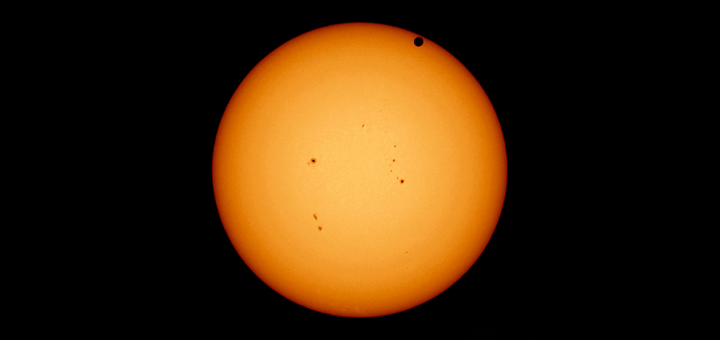
The Sun is so intensely bright we can't safely look at it directly. We need a filter to block much of its light. And when we do, we can start to see some interesting features. Sunspots are one of these features, and the ebb and flow of their numbers has been studied for centuries. But a more subtle feature is that the edge of the Sun appears less bright than its central region. It's an effect known as limb darkening.
The limb darkening of the Sun was first measured by Pierre Bouguer in the 1700s. It is an effect of the Sun's atmosphere. When you look at the center of the Sun you see light that passed straight through the solar atmosphere. Not much of the Sun's light is absorbed or scattered. When you look at the edge of the Sun, that light had to take a shallow path through much more of the atmosphere to reach you. More of the light is scattered or absorbed, so less light reaches you. Thus, the edge appears dimmer.
With careful measurements of limb darkening, we can get a measure of the solar atmosphere. We have a good idea of its thickness and how its density and temperature vary. Since other stars should have the same limb darkening effect, we could use it to study the atmospheres of other stars. Unfortunately this is difficult to do. We have directly observed limb darkening of a few large stars such as Betelgeuse, and astronomers have looked at the light curves of transiting exoplanets to measure the limb darkening of a few stars, but stellar limb darkening is difficult to observe.
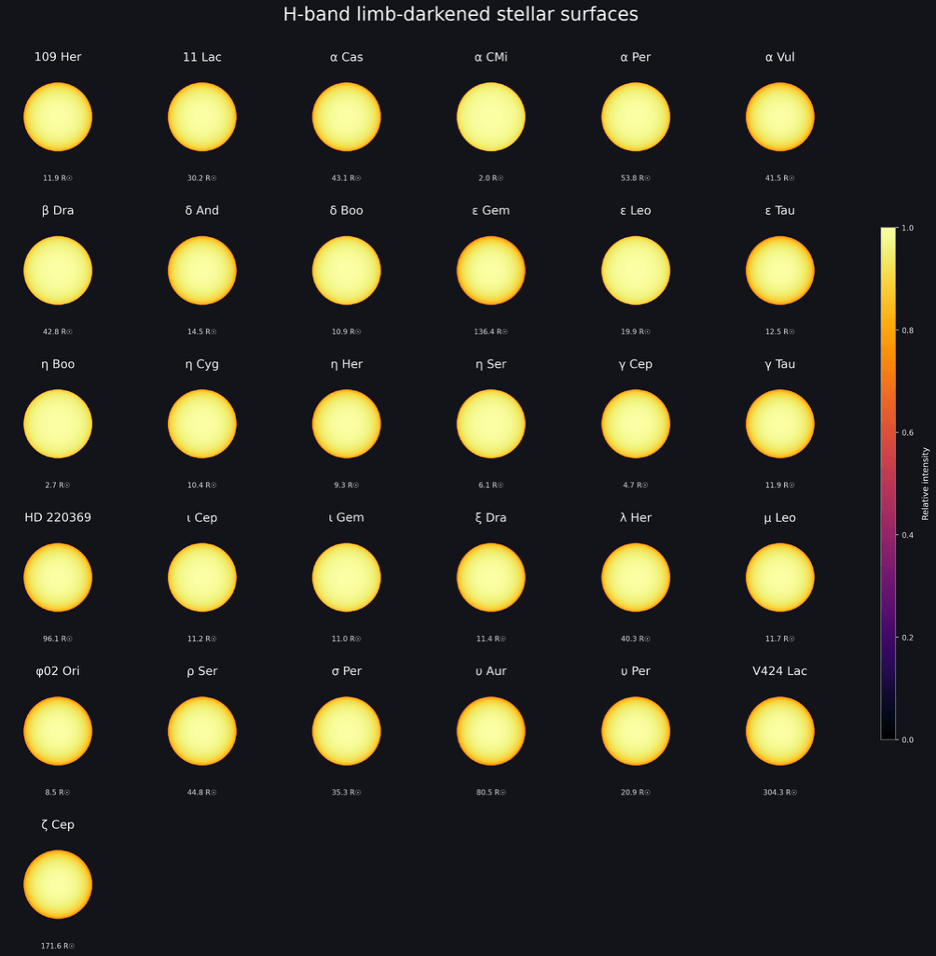 Limb-darkened model images for the sample of 31 stars observed with the CHARA Array in the near infrared. Credit: Center for High Angular Resolution Astronomy
Recently the Center for High Angular Resolution Astronomy (CHARA) Array has observed limb darkening in 31 nearby stars, and the results are published in The Astronomical Journal. The team measured the brightness of these stars along a line going from center to edge, similar to the way Bouguer first measured the effect in the Sun. But rather than observing in visible light, the team used two near-infrared wavelengths, 1.6 microns and 2.2 microns. This allowed them to compare how limb darkening varies with wavelength.
As expected, the limb darkening of these stars is less at the 2.2 micron wavelength than the 1.6 micron wavelength. Longer wavelengths are less scattered and absorbed by an atmosphere. This is why, for example, sunsets appear red. What was surprising is that the longer wavelength was about 38% weaker than the shorter one. Stellar atmosphere models predict about a 20% difference. This means that our understanding of stellar atmospheres is a bit off.
The study demonstrates that we now can observe stellar limb darkening directly. As future studies observe these stars at visible wavelengths and more infrared wavelengths, it will give us a clearer view of their atmospheres. But it's pretty astonishing that we can now see in stars an effect that for centuries we could only see in the Sun.
Reference: Anugu, Narsireddy, et al. "Empirical H-and K-band Limb Darkening for 31 CHARA Stars: A Near-infrared Benchmark for Stellar-Atmosphere Models." The Astronomical Journal 172.4 (2026): 214.