Universe Today
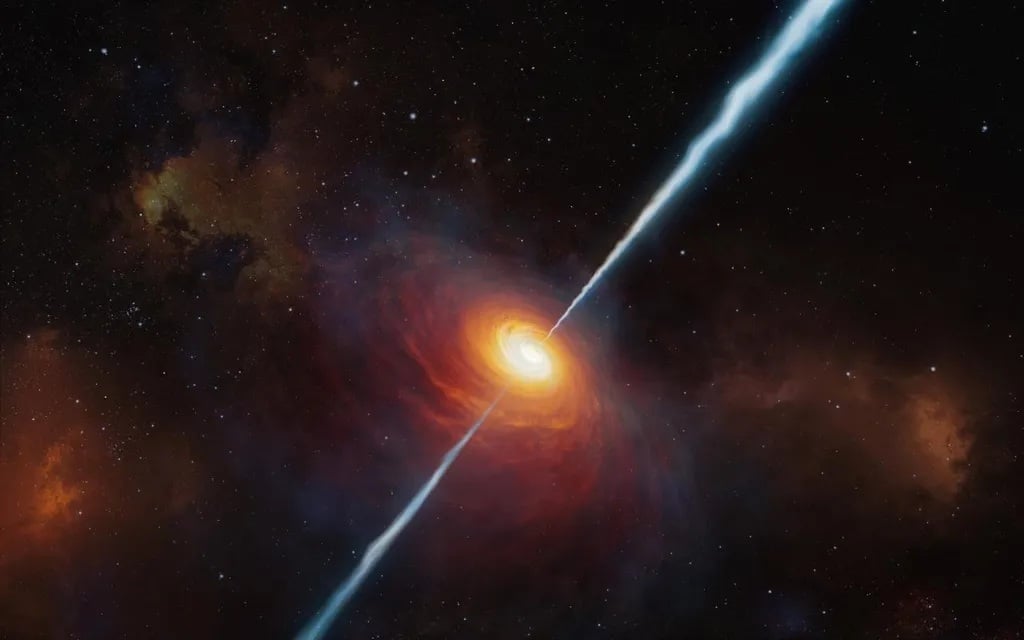
Supermassive Black Holes (SMBH), which reside at the center of many galaxies (ranging from dwarf to massive), are a true force of nature. Over time, dust and gas from their surroundings fall toward them, forming an accretion disk just outside the event horizon that is accelerated to near the speed of light (aka relativistic speed). This releases a tremendous amount of energy, temporarily making the core region outshine all the stars in the disk - what is known as an Active Galactic Nucleus (AGN). Over time, this matter slowly accretes onto the black hole's face, also resulting in radiation across the spectrum.
The process also generates radiation pressure, or "winds," that affect the core region and profoundly influence galactic evolution by suppressing stellar formation. In some cases, SMBHs can form jets of hot gas and dust that are emitted from the poles at relativistic speeds and are observable millions of light-years away. According to new research by an international team of astronomers, black holes don't just consume matter, but also manage it. Their findings show that they can either send it into space as relativistic jets or sweep it away with powerful winds.
The research was led by Zuobin Zhang, a Postdoctoral Research Assistant in High Energy Astrophysics from the Fudan Center for Astronomy and Astrophysics in Shanghai and the University of Oxford. He and his colleagues were joined by astronomers from the INAF-Osservatorio Astronomico di Roma, the Anton Pannekoek Institute for Astronomy, the LIRA Observatoire de Paris, the Harvard & Smithsonian Center for Astrophysics (CfA), the Space Sciences Laboratory (SSL), and multiple universities worldwide. Their research is detailed in a paper published in Nature Astronomy.
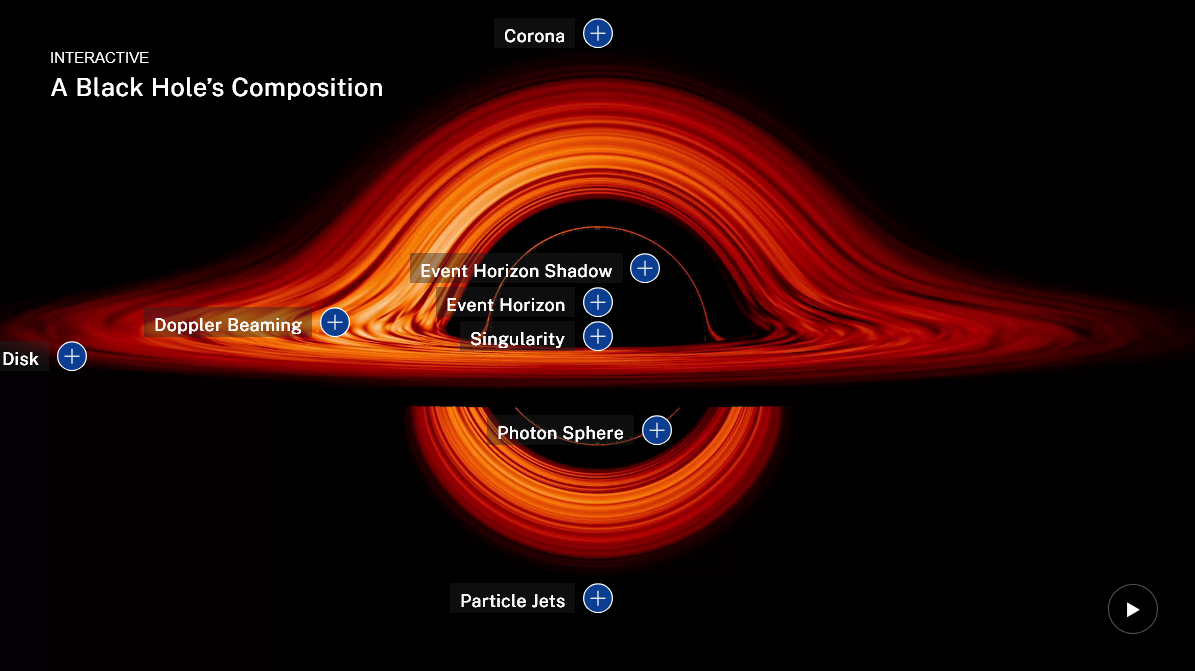 Interactive diagram showing the anatomy of a black hole. Click on the link to see more. Credit: NASA
One of the biggest misconceptions about black holes is that they simply consume matter. However, before matter crosses the event horizon (the point of no return), the material first falls into an accretion disk, much of which is expelled into space. This happens in one of two ways: the aforementioned relativistic jets, composed of focused streams of plasma powered by the black hole's magnetic fields and spin; and X-ray winds, which are slower and broader outflows of ionized gas blown from the surface of the accretion disk by radiation and magnetic pressure.
For a long time, astrophysicists have pondered how these two distinct outflows form and whether they are connected. To address this question, the team focused on 4U 1630-472, a black system of about ten solar masses that undergoes regular outbursts as it accretes material from a companion star. Using data from NASA's Neutron star Interior Composition Explorer (NICER) X-ray telescope aboard the International Space Station (ISS) and South Africa’s MeerKAT radio telescope, the researchers monitored the black hole over the course of three years.
This data showed that the black hole's accretion disk remained unchanged over time as it consistently consumed material from its companion. During that same time, 4U 1630-472 never showed evidence of strong winds or jets simultaneously. Their findings constitute the first clear observational evidence that the two are actually mutually exclusive. In essence, SMBHs "seesaw" between jets and winds and never perform both simultaneously. As Dr. Jiachen Jiang, a Teaching Fellow at the University of Warwick and co-author of the study, said in a press release:
We’re seeing what could be described as an energetic tug-of-war inside the black hole’s accretion flow. When the black hole fires off a high-speed plasma jet, the X-ray wind dies down, and when the wind starts up again, the jet vanishes. This tells us something fundamental about how black holes regulate their energy output and interact with their surroundings.
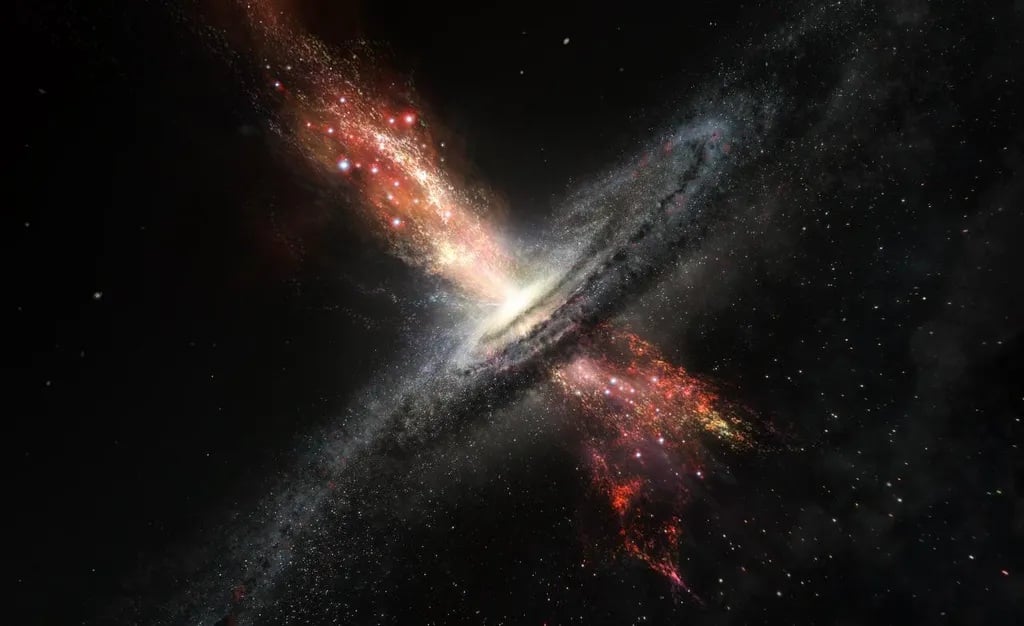 Artist’s impression of a galaxy forming stars within powerful outflows of material blasted out from supermassive black holes at its core. Credit: ESO/M. Kornmesser
This "cosmic seesaw" behaviour suggests that black holes have a self-regulating mechanism where winds and jets compete for the same energy or material. However, the total outflow remained relatively constant as both carried away comparable amounts of mass and energy.
"Our observations provide clear evidence that black hole binary systems switch between powerful jets and energetic winds—never producing both simultaneously—highlighting the complex interplay and competition between different forms of black hole outflows," added Dr. Zhang, a Postdoctoral Research Assistant at the University of Oxford and first author on the paper.
This discovery challenges many previous assumptions about how black hole outflows are powered. For instance, the team's findings suggest that the switch between winds and jets may depend on changes in the accretion disk's magnetic field configuration rather than solely on changes in the amount of material the black hole accretes. In any case, the balance between winds and jets is vital to the evolution of black holes, which in turn affects the rate of star formation around them and the overall evolution of their host galaxy.
In short, black holes don't simply consume matter, they arrange it and manage it in a way that goes beyond the matter supply. This seesaw-like behavior presents new and powerful insights into how black holes behave and shape the Universe.
Further Reading: University of Warwick