Universe Today
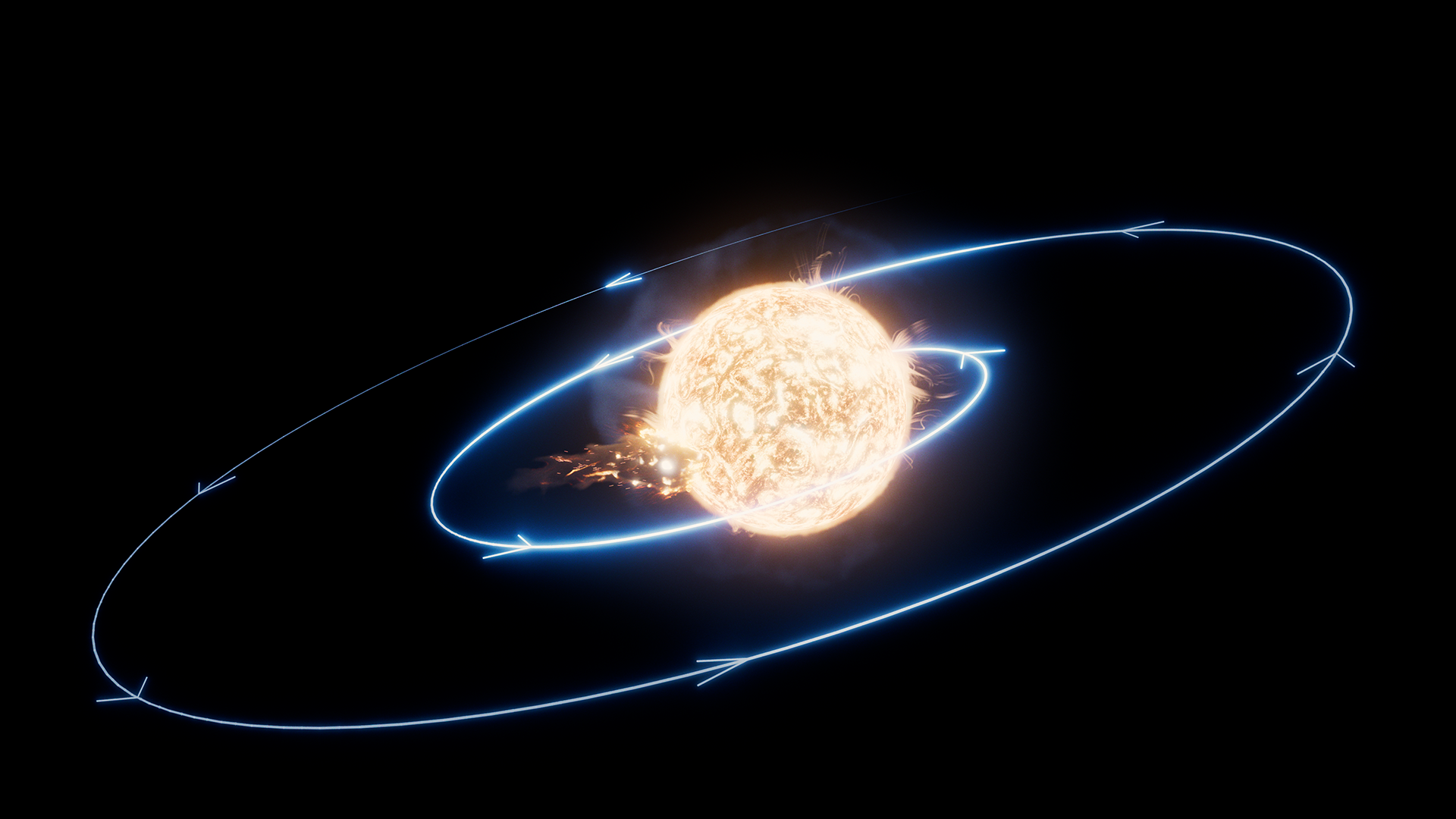
A team of 14 researchers from the United States and Chile have found evidence of a subgiant star eating one of its planets. The star, called TOI-5882, was already known to astronomers because of its massive companion, a brown dwarf called TOI-5882 b. The companion may well have helped kick a planet onto a spiraling journey into the star. The intense gravitational pull of the star ultimately pulled the planet apart, scattering its elements through the star's upper layers.
The evidence for this planetary engulfment is a high amount of the element lithium that appears in spectra of the star. Lithium is very abundant in planets. However, it's only slightly evident in stars because it gets destroyed by the high heat of a stellar interior. So, if a star gobbles up one of its planets, there's a good chance that world's lithium is eventually going to show up in the star, according to University of Michigan grad student Brooke Kotten, who led the team study of TOI-5882. “You are what you eat, right?” she said. “We know that there’s much more lithium in planetary material than there is in stars. So if a star eats a planet, it’s going to take on a bunch of lithium.”
Engulfment happens fairly quickly in the life of a planetary system. According to Kotten, astronomers aren't going to capture a view of it happening because is going to take only afew days or weeks. So, they have to use other methods to figure out if a star has eaten one of its planets. “That’s what makes this field so exciting. You really are solving a mystery,” said Kotten, who started working on the study as an undergraduate student at the University of California, Santa Cruz. “We can’t just watch the crime happen, so we have to work with all the clues we’re given to figure out whodunit.” Those clues often appear in detailed studies of the starlight.
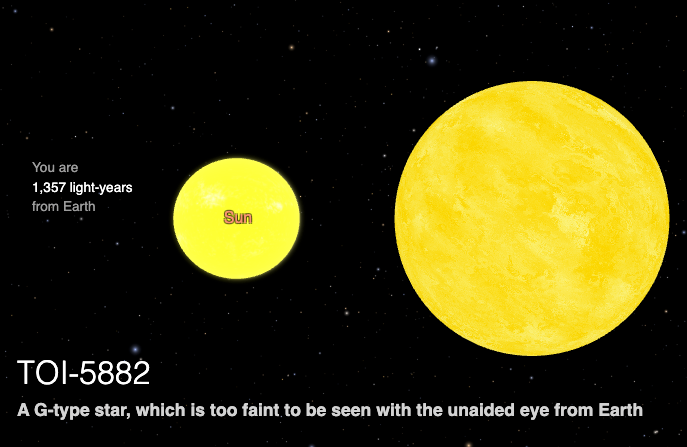 TOI-5882 in a schematic diagram in comparison with the Sun. Credit: NASA's Eyes on Exoplanets
The Clues Are in the Light
When astronomers study starlight using a spectrograph (an instrument that breaks the starlight into its component wavelengths), they'll see the fingerprints of the elements it contains in its upper atmosphere and convection zone. For example, if you look at the Sun in this way, the most abundant elements are hydrogen and helium, followed by smaller amounts of such elements as sodium, calcium, and mercury. Very few traces of lithium show up in the solar spectrum.
Contrast that with a look at TOI-5882, which is a subgiant with a mass about 1.3 times the mass of the Sun. Spectral studies of the star show it to have an extremely enhanced enrichment of lithium. It's not coming from the star itself, so the research team had to figure out where it could have originated. Planetary engulfment explains the high amount of lithium found.
The team compared spectra of 62 other subgiant stars at a similar evolutionary state as TOI-5882 to look for the existence of lithium. They compared those spectra to some taken of TOI-5882 by an instrument called the Tillinghast Reflector Echelle Spectrograph (at the Whipple Observatory in Arizona). It turns out that TOI-5882 ranks in the 98.4th percentile, meaning it has a significant amount of lithium enrichment. That's a very good indicator that something from outside the star deposited lithium, according to Seth Jacobson, an assistant professor at Michigan State. “Lithium atoms delivered by planetary engulfment to a star are like sports fans arriving at a stadium,” he said. “There may already be a few early arriving fans present, representing the initial amount of lithium in the stellar atmosphere, but they are quickly outnumbered.”
Based on the amount of lithium the researchers observed, they suspect the planet that TOI-5882 engulfed had a mass somewhere between a couple Earths and that of Neptune. “The fact that we can look at a star 1,300 light-years away and say with confidence, ‘This star has more lithium than you would expect,’ is a testament to both the precision of modern instrumentation and the hard interpretive work that goes into making sense of that signal,” said Melinda Soares-Furtado, a senior author of the study and assistant professor at the University of Wisconsin.
How Did It Happen?
If TOI-5882 didn't come by its high lithium naturally (that is, as a result of activity deep inside the star), what happened? That's what the team is working to figure out. Stellar engulfment isn't a strange new idea, particularly at the end of a star's life. For example, the Sun may swell up enough in about five billion years to swallow up Mercury, Venus, and possibly Earth. However, that's not what appears to be happening at TOI-5882. It's not far enough evolved to do that.
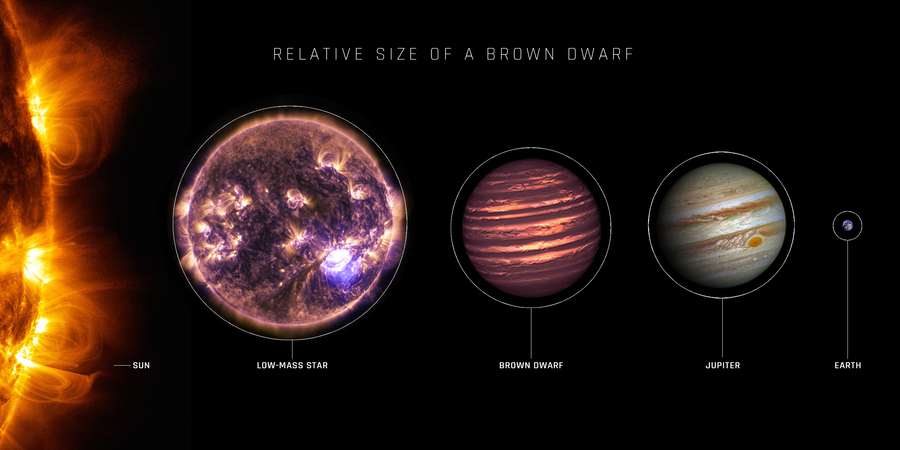 A size comparison of a low mass star, a brown dwarf, Jupiter, and Earth. The presence of a brown dwarf in a planetary system could have interesting dynamical effects on any nearby planets, including forced engulfment of a planet by the star. The only clue would be an enriched amount of elements such as lithium in the star after it gobbles up the planet. Credit: NASA, ESA, SDO, NASA-JPL, Caltech, A.Simon (NASA-GSFC); Designer: E. Wheatley (STScI)
However, there is a clue in the presence of the brown dwarf that's in an orbit with the star. It's about 20 times the mass of Jupiter, but isn't massive enough to light up as a star. This TOI-5882 b object is in an interesting dynamical relationship with its star. It orbits the star once every 7.1 days, which is a fairly tight orbit. That close-in orbit can perturb the orbits of smaller objects, such as a planet. Over time, it would be enough action to eventually push the planet into a death spiral toward the star. It ultimately ends up engulfed, with its component elements (including lithium) stirred into the upper layers of the star. So, based on the spectral studies of TOI-5882, its high lithium content provides interesting "fossil evidence" of past dynamical instabilities and the presence of at least one planet that got engulfed.
For More Information
You Just Ate That Planet, Didn't You?
Lithium Enrichment in a Subgiant Star with a Brown Dwarf Companion: A Planetary Engulfment Candidate