 Universe Today
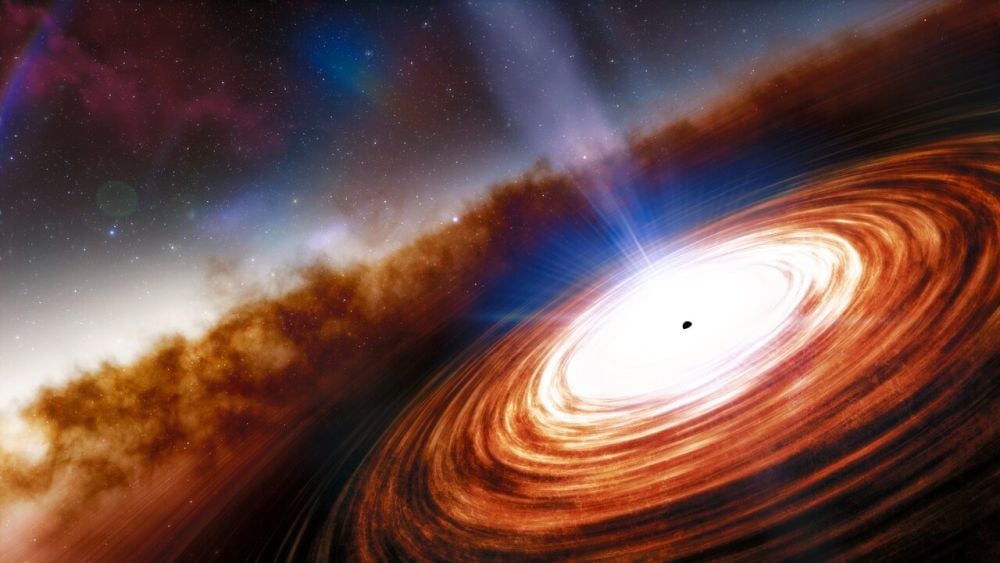
One of the most puzzling findings from the JWST's observations of the early Universe is the size of black holes. According to our understanding of black hole growth, these early black holes are far more massive than expected. Astronomers expected the unexpected from JWST, and it has delivered. Now the challenge is to update models of the Universe to include these new observations.
New research to be published in The Astrophysical Journal Letters has a solution to these over-massive black holes. It's titled "How Overmassive Black Holes Formed at Cosmic Dawn," and it's currently available at arxiv.org. The lead author is Muhammad Latif from the Physics Department in the College of Science at United Arab Emirates University.
When astronomers say that early black holes are more massive then they "should" be, they're referring to the ratio between the black hole's mass and the host galaxy's stellar mass. In the modern, local Universe, that ratio is remarkably consistent. Supermassive black holes (SMBHs) are typically between about 0.1% and 0.5% as massive as the stellar mass of their host galaxy. (That's especially true in elliptical and bulge-dominated galaxies, but not so much in disk-dominated galaxies like the Milky Way.)
But things look different in the high-redshift Universe. When the JWST observed galaxies in the Universe's first one or two billion years, it found that SMBHs were far more massive in relation to their host galaxies. They frequently made up 10% to 30% of their galaxies' masses. In some extreme cases of Little Red Dots, the BH masses exceeded the entire stellar masses of the host galaxies.
Scientists call these early galaxies with massive black holes overmassive black hole galaxies (OBG). After the initial shock of those findings, the astrophysical community got to work trying to explain what they'd found. Previous models showed that SMBH and their galaxies co-evolved and grew together at a more or less synchronized pace. But now that understanding been cast aside.
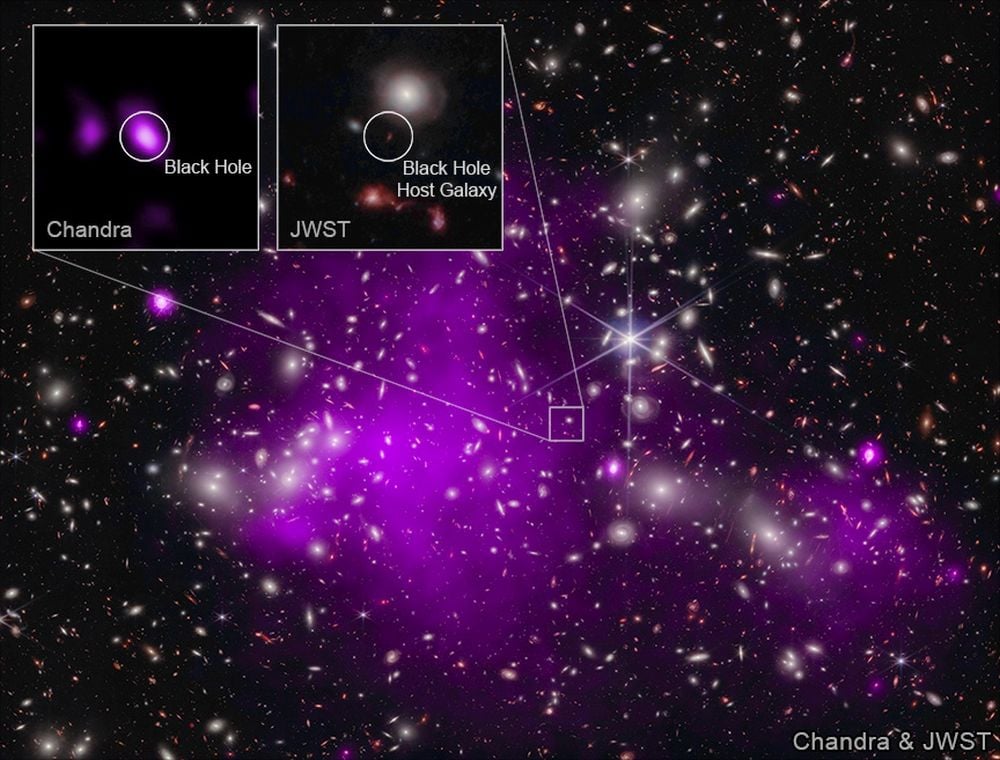 This figure shows Chandra (x-ray) and JWST (infrared) images of the OBG UHZ1. It's just one of the early galaxies found by the JWST that have extraordinarily massive black holes compared to the host galaxies stellar mass. Image Credit: X-ray: NASA/CXC/SAO/Ákos Bogdán; Infrared: NASA/ESA/CSA/STScI; Image Processing: NASA/CXC/SAO/L. Frattare & K. Arcand
In this new research, the authors say that the BH in these OBG are direct-collapse black holes. "Here we show that OBGs are simply the result of DCBH birth in primordial halos at early times," they write.
The primordial halos they're referring to are dark matter halos. These halos are usually described as the scaffolding upon which galaxies form. They're the gravitational backbone of the Universe. Primordial dark matter (DM) halos are the first generation of DM halos that formed, the first structures to collapse in the Universe's original density field.
The DCBH the authors refer to are direct collapse black holes. Just like their name says, these BH collapse directly from matter; there's no stellar precursor and no stellar collapse. These types of BH could only have formed in the early Universe, theorists say, when conditions were different. DCBH formed black hole seeds that were the precursors to SMBH.
In this work, the authors used cosmological simulations to reach their conclusion. Their simulation shows that unlike some other explanations for these massive black holes, no super-Eddington accretion is required. In fact, the simulation shows that these BH grow at only half of the Eddington rate.
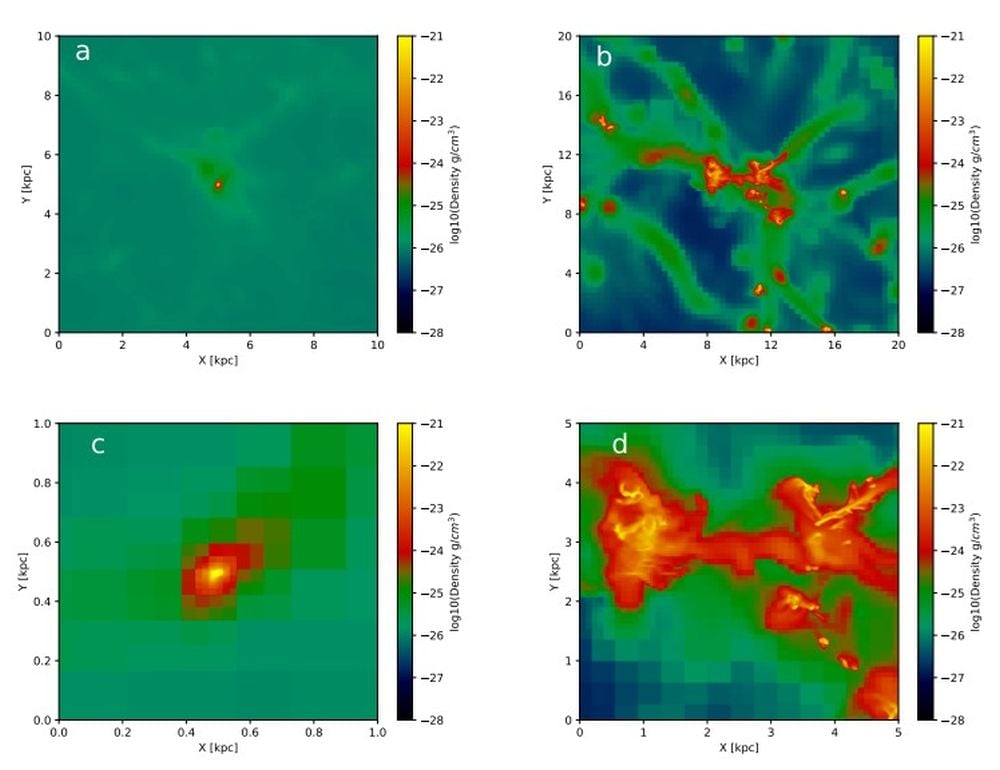 These four panels are snapshots from the simulations of the DCBH at different times and resolutions. Panel (a): 10 kpc image of the DCBH at birth at z = 25.7. Panel (b): 20 kpc image of the OBG at z = 11.4 centered on the black hole. Panel (c): 1 kpc image of the DCBH at z = 25.7. Panel (d): 5 kpc image of the OBG at z = 11.4. Image Credit: Latif et al. 2026. ApJL
One key to this understanding concerns star formation in the host galaxy. The authors explain that their simulations are the first to follow the co-evolution of a DCBH and its host galaxy for several hundred million years. They also explain that their simulation resolves "star formation in the earliest minihalos," and that it "shows that this ratio is a natural result of initial suppression of star formation by the DCBH and the later, violent blowout of metals by Pop III supernovae."
Black hole feedback is known to suppress star formation by heating and dispersing cool, star forming gas. Astrophysicists also know that Pop III stars, the first generation of stars to form, were massive, short-lived, and many of them exploded as extraordinarily powerful supernova. Those supernova would've worked alongside black hole feedback to inhibit star formation, helping create the lopsided mass ratios between BHs and stellar mass in these early galaxies.
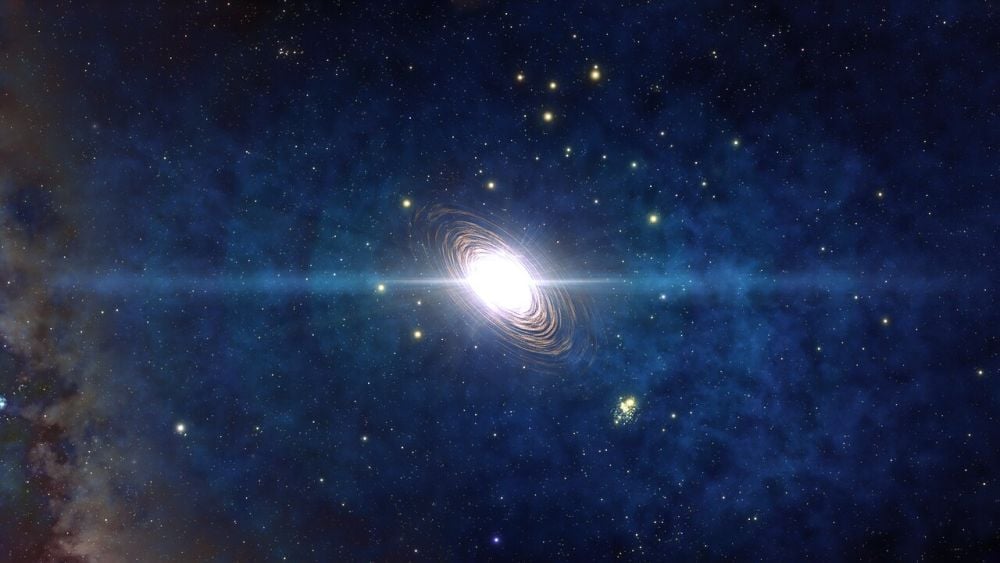 This artist's illustration shows a Population III star exploding as a supernova in the early Universe. Pop III stars were massive and short-lived, and many of them exploded, helping suppress star formation in OBG, leading to their lopsided mass ratios. Image Credit: NOIRLab/NSF/AURA/J. da Silva/M. Zamani/Spaceengine
As proof of their simuation's accuracy, the authors point to a pair of well-known early OBG observed by the JWST: GHZ9 and UHZ1. "Our models yield an excellent match to the spectra of UHZ1 and GHZ9 at z = 10.1 and 10.4, respectively," they write.
Astrophysicists theorized that DCBH in the early Universe were black hole seeds for eventual SMBH in galaxies, and this work supports that idea.
"Given that the numbers of OBGs found so far are consistent with previous estimates of DCBH number densities, our simulations suggest that OBGs may be a natural phase of evolution in most DCBH hosting galaxies and reinforce the case for massive seeds for the first SMBHs in the Universe," the authors conclude.

