 Universe Today
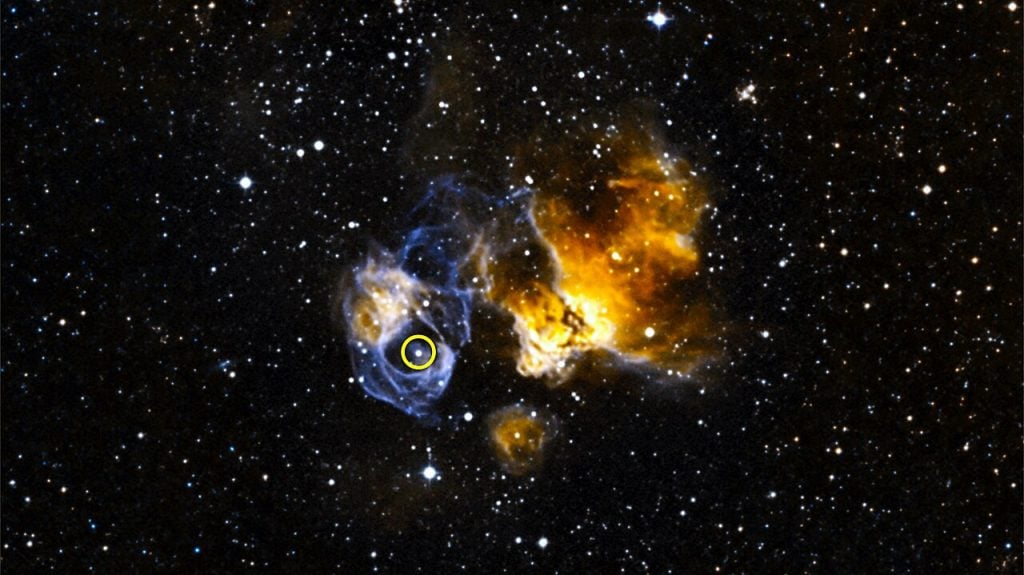
There's a strange gamma-ray emitter in the Large Magellanic Cloud that has astronomers stumped about its source. It lies within the ashes left behind by a supernova that created a compact object that's part of the system. The supernova remnant provides a piece of evidence to explain the emissions, but not the whole story.
So, a research team from two Japanese universities decided to give the object, called LMC P3, a closer look. Instead of tracking the gamma rays, they looked at the object with the Atacama Large Millimeter/Submillimeter Array (ALMA) in Chile. This is a series of radio telescopes that provide highly detailed radio views of objects in the sky. ALMA focused on radio emissions from carbon monoxide (CO) molecules in proximity to the cold cloud in the area around LMC P3. It's one of the few such objects found outside the Milky Way, and astronomers have dubbed it a microquasar. It consists of a giant O-type star and a compact object that could be explained by the existence of a black hole or a neutron star.
According to astronomer Yasuo Fukui of Nagoya University, who worked with team leader Bhuvana Gadikere Rajendra of Gifu University, what they detected at LMC P3 is unusual. “We discovered a gigantic molecular jet,” said Fukui. The jet consists of molecular gas that stretches out across 26 light-years of space. For reference, the bright star Vega lies 25 light-years away from us, so the jet would connect us and that star quite easily.
The strange thing is, the molecular jet itself is cold (by our standards), but astrophysically "heated" to a temperature of about 35 to 60 Kelvin. By comparison, that's warmer than the 15 Kelvin surrounding gas but still very cold. That temperature difference means that the gas is interacting with another jet— this one a high-energy stream of particles coming from the nearby compact object with enough energy to power gamma-ray emissions. The object turns out to be a micro-quasar, which would have the energy to do the job.
Micro-Quasar Explains the Emissions
Micro-quasars are interesting objects. They actually consist of two objects: a stellar-mass black hole or neutron star coupled with a companion star. The black hole constantly sucks material from the star, and that creates a swirling accretion disk around the black hole. It's a fairly energetic interaction that leads to X-ray and gamma-ray emissions. It also creates high-speed jets that travel out at nearly light-speed velocities. They're called micro-quasars because they're a smaller type of quasar, which is a highly active region around a supermassive black hole at the center of a galaxy.
Fukui said the relatively high temperature observed over a large fraction of the molecular cloud makes it a very strong case that the gas is interacting with a high-energy jet coming from the compact object — precisely the kind of jet that can also power LMC P3’s gamma rays. This also provides a boost to the idea that the object is a black hole, leftover from the collapse of a supermassive star in a supernova explosion.
Solving for Two Competing Theories
Prior to this discovery, scientists had two competing theories about what could be powering the emissions. One is that pulsar winds could have been causing the emissions. That means the object has to be a pulsar, which would send out streams of energetic particles in pulsations as the object spins. Neutron stars are created when a supermassive star collapses, but a stellar remnant remains behind consisting solely of neutrons packed tightly together in a space about the size of a city.
The other theory is that the object is indeed a microquasar. The discovery of the newly found "cold" jet strongly suggests that the compact object could be a stellar-mass black hole or neutron star that draws in material from its companion to form an accretion disk. Since black holes drive more powerful jets than neutron stars, the fact that LMC P3’s gamma-ray emission is particularly high is a smoking gun pointing toward the micro-quasar origin of the signals found by ALMA. “It provides very strong support for the possibility that its central object is a black hole," said Fukui.
ALMA Answers and Poses Questions
Object LMC P3 was first discovered in 2016 thanks to its very strong gamma-ray emissions. It was also the first one found outside the Milky Way. From the beginning, astronomers suspected it was an X-ray binary, and Chandra X-ray Observatory studies seemed to confirm that. Then, the FERMI telescope observed it and found a 10.3-day period in gamma-ray emissions from the object. That suggested a number of ideas, including jets.
Detailed observations with ALMA focused on the surrounding gas clouds and found the "cold" jet streaming away. That raised questions about the "launch mechanism" for such a jet. In the paper the team published about their observations, they wrote: "We interpret that the high temperatures are due to shock heating of a microquasar jet driven by the gamma-ray binary, where the compact object has an accretion disk fed by the O-star winds. The CO jet matches existing predictions from magnetohydrodynamical simulations, which show that a CO jet can form from the interaction of the microquasar jet and an ambient interstellar medium (ISM) cloud. These results provide strong evidence that CO jets are a signature sculpted by microquasar jets, lending support for mass accretion in LMC P3 as the gamma-ray origin.
This discovery has important astrophysical implications for the study of high-energy emissions and the objects that provide them. Coupled with ongoing studies of such objects as SS 433, which is the first microquasar ever found, discoveries such as LMC P3 give new insight into the actions of compact objects and their interactions with surrounding objects.
For More Information
Has a Mysterious Gamma-ray Powerhouse Revealed its Smoking Gun?