 Universe Today
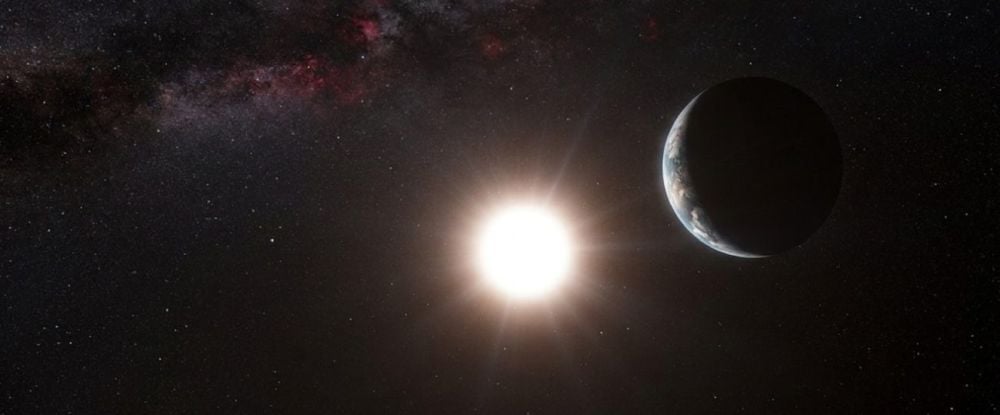
The stable Solar System we see around us today took time to develop. Not only did it take time for planetary orbits to stabilize, but planetary atmospheres also needed time to evolve. In fact, planetary orbits and evolving atmospheres work together to determine what a solar system eventually looks like, and photoevaporation drives the process.
Photoevaporation is when UV and/or X-ray radiation from a star heats up and ionizes gas in a planetary atmosphere or a protoplanetary disk, dissipating it and stripping it away. This removes mass, and the loss of mass affects the orbital arrangement of planets.
Photoevaporation is a brief yet critical stage in a solar system's development, and that stage happened billions of years ago in our system. But how, exactly, does it work?
Observations of what researchers are calling a teenage solar system may hold some answers. The system is named TOI-2076 and was first discovered by TESS in 2020. New research in Nature Astronomy presents these observations. It's titled "An adolescent and near-resonant planetary system near the end of photoevaporation," and the lead author is Mu-Tian Wang. Wang is from the School of Astronomy and Space Science at Nanjing University, China.
"We present a thorough characterization of the TOI-2076 system whose adolescent age of ~210 ± 20 Myr makes it a key signpost for studying dynamical evolution and the erosion of primordial atmospheres," the authors write.
They explain that young Solar Systems often exhibit mean-motion resonances (MMR). These occur when multiple planets have orbits that are simple integer ratios of each other. Often, these MMRs are disrupted, something predicted by the Nice model.
The Nice model basically says that our Solar System's giant planets formed close together then migrated to their current positions through gravitational interactions. That lead to the Late Heavy Bombardment, a period of time that can explain the massive numbers of craters seen on the surfaces of the Solar System's rocky bodies. This happens after photoevaporation, a phase when the young star has dissipated the gas in its protoplanetary disk, and has also stripped planetary atmospheres away with its radiation. This upsets the orbital relationships between planets.
Photoevaporation is an important phase in a Solar System's development. It's a transformative stage between a young solar system and a more mature one like ours. Research shows that photoevaporation can dampen the disruption of MMRs in planetary systems by depleting gas between planets, stabilizing the orbits. The photoevaporation period can also erode planetary atmospheres.
“The transformative period is so short compared to the entire lifespan of the system,” said Howard Chen, a co-author from the Department of Aerospace, Physics, and Space Sciences at the Florida Institute of Technology. “That period is really the key in determining how it turns out at its mature state.”
"Here we present a detailed characterization of the ~200-Myr-old TOI-2076 system, which contains four sub-Neptune planets between 1.4 and 3.5 Earth radii," the authors write. "We demonstrate that its planets are near to but not locked in mean-motion resonances, making the system dynamically fragile."
TOI-2076 is a young K-type star only about 210 million years old. Its four planets are orbiting in an almost consistent sequence, evidence that they were once much closer together but are slowly migrating outward. Observations also show that they all have rocky cores. But their atmospheres are different. The closest planet to the star has lost its atmosphere due to photoevaporation, while the outer three have not suffered the effects as strongly.
Chen works with computer models on planetary evolution, and those models show that planets gradually lose their atmospheres due to photoevaporation. What's uncertain is how long it takes, and exactly how photoevaporation affects a young solar system.
Chen used his models to simulate how photoevaporation would shape planet evolution from birth to adolescence. With observations of the TOI-2076 in hand, the researchers compared them to his models.
They found agreement between the models and the observations. Over time, the planets evolved to resemble the planets in the TOI-2076 system. This means that photoevaporation was hard at work shaping the evolving planets. The powerful radiation from the star stripped the planets' atmospheres away over time, with the ones furthest from the star retaining more of theirs. Photoevaporation removes mass, and the planets gradually grew more distant from each other as their atmospheres were stripped away. "This trend is consistent with atmospheric mass loss due to photoevaporation, which predicts that the envelopes of irradiated planets either erode completely or stabilize at a residual level of ~1% by mass within the first few hundred million years, with more distant, less-irradiated planets retaining most of their primordial envelopes," the researchers explain.
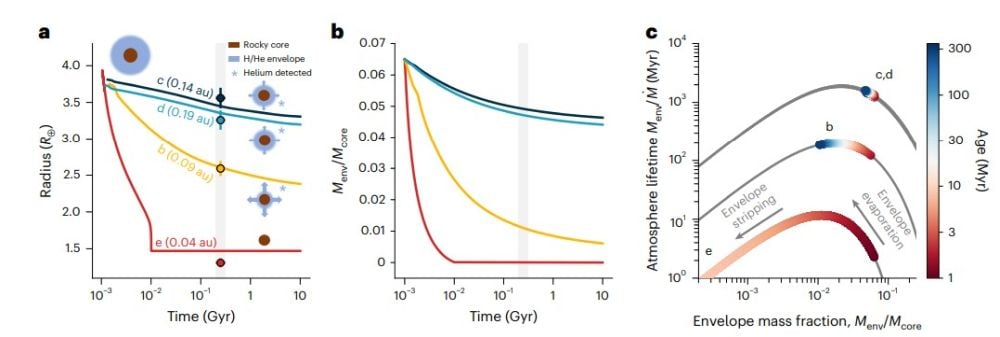 These panels show the simulated photoevaporation mass loss for the planets in the TOI-2706 system. It's driven by the star's X-ray and UV radiation. (a) shows the radius evolution of TOI-2076 e (red), b (yellow), c (dark blue) and d (light blue), with the grey band showing the system's current age. (b) shows the evolution of the H/He envelope mass fraction for each exoplanet. (c) shows the planetary atmosphere lifetimes. Image Credit: Wang et al. 2026. NatAstr.
“For me, the whole point of going into modeling is to be able to connect with observations. You want your models to say something about the real world, but that’s not necessarily the case every time,” Chen said in a press release. “To see the model work in the real world and explain what’s happening is pretty powerful.”
The results also show that most solar systems should stabilize after the photoevaporation phase. After about 100 million years, the system stabilizes like our Solar System has, and should remain that way for billions of years.
"We found that XUV-driven hydrodynamic escape offers a plausible explanation for the divergent atmospheric outcomes observed among the four modelled planets, even though they probably formed in broadly similar disk environments with comparable primordial compositions," the researchers write.
But the authors also point out that there are other mechanisms operating at the same time, and that the photoevaporative atmospheric loss isn't the only force shaping a system. "However, this mechanism is unlikely to operate in isolation or to dominate in every case," they write. During the pre-main-sequence phase, irradiation is stronger, powering greater mass loss. An exoplanet can also have internal causes for mass loss, ilke core-powered escape driven by residual heat from a planet's formation. In some cases, sub-Neptunes could continue to suffer atmospheric mass loss much later in a solar system's history.
"Our finding provides direct observational evidence that the dynamical and atmospheric reshaping of compact planetary systems begins early and offers an empirical anchor for models of their long-term evolution," the authors conclude.

