Universe Today
How about that Total Lunar Eclipse this past July 13th? It has been a busy year for astronomy for sure, with two total lunar eclipses, a comet fading out from an unexpected burst of glory, and Saturn, Jupiter and Mars reaching opposition in quick succession.
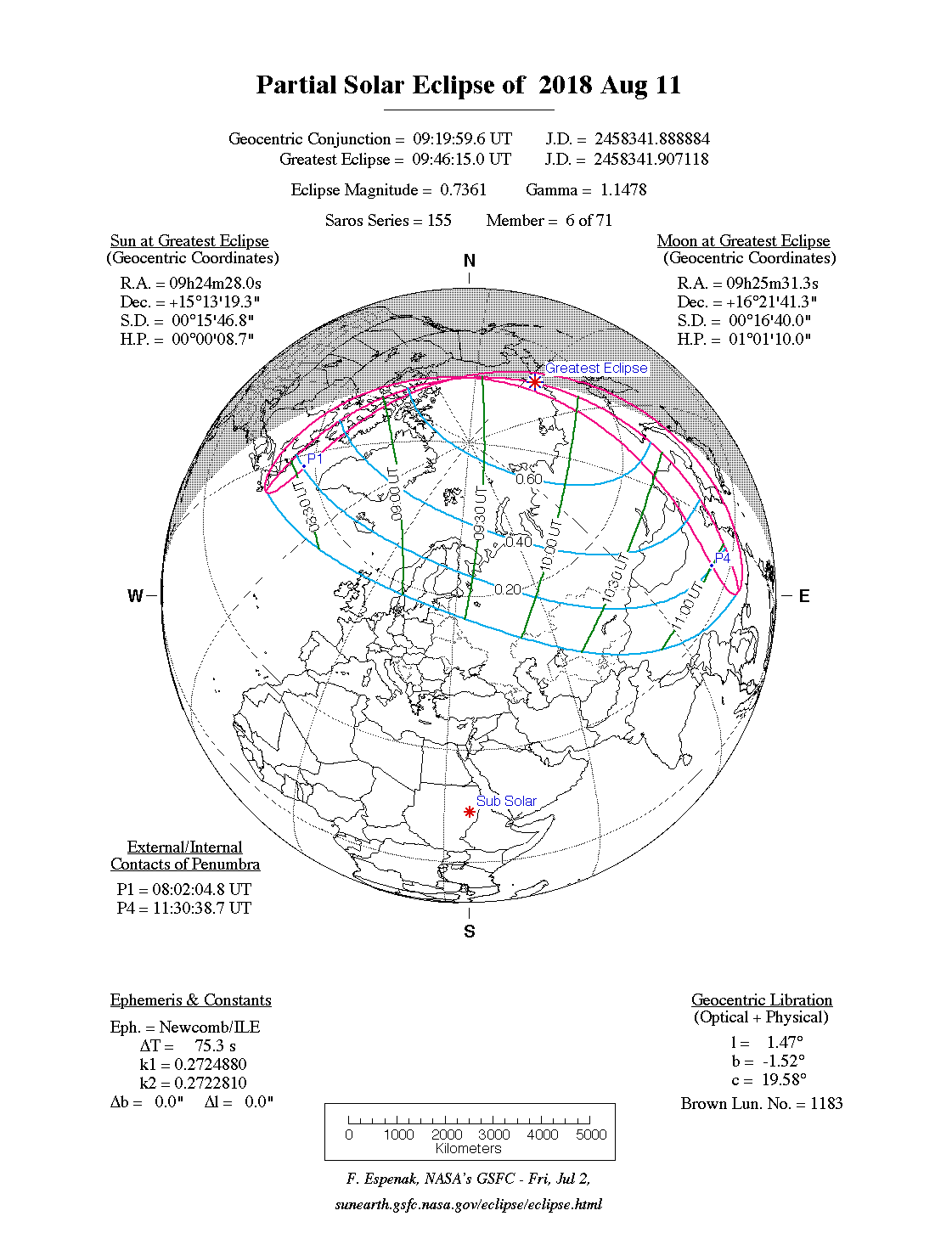
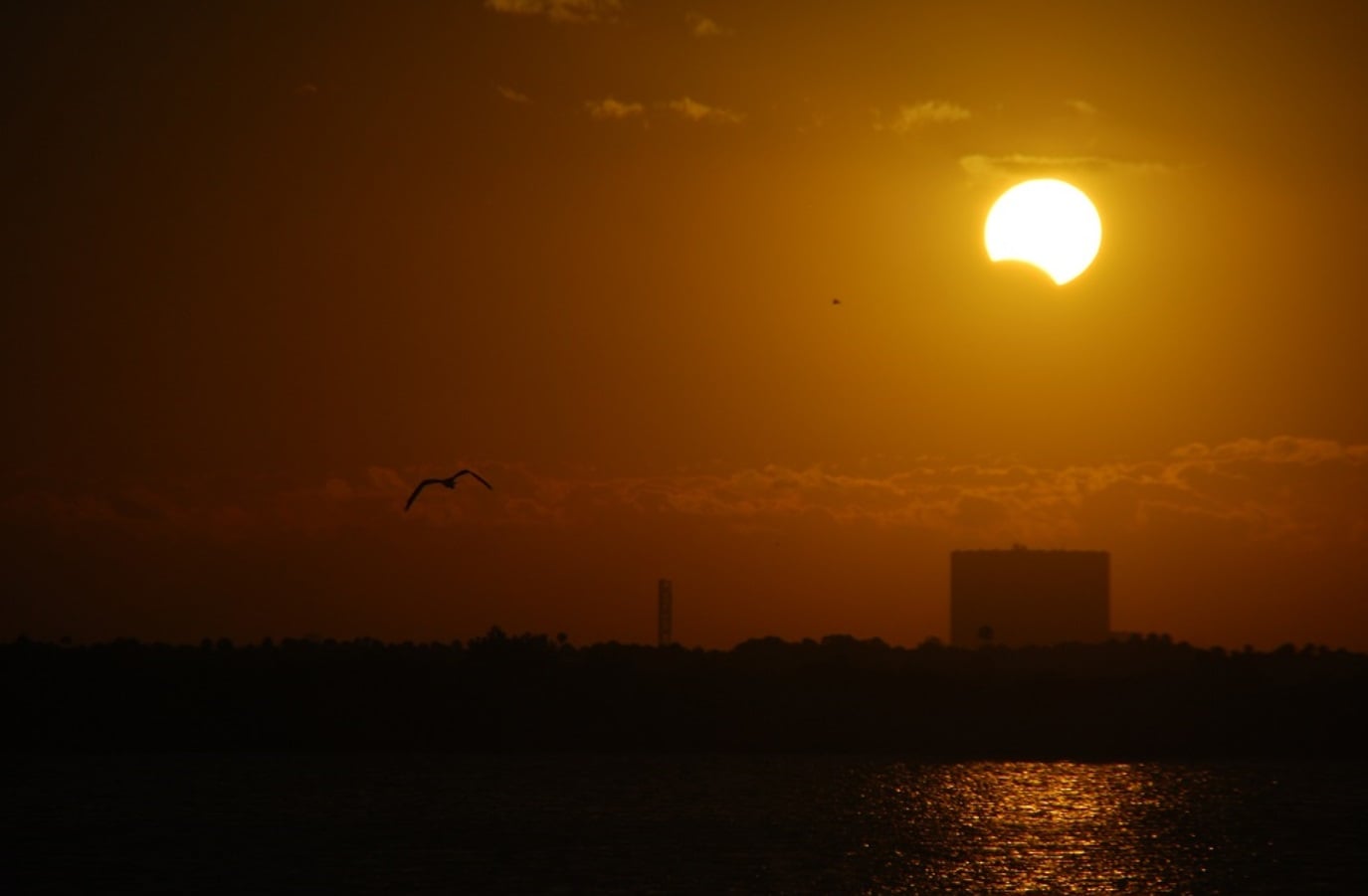
Now, watch for a rare event this weekend, with the final eclipse for 2018 coming up on Saturday, August 11th, with a partial solar eclipse spanning northern Europe and the Arctic.
What's so unique about this eclipse? Well, not only is it the last one for 2018, but it's part of three eclipses in the second eclipse season of the year. Most seasons only feature two eclipses (one lunar and one solar) but every few years or so, it is possible to have a season with three: either lunar-solar-lunar (such as occurred in 2013) or solar-lunar-solar.
This is only possible when the middle eclipse occurs very near ascending or descending node along the ecliptic. The nodes are where the path of the Moon, inclined 5.1 degrees relative to the ecliptic plane intersect it—when these nodes are occupied by an alignment of the Earth, Sun and Moon (known as a syzygy, a fine word in Scrabble to land on a triple word score, though you'll need a blank tile for the third 'y') a solar or lunar eclipse occurs. For an eclipse triple play, the middle eclipse needs to happen very near a node crossing, producing a fairly long eclipse. That's exactly what happened on July 28th, when the Moon crossed through descending node just over an hour after crossing out of the Earth's umbral shadow after the longest lunar eclipse for the 21st century.
This also leaves the Moon close enough to the opposite ascending node two weeks post and prior to July 28th on July 13th and August 11th to just nick the Sun for a partial solar eclipse, one over the Antarctic and one over the Arctic.
Eclipse Circumstances
Saturday's partial eclipse touches down over the eastern coast of Canada at sunrise. From there, it sweeps eastward over Greenland, Iceland and the North Atlantic, with the Moon's penumbra just grazing the northern United Kingdom before crossing over Scandinavia. Then, the shadow crosses over Asia, with a photogenic partial solar eclipse wrapping up at sunset over eastern China, the Koreas and the Russian far east.
Note that this eclipse is also a relative newcomer for its particular saros 155, as it is member 6 of a series of 71 eclipses. The saros just began less than a century ago on June 17th, 1928, and won't produce its first total solar eclipse until September 12th, 2072 AD.
As of this writing, we've yet to see evidence of anyone carrying the eclipse live, though we'll note it here if any webcast(s) surface.
When is the next one? Well, the next partial solar eclipse is on January 6th 2019, and the next total solar eclipse occurs on July 2nd, 2019.
Enter the Perseids
This weekend's eclipse at New Moon also sets us up for a fine display of the Perseid meteors for 2018. This year, the Perseids are expected to peak on the morning of August 12th and August 13th. Watch for a zenithal hourly rate of 100 meteors per hour at the peak. A dependable annual favorite, the Perseids are debris remnants of period comet 109/P Swift-Tuttle.
Astronomer Gianluca Masi and the Virtual Telescope Project 2.0 will host a live webcast for the 2018 Perseids on August 12th starting at 20:30 UT.
Don't miss the astronomical action worldwide this weekend, either live or online.