Universe Today
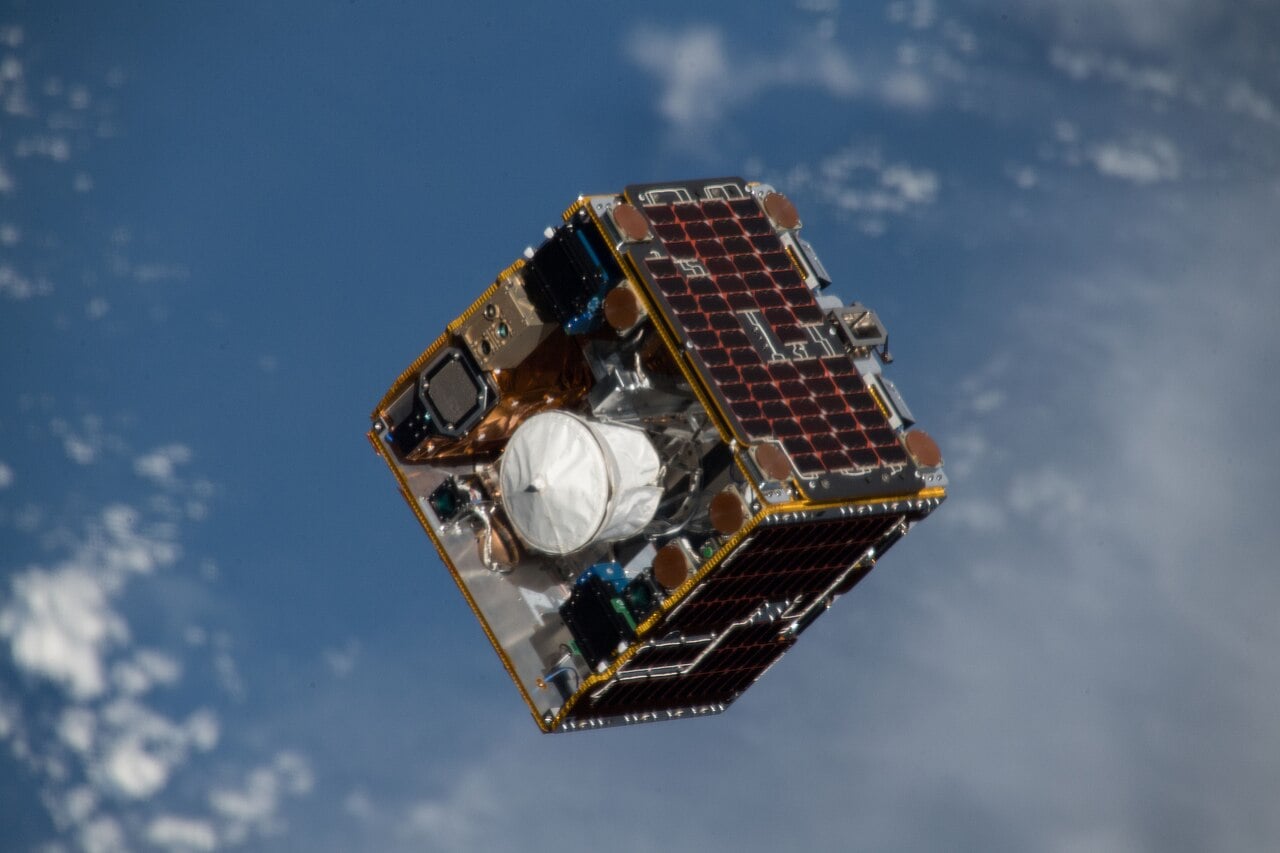
We’ve reported on all kinds of wacky ideas for capturing and deorbiting space debris safely. From electric tethers to lasers, engineers and scientists have been trying everything they can think of to deal with the ever-increasing orbital debris problem. But one simple design keeps popping up over and over again - a net. A new paper from researchers at the Chinese Academy of Sciences and the University of Electronic Science and Technology of China details one of the most advanced net concepts yet - but whether we can actually build one remains to be seen.
A net has obvious advantages. Alternative solutions, such as robotic arms, require a “cooperative” satellite that is able to be easily interfaced with. Others, such as grappling hooks, don’t have the same requirements, but could result in causing even more debris by breaking up the satellites in-situ. Yet others, such as the aforementioned lasers, require significant amounts of power and a complex understanding of the dynamics of the target in order to be effective.
Nets, on the other hand, are much simpler. But, they do have disadvantages as well. Once they are deployed they are essentially uncontrollable. And, perhaps more importantly, they are notoriously difficult to reuse. So if a net was to be used to deorbit debris, we would have to send a specific mission up to deorbit each piece - a potentially prohibitively expensive proposition.
Fraser reports on an alternative way to remove space debris, using technology that sounds like science fiction.Enter the new net from the paper, which was published in the journal Space: Science & Technology. It could actually be thought of as more of a hybrid “net-membrane” system. It incorporates a multilayered flexible membrane with electronics, battery layers, and Shape-Memory Alloys (SMAs), which are becoming ubiquitous on some types of spacecraft.
Deploying the net is simple enough. A “chaser” satellite approaches a target piece of debris and fires four bullets, each attached to a corner of the net, at a 30 degree angle (which is the optimal angle according to the paper). The pull from the bullets unfurl the membrane, which then wraps around the debris, effectively capturing it. Using the SMAs embedded in it, the membrane can maintain its shape, and hold onto the debris tightly while deorbiting it to a point where it will safely drop into the atmosphere. And, crucially, the membrane then folds itself back up and retracts back into the chaser satellite, which is then ready for another run.
There are lots of “firsts” in the description of how that works. But, according to the paper, it works in theory at least. The researchers decided to model that process using a technique called the Multiparticle Method (MPM), rather than the traditional finite element analysis (FEA) techniques, due to the latter's computational complexity. MPM allowed them to break the membrane itself down into a grid of masses that are connected via spring-dampers to simulate bending, stretching, and shearing.
Fraser talks about why we need to deal with space junk before it’s too late.A few key features came through the simulations. One was the deployment angle mentioned above. But another was the fact that the distance to target makes a huge difference in the forces the membrane is subjected to. At a 2m distance, it will undergo a massive 3,374N force, but moving the deployment distance back to 3m drops that number in half.
While simulations are great, withstanding that amount of force is a lot to ask of a 10 micron thick piece of material. Even more so when it has so many interwoven layers that aren’t necessarily designed for their mechanical properties. The simulations themselves also represented simplified versions of the operational environment the membrane would be working in - they ignored solar radiation pressure as well as atmospheric resistance, both of which play a huge role in orbital debris capture.
But when it comes to tackling the problem or orbital debris, we need all the help we can get. Proving an idea is theoretically possible is the first step to actually doing it, though it will probably be at least years if not decades before we would see such a hybrid membrane actually deployed in a debris removal mission. In the meantime, other technologies, such as robotic arms and magnetic plates, are making progress in their testing. Though, in this writer’s opinion, the more options we have for solving this potentially devastating problem, the better.
Learn More:
Beijing Institute of Technology Press - Dynamic modeling of a net-membrane capture system with combined deformation for space debris removal
S. Yu, J. Liu, & P. Zhao - Dynamic Modeling of a Net-Membrane Capture System with Combined Deformation for Space Debris Removal