Universe Today
The infrared-sensitive James Webb Space Telescope (JWST) has been doing multiple surveys of the very distant Universe, digging into what was happening in the first billion years after the Big Bang. As part of these deep surveys, its sensors have been picking up mysterious objects dubbed "Little Red Dots". It has found more than 300 of them since their discovery in 2024. These intriguing little objects look like their name: distant, small objects that appear red in the JWST observations.
What are they? Good question, and one that astronomers are working to answer. Let's look at what we know about them. LRDs (as they are nicknamed) seem to exist during an epoch of time between 0.6 and 1.6 billion years after the beginning of the Universe. That's a point when the first galaxies were starting to form. One idea is that the LRDs are primordial galaxy structures with bright nuclei. That description also fits active galactic nuclei (AGN), which are powered by supermassive black holes. The LRDs appear so early in cosmic time that not much is known about the engines that power them. If—as astronomers now seem to think—they are early AGN with supermassive black holes at their hearts, that raises questions about how massive black holes could form so early in cosmic time. Black holes need time to form, but the idea that they exist very early on causes scientists to recalibrate what they know about the early Universe.
Another idea is that these LRDs could be supermassive early stars with masses up to a million suns. Maybe astronomers are seeing them in the last epochs of their lives before they explode as supernovae. That's entirely possible, since the earliest stars were very likely cosmic monsters with many times the mass of the Sun. If that's true, then these could be the stars that spread the elements they created in their cores to space. As part of the supernova event, they also would have created the first stellar black holes. Those could then go on to collide, especially if they exist in crowded stellar environments, and form even more massive black holes. Until astronomers can get more information about the LRDs, however, they remain something of a mystery.
Other recent JWST studies of LRDs suggest they could be ancient globular clusters dominated by at least one supermassive star. It's also possible that they're actually black holes surrounded by dense cocoons of ionized gas. If that's what they turn out to be, we're back to the same questions about black hole formation in the newborn Universe.
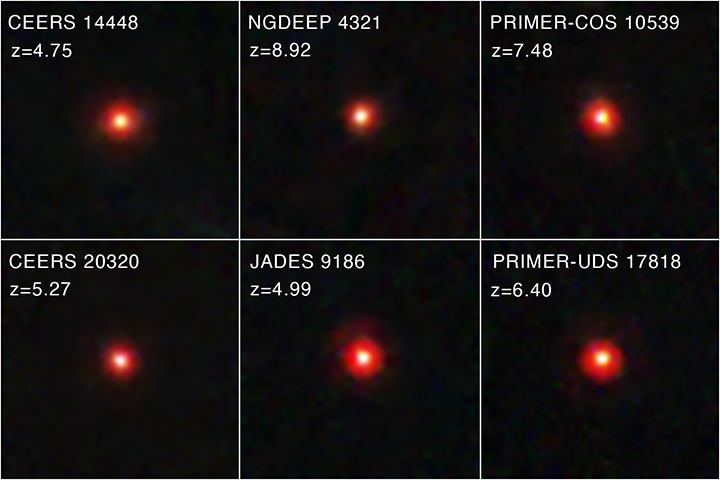 A collection of little red dots as seen by JWST during several sky surveys. These distant red objects seem to pop up some 600 million years after the Big Bang and undergo a rapid decline in quantity around 1.5 billion years later. Spectroscopic data of some of the LRDs in their sample, provided by the Red Unknowns: Bright Infrared Extragalactic Survey (RUBIES), could prove that many are accreting black holes. However, further study of these intriguing objects is required. Credit: NASA, ESA, CSA, STScI, Dale Kocevski (Colby College)
Astronomers Spot a Primordial Target
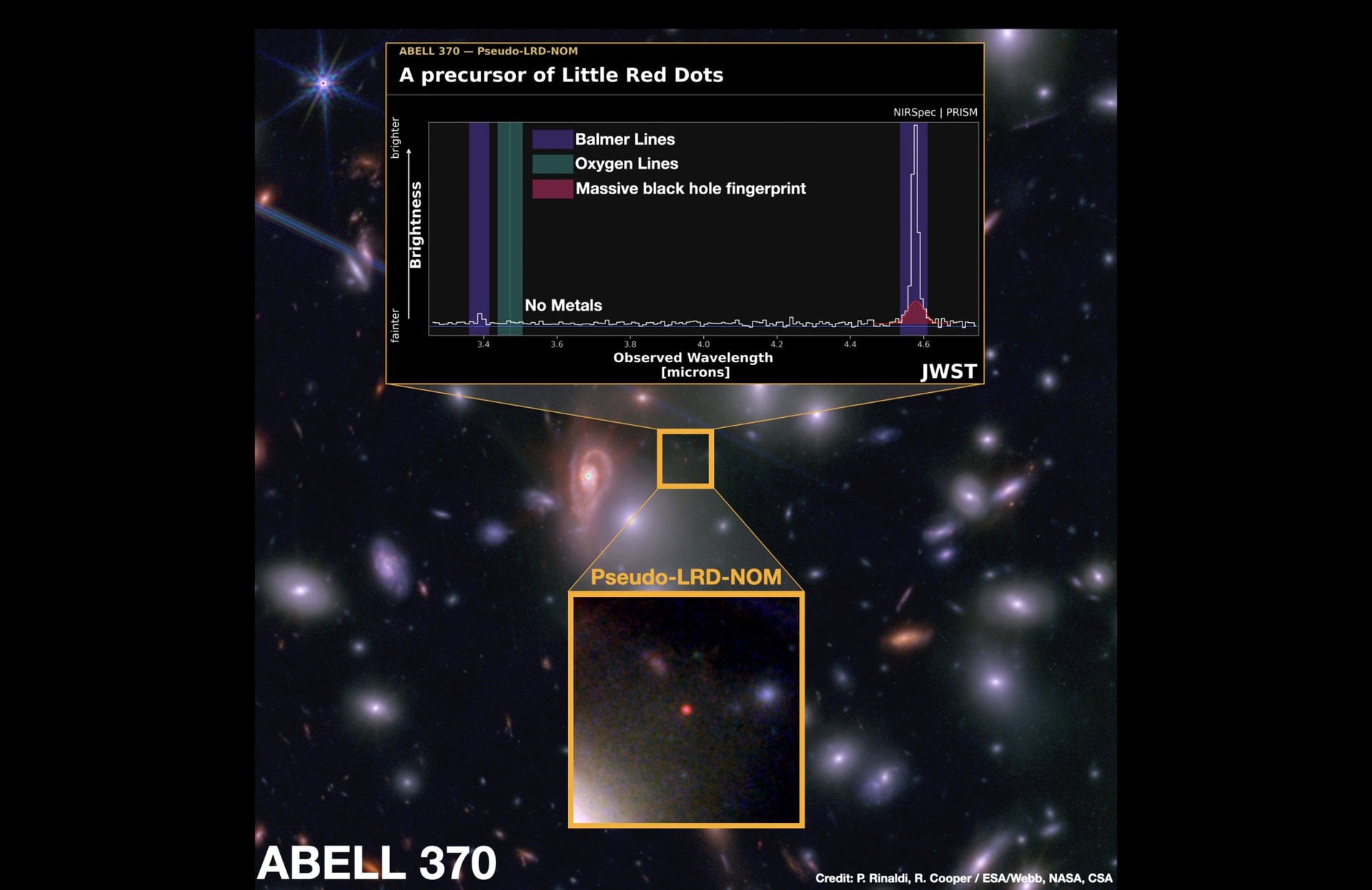
Recent observations with JWST, made by Dutch scientist Karina Caputi and a team of astronomers, found what may well be an LRD in formation. It's a small starburst galaxy caught in its own infancy within its first ten million years of existence and lies some 12 billion light-years away. It appears to be metal-poor (meaning that it's mostly hydrogen and helium, with few to no traces of heavier elements), but is quickly forming stars.
The tiny galaxy, named Pseudo-LRD-NOM, could well be the precursor to an LRD, rather than an LRD itself. Its faint light is magnified by the effect of gravitational lensing from the intervening Abell 370 galaxy cluster (which lies just over 5 billion light-years from us). The LRD in the JWST results appears to have a black hole at its heart that could well have formed before the star-forming galaxy where it exists. That starburst activity eventually helps the black hole grow by funneling gas in from other regions in the galaxy and its dark-matter halo.
Why Study LRDs?
Caputi and her colleagues have been studying many small distant galaxies using JWST. Most of them have spectra with multiple emission lines. The spectrum of this source caught their attention due to the lack of metal lines, which is extremely rare in star-forming galaxies because metals are produced very quickly when there is new star formation. Caputi describes the team's finding at Pseudo-LRD-NOM as a fundamental step to understanding the formation of LRDs. It seems to provide evidence for an active black hole located in a high-density, dusty starburst galaxy that is actively being enriched (chemically) by stellar activity.
Knowing what LRDs are and what role they play in the early Universe gives astronomers more insight into the formation of galaxies we see today. LRDs may well be the building blocks of modern galaxies, and they carry the chemical information about the first populations of stars. In addition, as the LRDs evolve, astronomers may well see the chemical evolution of galaxies as their stars are born, live, die, and expel their heavier elements to space to help form the next generations of stars.
Since LRDs are likely the sites where the first black holes formed and began to grow, observations of these early galaxy progenitors are an important step in understanding that process. Further LRD studies using spectroscopic observations should provide important clues to the combined process of LRD formation, early galaxies, and black hole formation as part of galaxy evolution.
For More Information
Astronomers Find an Enigmatic Source that is Most Likely a Little Red Dot in Formation
Little Red Dots as Young Supermassive Black Holes in Dense Ionized Cocoons