 Universe Today
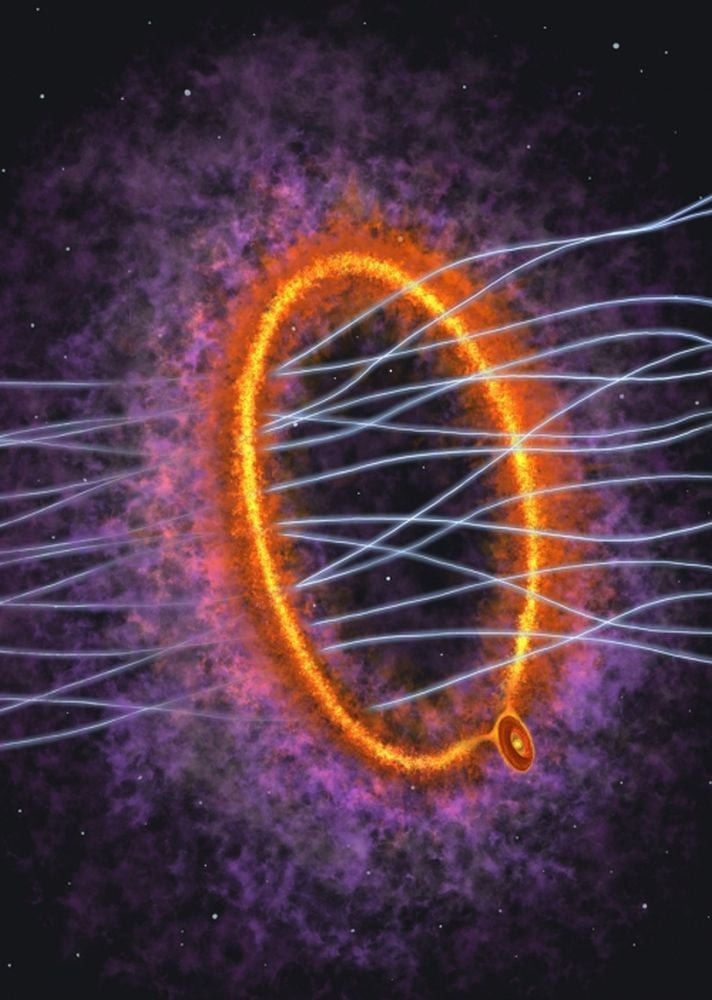
Despite all we've learned about star formation, the process is still riven with mystery. Our prying telescopic eyes struggle to pierce the thick gaseous regions that give birth to stars. Progress has been steady, though, and we can thank the Atacama Large Millimeter/sub-millimeter Array (ALMA) for some of it.
ALMA is a radio-telescope interferometer comprised of 66 separate antennae. It observes electromagnetic radiation from 3.6 to 0.32 millimeters, or 31 to 1000 GHz. This is an important range in astronomy because it marks the boundary between radio and infrared. Energy in this range is non-ionizing, yet it can interact with the rotational transitions of molecules like carbon monoxide (CO), making molecules visible to ALMA. Waves in this range can also pass through thick gas where stars are born.
This leads us to one of ALMA's main strengths. It's the primary observatory for this range, and its Band 9 specifically probes the warm, dense gas near young stars and the molecular transitions that occur there. Japanese researchers used ALMA's Band 9 to observe a young protostar in the Taurus Molecular Cloud that's deeply embedded in dust and gas.
The research is titled "ALMA Band 9 CO(6–5) Reveals a Warm Ring Structure Associated with the Embedded Protostar in the Cold Dense Core MC 27/L1521F." It's published in The Astrophysical Journal Letters, and the lead author is Kazuki Tokuda. Tokuda is a senior lecturer and researcher from Kagawa University in Japan.
To understand how a protostar grows, astronomers examine it and its surroundings. The way gas moves around, the form it takes, its composition, and the magnetic fields that influene it all reveal important info about star formation.
“Thankfully, one of the most promising ways to get a clear view of protostars is to use the Atacama Large Millimeter/submillimeter Array (ALMA) in Chile,” explains Professor Masahiro N. Machida of Kyushu University’s Faculty of Science, who led the study. “This radio telescope lets us see the different materials that make up stellar nurseries."
In previous research, Tokuda and his colleagues discovered a baby star that's forming spike-like structures about 10 au long from its protostellar disk. They called them "sneezes" because they appeared to let the young star release some of its excess energy, a necessary process that lets a star keep growing.
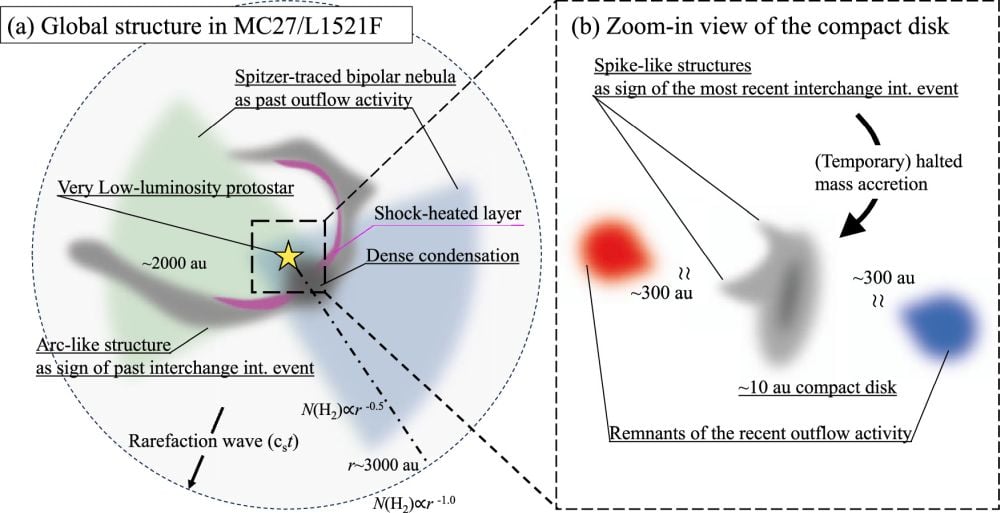 This figure from the 2024 paper shows the structure around the protostar MC 27, including the puzzling spike features (inset). Image Credit: Tokuda et al. 2024. ApJ
Star formation contains a bit of a paradox. As a protostar accretes matter and becomes more massive, it also acquires energy from the in-falling gas. It has to release some of this energy in order to keep growing. If it doesn't, its angular momentum can become so great that the protostar tears itself apart.
The sneezes seem related to the energy releasing process, but exactly how they fit in was unclear. Before they could figure out what caused them, they eliminated potential causes. The researchers said that these structures cannot be explained by gravitational instability or other fragmentation mechanisms.
Gravitational instability (GI) is one of the most important processes to play out in protostellar disks. GI is when an object's own gravity breaks its disk apart into clumps. But the protostar in question, named MC 27, is simply not massive enough to incur GI.
Instead, the sneezes may be caused by interchange instability. This is a mechanism whereby built up magnetic flux in the protostar's disk is periodically and rapidly transported outward through the disk. This happens during a protostar's main accretion phase, and it keeps the disk compact, allowing gas to continue in-falling onto the star. This lets the young star keep growing.
Now the researchers have pointed ALMA at the same star again, hoping to learn more. This time, they took a wider look at MC 27 and detected a large gaseous ring about 1,000 au in size.
“Our data showed that this ring is slightly warmer than its surroundings. We hypothesize that it is produced through a magnetic field threading the protostellar disk. In essence, the ‘sneezes’ we’ve observed in the past, but at a much bigger scale,” explained lead author Tokuda. “The warm ring we detected this time strengthens our hypothesis that baby stars undergo dynamic magnetic-gas redistribution shortly after birth, generating shock waves that warm the surrounding gas.”
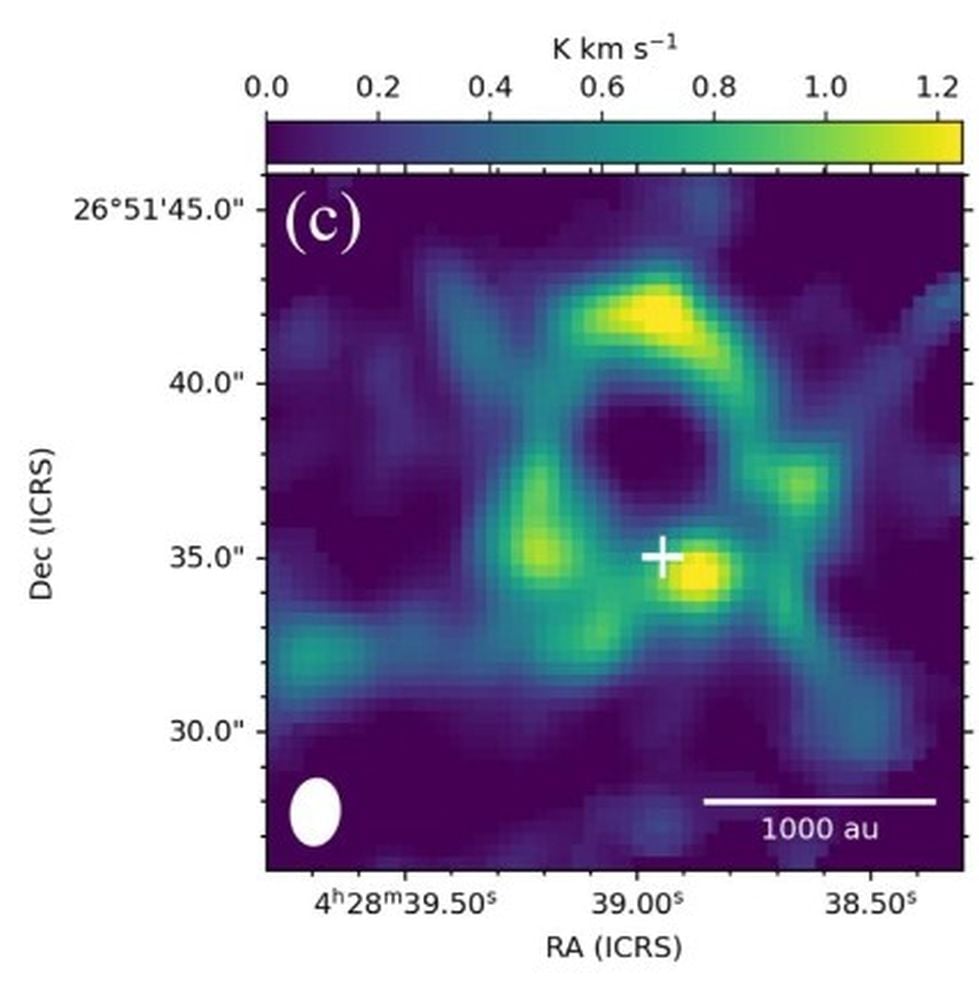 This is typical of scientific astronomical images. They're rich in data, but don't necessarily find their way into articles for non-astronomers. In this figure, the small white cross marks the protostar's location, and the large gaseous ring is easily seen. The image is called an integrated-intensity map of rotating carbon monoxide molecules that are releasing photons as they drop from one rotational energy level to another. In particular, this map traces warm, dense CO gas. Image Credit: Tokuda et al. 2026. ApJL
“We were very surprised by these results because we didn’t expect to find such a clear ring. I was so excited that I drafted this paper in two to three days,” said Tokuda.
These gaseous rings are garnering more interest from astronomers. "Candidates for ring- or bubble-like structures that may be produced by drastic magnetic-flux redistribution driven by interchange instability are increasingly being reported in both observations and theory," the authors write. "A natural question is how common such ring structures may be."
That's difficult to determine, according to the researchers. "At present, it is premature to discuss their universality," they explain. Despite ALMA's prowess, spatially-resolved imaging in deeply embedded protostars like MC 27 is still rare.
“We will keep collecting data to strengthen our hypothesis," said Machida. "In the meantime, we welcome rigorous debate on our results so we can advance our field. The gas motion involved in star formation is generally ordered, yet very chaotic and appears in different shapes and sizes. It took us a decade to reach these conclusions, and we look forward to doing more work to uncover the mysteries of the universe.”
For now, typical protostellar outflows can't explain the features detected around the protostar.
"Forming an off-centered ring on ∼1000 au scales is difficult to reconcile with standard outflow-driven scenarios alone. Instead, our results favor an interpretation in which magnetic-flux redistribution from the disk/envelope interface, potentially driven by interchange instability, generates expanding structures and associated shock heating," the authors conclude.

