
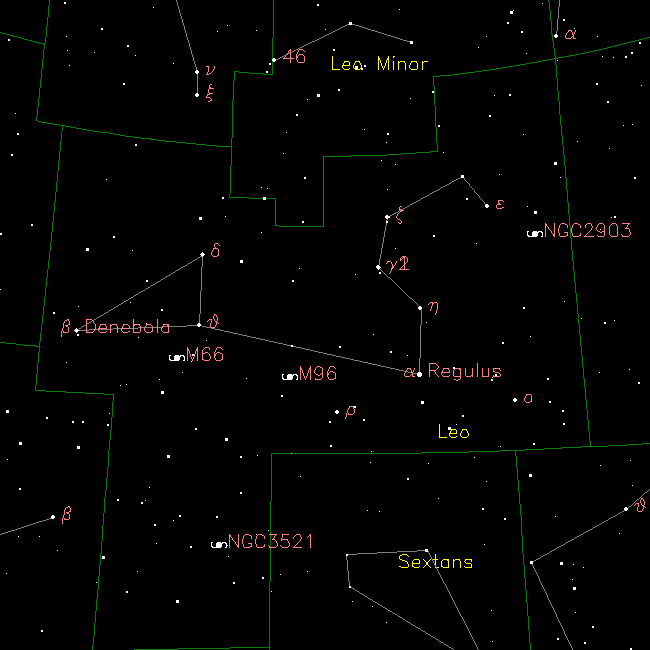
[/caption]
Positioned directly on the ecliptic plane, Leo is a constellation of the zodiac preceded by Cancer to the west and followed by Virgo to the east. It is an ancient constellation, originally charted by Ptolemy and recognized by the International Astronomical Union as one of the 88 modern constellations. Leo spans 947 square degrees of sky and is the twelfth largest of all. It contains 3 bright stars and around 15 stars in its asterism, with 92 Bayer/Flamsteed designated stars within its confines. It is bordered by the constellations of Ursa Major, Leo Minor, Lynx, Cancer, Hydra, Sextans, Crater, Virgo and Coma Berenices. Leo is visible to all observers located at latitudes between +90° and ?65° and is best seen at culmination during the month of April.
There are five annual meteor showers associated with constellation Leo. The first is the Delta Leonid meteor stream which begins becoming active between February 5 through March 19 every year. The activity peaks in late February with no exact date, and the maximum amount of activity averages around 5 meteor per hour. The next date is April 17 and the Sigma Leonid meteor shower. Look for this rare occurrence to happen near the Leo/Virgo border. It is a very weak shower and activity rates no higher than 1 to 2 meteors per hour. The next is the most dependable shower of all – the November Leonids. The peak date is November 17th, but activity occurs around 2 days on either side of the date. The radiant is near Regulus and this is the most spectacular of modern showers. The year 1966 saw 500,000 per hour a rate of up 140 per second! Just a few years ago, in 2005 the rates were equally impressive. Why? Comet Temple-Tuttle is the answer. Whenever it nears perihelion, it adds fresh material to the stream and gives us a spectacular show. On the average, you can expect around 20 per hour between 33 year shows, but they are the fastest known at 71 kps. The last is the Leo Minorids which peak on or about December 14. This meteor shower was discovered by amateurs in 1971 and hasn’t really been confirmed yet, but do look for around 10 faint meteors per hour.
In Greek mythology, Leo was identified as the Nemean Lion, which may have been the source of the “tail” of the lion that killed Hercules during one of his twelve labors. While many constellations are difficult to visualize, Leo’s backwards question-mark is relatively easily to picture as a majestic lion set in stars. One of the reasons for its placement in the zodiac is possibly due to the fact that lions left their place in the desert for the banks of the Nile when the Sun was positioned in these stars. It is also possible that the Nile’s rise at this time and the lion’s migration is also the reason for the Sphinx to appear as it does – a leonine figure. The Persians called it Ser or Shir; the Turks, Artan; the Syrians, Aryo; the Jewish, Arye; the Indians, “Sher”; and the Babylonians, Aru — all meaning a lion. Early Hindu astronomers recognized it by regal names, as did other cultures. All befitting of the “King of Beasts”!
Let’s begin our tour by taking a look at the brightest star – Alpha Leonis – the “a” symbol on our map. Its name is Regulus and it is one hot customer when it comes to spin rate. Revolving completely on its axis in a little less than 16 hours, oblate Regulus would fly apart if it were moving any faster. Ranking as the twenty-first brightest star in the night sky, Alpha Leonis is a helium type star about 5 times larger and 160 times brighter than our own Sun. Speeding away from us at 3.7 kilometers per second, Regulus isn’t alone, either. The “Little King” is a multiple star system composed of a hot, bright, bluish-white star with a pair of small, faint companions easily seen in small telescopes. The companion is itself a double at around magnitude 13 and is a dwarf of an uncertain type. There is also a 13th magnitude fourth star in this grouping, but it is believed that it is not associated with Regulus since the “Little King” is moving toward it and will be about 14″ away in 785 years. Not bad for a star that’s been reigning the skies for around for a few million years!
Let’s fade east now, and take a look at Beta Leonis – the “B” symbol on our map. Its name is Denebola which means the “Lion’s tail” in Arabic. Located about 36 light years from Earth, this white class A dwarf star is more luminous than the Sun, emitting 12 times the solar energy and a Delta-Scuti type variable star. While that in itself isn’t particularly rare, what makes Denebola unusual is that it belongs to the Vega-class stars – ones that have a shroud of infra-red emitting dust around them. This could mean a possibility of planet forming capabilities! In binoculars, look for an optical double star companion to Beta. It’s not gravitationally, or physically related, but it’s a pleasing pairing.
Now, return to Regulus and hop up for Eta Leonis, the “n” symbol on our map. Eta is very special because of its huge distance – about 2100 light years from our solar system – and that’s only a guess. It is a supergiant star, and one that is losing its stellar mass at a huge rate. Compared to Sol, Eta loses 100,000 times more mass each year! Because of its position near the ecliptic plane, Eta is also frequently occulted by the Moon. Thanks to alert observers, that’s how we learned that Eta is also a very close binary star, too – with a companion only about 40% dimmer than the primary. Some time over the next 17 million years, the pair of red supergiant stars will probably merge to become a pair of massive white dwarf stars… or they may just blow up. Only time will tell…
Hop north for Gamma Leonis – the “Y” symbol on our map. Its name is Algeiba and it is a very fine double visual star for binoculars and and true binary star small telescopes. Just take a look at this magnificent orange red and and yellow pair under magnification and you’ll return again and again. The brighter primary star is a giant K type and orbiting out about four times the distance of Pluto is its giant G type companion. Further north you’ll find another excellent visual double star for binoculars – Zeta Leonis. It’s name is Aldhafera and this stellar spectral class F star is about 260 light years away.
Are you ready to try your hand at locating a pair of galaxies with binoculars? Then let’s try the “Leo Trio” – M65, M66 and NGC 3623. Return towards Beta and look for the triangular area that marks the asterism of Leo’s “hips”. If the night is suitable for binocular galaxy hunting, you will clearly see fifth magnitude Iota Leonis south of Theta. Aim your binoculars between them. Depending on the field of view size of your binoculars, a trio of galaxies will be visible in about one third to one fourth of the area you see. Don’t expect them to walk right out, but don’t sell your binoculars short, either. The M65 and M66 pair have higher surface brightness and sufficient size to be noticed as two opposing faint smudges. NGC 3623 is spot on the same magnitude, but is edge on in presentation instead of face-on. This makes it a lot harder to spot, but chances are very good your averted vision will pick it up while studying the M65/66 pair. The “Leo Trio” makes for a fine challenge!
Now let’s begin working with larger binoculars and small telescopes as we head for M96 galaxy group (RA 10h 46m 45.7s Dec +11 49′ 12″). Messier 96 is the brightest spiral galaxy within the M96 Group which includes Messier 95 and Messier 105 as well as at least nine other galaxies. Located about 38 million light years away, this group of galaxies with the Hubble Space Telescope and 8 Delta Cephei variable stars were found to help determine each individual galaxy’s distance. While you can’t expect to see each member in small optics, larger telescopes can hope to find elliptical galaxies NGC 3489 (11:00.3 +13:54), NGC 3412 (10:50.9 +13:25), NGC 3384 (10:48.3 +12:38) and NGC 3377 (10:47.7 +13:59), as well as barred spiral galaxy NGC 3299 (10:36.4 +12:42),
For an awesome spiral galaxy in a small telescope, don’t overlook NGC 2903 (RA 9:32.2 Dec +21:30). At a bright magnitude 9, you can often see this particular galaxy in binoculars from a dark sky site as well. Discovered by William Herschel in 1784, this beauty is often considered a missing Messier because it just so bright and conspicuous. As a matter of fact, the comet of 1760 passed it on a night Messier was watching and he didn’t even see it! For larger telescopes, look for NGC 2905 – a bright knot which is actually a star forming region in the galaxy itself with its own Herschel designation.
Before we leave, you must stop by NGC 3521 (RA 11:05.8 Dec -00:02). This 35 million light year distant spiral galaxy is often overlooked for no apparent reason – but it shouldn’t be. At a very respectable magnitude 9, you can often find this elongated gem with the bright nucleus in larger binoculars from a dark sky site and you can easily study spiral galaxy structure with a larger telescope. Look for an inclined view with patchiness in the structure that indicates great star forming regions at work. Its stellar counter rotation is being studied because it has a bar structure that we are seeing “end on”!
This doesn’t even begin to scratch the surface of what you can find on Leo’s hide. Be sure to get yourself a good star chart or sky atlas and go lion taming!