
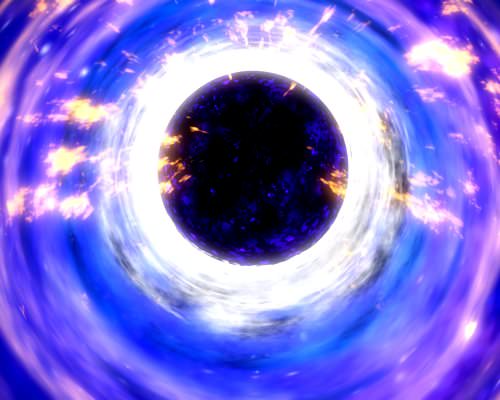
[/caption]
What would happen if humans could deliberately create a blackhole? Well, for starters we might just unlock the ultimate energy source to create the ultimate spacecraft engine — a potential “black hole-drive” — to propel ships to the stars.
It turns out black holes are not black at all; they give off “Hawking radiation” that causes them to lose energy (and therefore mass) over time. For large black holes, the amount of radiation produced is miniscule, but very small black holes rapidly turn their mass into a huge amount of energy.
This fact prompted Lois Crane and Shawn Westmoreland of Kansas State University to calculate what it would take to create a small black hole and harness the energy to propel a starship. They found that there is a “sweet spot” for black holes that are small enough to be artificially created and to produce enormous amounts of energy, but are large enough that they don’t immediately evaporate in a burst of particles. Their ideal black hole would have a mass of about a million metric tons and would be about one one-thousandth the size of a proton.
To create such a black hole, Crane and Westmoreland envision a massive spherical gamma-ray laser in space, powered by thousands of square kilometers of solar panels. After charging for a few years, this laser would release the pent-up energy equivalent to a million metric tons of mass in a converging spherical shell of photons. As the shell collapses in on itself, the energy becomes so dense that its own gravity focuses it down to a single point and a black hole is born.
The black hole would immediately begin to disgorge all the energy that was compressed to form it. To harness that energy and propel a starship, the black hole would be placed at the center of a parabolic electron-gas mirror that would reflect all the energy radiated from the black hole out the back of the ship, propelling the ship forward. Particle beams attached to the ship behind the black hole would be used to simultaneously feed the black hole and propel it along with the ship.
Such a black hole drive could easily accelerate to near the speed of light, opening up the cosmos to human travelers, but that’s just the beginning. The micro-black hole could also be used as a power generator capable of transforming any matter directly into energy. This energy could be used to create new black holes and new power generators. Obviously, creating and harnessing black holes is not an easy undertaking, but Crane and Westmoreland point out that the black hole drive has a significant advantage over more speculative technologies like warp drives and wormholes: it is physically possible. And, they believe, worth pursuing “because it allows a completely different and vastly wider destiny for the human race. We should not underestimate the ingenuity of the engineers of the future.”
This reminds me of the movie “Quest for Fire” and the parallels between humans creating and harnessing fire in the past, to similar challenges for humans creating and harnessing black holes in the future. The last paragraph of this article touched on the possibility of micro-black holes creating new black holes, similar to how early humans kept a “pilot light” going once they first captured fire. On an evolutionary scale, chemical rockets are only a slight variant of man’s early burning log. So we’ve got a long way to go.
Hmm I wonder, this ship should also accelerate that million metric tons black hole. It might be tiny but it still weighs that much do can enough energy be created to accelerate the ship and the black hole?
Sligt problem as I see it.
Now you don’t just have to accelerate your payload effectively. You’re also carrying “about a million metric tons” of dead weight.
Olaf: Yes, the black hole produces enough energy to accelerate both the ship and itself to relativistic speeds. Check out the ArXiv paper for more info (linked at the bottom of the post).
D’oh. Shoulda updated. Now I look like a rip-off.
I actually read Crane’s paper on this. There is a bit of a rub with the idea. You can’t focus light rays onto a point with a temperature higher than the source. This is Fermat’s theorem, and it has to do with the conservation of phase space volume for systems in classical mechanics. From a wave mechanics perspective, it means you can’t concentrate an energy flux larger than c*hbar/wavelength. Here c = speed of light, hbar = Planck unit of action.
Now their scheme involves taking light energy from enormous solar panels and concentrating it into gamma rays. That is possible, but you still run into the same limitation. Those gamma photons would have to have an energy in the TeV range, or equivalently the pulse need a temperature of about 10^20K. Anything less will concentrate photons with too large a wavelength to do the trick. This means the shell which produces gamma rays would have to be a nearly continuous distribution of LHC energy scale lasers! In fact at a million metric tons, which would be the mass-energy of this grand pulse of gamma rays, this would require over a million billion billion times the beam flux (or imploding wave flux) of gamma rays than what the LHC delivers. This would be one hell of a machine!
Besides the solar arrays being large, consider the size of the energy storage system. it would have to hold a million metric tons in mass equivalent of energy. Clearly the storage system would be many orders of magnitude larger in mass. Then to pulse it right that energy would have to charge up a Marx bank or something. That would have to be utterly huge to prevent the collosal charge stored up from tearing it apart. Imagine the enormous size of this system! This thing would be the size of Ceres, or something comparable.
Oh well, I suppose it is not completely out of line with ideas of space elevators. Congress is not going to authorize funding for either any time in the near future.
LC
LBC, good points.
This sounds like classical mega-scale engineering.
I assume making a BH a lot smaller (a few kg, say) and then somehow trying to feed it directly with matter would probably not work. It would irradiate much faster than you would be able to send stuff over the miniscule event horizon.
[I]This reminds me of the movie “Quest for Fire”[/I]
Well, the ship Event Horizon (1997) had black hole drive 🙂
LBC: Do you mean Fermi? I don’t think the complaint about filling the phase space applies in this case because photons are bosons; there’s not a problem with them occupying the same quantum state. Also, this is definitely not a “classical” system since black holes are involved.
The rest of your comments are right on though; this would require engineering on a huge scale!
Don: Yes, a small black hole would evaporate too fast. There is also the concern with even the
“sweet spot” black holes that they might be too small to feed! An attometer is a pretty small target for the “feeding beam”. In that case you could still use them for the starship drive, but you would have to just discard them at the end (and get away before they explode!).
The instant I read the title, I thought of the movie Event Horizon. That thought alone almost makes me NOT want a black hole powered ship engine. Almost.
*remembers the violent and bloody Video Log scene*
….Yeah, good luck.
The Romulan birds of prey had something called “artificial quantum singularity.”
Ryan Anderson: No this does not involve Fermi-Dirac statistics, which indicates by the anti-symmetry of the fractional spin state one can put on particle in one state. This is about packing photons not in Hilbert state space, but in configuration space (ordinary space).
BTW, with the Bose Einstein case of generating a black hole, that is a huge scale up of a problem I have been picking at for a while with fusion. The idea is much the same, but to get tritium nuclei to transition into He by these means. A much more modest idea, but damnedably tough to figure out.
LC
The old addage states that you can’t get something for nothing. I think the article oversimplifies the undertaking to produce such a thing by many orders of magnitude. You would need an enormous amount of mass and energy to create this thing and it would need to be precisely coordinated. All the black hole would amount to is simply the concentration of all of this matter into a confined and therfore portable and useable state. The good news is that this is doable. The bad news is that all that exists of the U.S. would be archaeological relics by the time the human race the technology and industrial capablility to scale this up to produce a space shipyard with this propulsion capability.
On the ligher side it looks like the Romulan propulsion design is going to win out over the Federation Warp drive in the future. Just when we thought the Romulans were a bunch of hapless, feckless thugs.
Lawrence – I must of course respond to the Space Elevator comment…
A goos sized SE weighs several thousands tons, and is powered by maybe a Megawatt-class laser beam – hardly a “mega project”.
Feasible or not – this remains to be seen, but if it is, the launched weight will be less than the ISS.
Ben
Hi Ryan
One issue with the drive is whether black holes decay to zero mass or “choke” themselves due to quantum back-reaction, thus only converting about 10% of their mass to energy. Tony Rothman has analysed this possibility recently and there’s nothing astrophysically to preclude the possibility. We’ll need a lot more study of black holes generated by successors of the LHC to tell if this occurs.
Even so 10% conversion efficiency is nothing to sneeze at and we avoid the “Hawking Explosion” during the last second of a decaying hole.
As far as I know, the warp drive is physically possible. The only problem is (but that is a problem for engineers 😉 ) that you need to pack 30 solar masses into the Enterprise. I guess this needs to be a black hole 😉
@CrazyEddieBlogger. A space elevator weighing in at a few thousand tons? Given geosychronous orbit is 37,000 km out that would mean an average of about 100kg per kilometer. That is about the mass of two cargo sacks of potatoes. BTW, a few days ago I volunteered at a food bank (very busy these days!) and hauled a whole bunch of them around
@ Dr Flimmer: The Alcubierre warp drive is a solution to the Einstein field equation. There are a fewf problems though. The solution violates the weak energy condition that the momentum energy component T^{00} >= 0. This means the quantum field which is the source of the solution is not bounded below with a discrete energy spectrum. This is a disaster for physics. Another problem is that any such configuration of spacetime would permit one to enter a black hole, acquire information about its interior and then return to the outside. This would violate the second law of thermodynamics for black holes. Finally, such configurations can be converted to solutions with closed timelike curves, or in other words time machines. There you have causality issues and properly define Cauchy spatial surfaces of data.
@Graff: There are issues along these lines. The questions are open because metric back reactions are a classical response to a quantum process. Hawking radiation is derived in a semi-classical setting, where the black hole is classical. In what I am working on gravity is not really quantized as such, so as the BH becomes smaller there its radiative processing departs from what might be expected. It is possible that it actually slows down as it reaches the 10^6 Planck units of mass and leaves behinds a remnant which is a topological “knot” in spacetime.
LC
What a fascinating idea!
Even if it is one of Fermi’s theorems, it doesn’t say much as a reference.
More to the point here, BH’s are outside of classical mechanics, so AFAIU all bets are off. What will happen at the transit between classical to BH regime?
Sorry to pick on the comments, but I don’t get the idea here. Black holes will eventually give back their information to the universe, so why would a worm hole or similar information channel be a problem for them? Wouldn’t they just diminish in surface area (volume) faster?
This doesn’t save Alcubierre’s drive though. Famously, it depends on the solution (and it’s confined transit volume) being already transiting at supra-light speed at it’s creation. As we can’t get from here to there without the drive, we can’t get from here to there to make the drive! (o.O)
Causality can be a bitch.
Worse; as Scott Aaronson points out time machines would also implode the algorithmic tower of complexity. (Physics with time travel becomes unboundedly algorithmically powerful, or conversely everything is equally easy.) As this isn’t so, they can’t exist.
Which of course means that FTL drives and communication can’t exist either. No loop holes.
I sure hope Crane and Westmoreland didn’t use taxpayer funds for this trip down fantasy lane…
How would you contain the black hole?
Also, traveling near the speed of light, what happens if you hit a dust particle? (Answer = Boom!)
Also, wouldn’t radiation thats coming from space in front of you be blue shifted to higher energies?
Do we have enough resources in this solar system to actually do this? Or would this be a single event and then we need another solar system to find new resources?
We might also try to find black hole deposits so we do not have to create them just harvest them.
I am not an expert in black holes, but I saw this formula that you would need a 228 metric tons of black hole so it can exist for 1 second. But if we let it run in a circle near the speed of light would it stay longer like 1 hour a black hole?
The Fermat theorem here is a different Fermat theorem, not the “Fermat Last theorem” which Wiles proved last decade. What I am talking about is Fermat’s principle of least time. This idea is that the time it takes a light ray to travel through a media is minimized to give the correct path
& int dt = 0
& = delta, and dt = dx/c, c = speed of light. Well the speed of light in a medium changes by an index of refraction c–>c/n, where n can vary with position n = n(x). The problem is equivalent to the extremization in classical mechanics and leads to the Euler-Lagrange equation.
As for information, yes a black hole does return all its information. In fact we can say that information is generally conserved. Yet it does not remain available, or correlated. Information can be encrypted in various ways, or it can be dispersed. That is the measure of entropy. The Susskind-Preskill win over Hawking is over this matter. Hawking insisted that information was destroyed, while it has been found that it is simply encrypted by some grand algorithm of the unvierse into forms that are much harder to cypher.
The wormhole connecting up the outside world with the interior of a black hole would reduce the area of the black hole. Entropy is by the Bekenstein-Hawking result related to the event horizon area of a black hole A = 4piM^2 with mass M by
S = kA/(4L_p^2),
where L_p = sqrt{G hbar/c^3} or the Planck length, k = Boltzman constant. So we can think of the entropy of a black hole as the number of units of Planck area on the event horizon. The reduction in the area of the event horizon means that entropy is reduced, but if presented to the outside world without encryption then the second law of thermodynamics is violated. For instance one might imagine rescuing an astronaut who fell throught the BH.
Now this presents some other funny things, for you might rescue the astronaut, bring him back and you might be able to have him see himself time dilated and redshifted above the black hole horizon. This then leads to another “no-go” theorem in physics that you can’t clone quantum states. Yet a traversible wormhole would permit you to do that.
Worm holes would allow one to solve an NP problem in P time. In fact it might well mean you could solve all P-space problems with equal efficiency. A factorization problem can be solved in a time loop so the closed timelike loop exists with the problem solved. It is like the old science fiction idea of getting instructions on how to build a time machine, building it and then sending the instructions back in time to yourself.
These things simply don’t happen, at least if the universe is at least not logically self contradictory.
LC
The problem with using black holes is the same with other conventional methods of propulsion… weight. Even a relatively small black hole weighs a lot. In this case… more than anything else proportionally.
Then there is the little problem being, the faster you go, the more mass you have… which means you need more propulsion.
Why can light move as fast as it does? …because it doesn’t have mass.
In theory, you would be better off using some sort of fission device, and make the most of E=MC^2 to move around in space. The heck with black holes, lets use the strong nuclear force.
Even better… find a way to compress the space you want to move into; then you wouldn’t need to travel quite as fast, since you are basically making space come to you.
Shielding a ship from harmful radiation is simple… you simply do the same thing Earth does. Something we’ve been able to do for over a hundred years. Create a magnetic field.
Shielding a ship from particles using energy or a form of plasma is probably within our reach now, and I would bet we see something feasible within the next 10-20 years.
It would need to be a very powerful magnetic field of you are traveling at such speeds, as even optical light would be blueshifted to dangerous frequencies, right?.
Such a strong magnetic field would also interfere with sensory equipment and communications, assuming there would be anyone to talk to out there. I suppose during the high speed travel, all cell phones would need to be turned off!
I kind of think that navigation at near light speeds would be very difficult. I suppose you could have predetermined “jump points” and hope there are no objects in the way.
Lastly, wouldn’t it need to be a gradual acceleration to keep the crew from being splattered all over the back of the bridge?
@Lawrence (staying off-topic – I know a lot less about black holes than I do about SEs)
You are correct with the linear mass density figure, but start with a Carbon Nanotube material that has a specific strength of 40 GPa-cc/g, and see how much cable is required to carry a 20 ton climber… you’ll be surprised, as I was a few years ago. I used to have in mind the multi-megaton Arthur C Clarke vision, but it’s a mazing what a little bit of math can cure. 🙂
I can’t comment too much on space elevator ideas. I will be honest I have regarded the idea as utterly daft. I am aware that there are ideas about carbon nanotube composite materials and the like, but I had not thought that this would involve as little as a few 100 kg per km of the “cable.” EVen if the thing can be made to only a few thousand tons I have a heard time seeing how all that mass is going to be lofted up.
LC
How large would the parabolic electron-gas mirror need to be such that the radiation from the black hole doesn’t destroy it?
And how large would the particle beams need to be to “anchor” the ship to the black hole?
As I indicated two days ago there are maybe more subtle ways of working with this physics. Thieapproach presented here is pretty much a sledgehammer approach. Yet if you were to do this and had this mini-black hole you would need to control it by putting a charge on it. The Kerr-Neumann metric for a charged black hole would permit one in principle to hold the BH with large electric fields. You would need to keep pumping charged particles into the BH as it will tend to radiate away quanta to equilibrate its charge to zero. If you run some numbers you will find that the field energy density required to hold the BH is enormous.
This goes into a general problem of how to put a black hole in a “box.” It turns out there is no perfect box, except one which general relativity provides — the anti-de Sitter (AdS)spacetime. This is a whole universe of sorts. This is a theoretical setup, where the AdS is a field theoretic map of sorts from our entire universe. So we are not going to be doing that obviously in some engineering sense.
LC
My gawd, Mr. Crowell can you actually do the math on these ideas? I am in awe of such skills. Me brain seizes at the very word, Calculus. I must take it all on faith.
My first thought when I read the title was “What Clarke novel had those black hole powered space ship, only they were for interplanetary use.” Or was it a Varley novel? I am have a foggy mental over this, once again.
And then I thought of Anderson’s “Tau Zero”. Okay, less us say Mr. Crowell’s math is off or someone is motivated to actually build this puppy. You pointed it, i dunno, that third star on the left and go until morning. And you get to .9999999 C or whatever.
Can you turn it off and restart it at will? You are going to have to a 180 and restart it to decelerate. Is that possible?
Maybe you will two of these boosters (like two SRB pointer together). Fire one to get to speed and throw it away when you get there and then fire number two to slow it down.
What, you wanna come home? Then you will need four. Do these things even have a “shelf life”?
Tricky
After reviewing the comments, I can see that a solid majority of commenters realize this is fanciful (fun to talk about, but not practicable)..
That’s a good thing.
Because when you are talking about propulsion systems, you are talking about real engineering and physics that have been confirmed in a laboratory, no if’s, and’s, or but’s.
That’s where the “rubber meets the road”.
And as much as the “black hole” crew believes in the reality of “black holes”, there is NO laboratory confirmation that any of the supposed scientific principles that support “black holes” actually exist.
The collider might bring some, who knows, or bosons from the future might sabotage it again 🙂
What this little exercise should do is concentrate the mind on the lack of ANY laboratory evidence that “black holes” exist.
And readers should note the number of comments on the respective posts, one a “black hole” fantasy, the other, plasma propulsion reality.
Apparently fantasy is more interesting and enjoyable than reality for this crew.
(Universe today deserves credit for the juxtaposition of the two posts.)
@Vanamonde, I seem to remember reading a short story by Varley about a spacecraft tracking a miniblack hole, but where the black hole starts talking to the woman running the ship, and deludes her into destruction. It had that PK Dick sense of not distinguishing between reality and delusion.
Making and controlling a micro black hole would be a daunting problem. To see that it is hard to build a box, all one needs to appeal to is Gauss’ law. A shell of material that is the source of a static field, whether gravity or electric, has a constant potential inside. Force is the gradient of a potential, so enclosing a charge or a gravitating point-like object with a shell does not induce a force on it. So you can’t confine it and guarantee it will not drift and eventually bump into the shell. So dynamic control is required which would be tough.
LC
@LC – keeping the off-topic theme, the since the SE is a linearly-scalable transportation system, the plan is to build a 10% scale unit, which will lift only 2 tons at a time, and there are several methods proposed for using it to bootstrap, carrying more tether material.
A key parameter in a Space Elevator design is the Characteristic Time Constant, which is a measure of how long the system can transport its own weight into orbit.
Read more at http://www.spaceward.org/elevator-feasibility
Ben
Anaconda – There’s a simpler explanation than that…
One article is about a highly hypothetical device relying on extreme physic and that has at its core an astronomical phenomena.
The other article is about a comparatively “straight forward” engineering implementation.
This is a web site for Astronomers and Astro-physicists… Which do you think will be of more interest ?!
That said, you need to be careful, since you’re moving from the purely delusional phase to the paranoid.delusional phase. That’s not good for your credibility… If everyone thinks you’re out to lunch, you should carefully consider the possibility that indeed maybe breakfast’s over and dinner is not yet served.
just my 2c, of course. 🙂
CrazyEddieBlogger
Anaconda has been black banned as a troll in this group.
Just ignore the jackass, please.
Thanks
@ CrazyEddieBlogger:
Sure, I got you: Fantasy is more fun than reality.
But that ain’t Science.
Of course, Crumb jokes about “burning” heretics at the stake.
Oops, I meant “deflagation”, how careless of me:
As in, “Pity deflagration doesn’t work with some people, here. It’s probably illegal to do so”.
What do you say when somebody reveals their religious fervor?
“Science has nothing to do with it.”
@CrazyEddieBlogger: I’ll think about his. The space elevator idea has always struck me as way over the top.
This article is not a judgment about the physics of black holes, but rather about engineering concepts for black hole power.
Don’t feed trolls. Anaconda is a pseudo-science exponent. Plasma cosmology has been rejected by the scientific community.
LC
Yeah, I slipped.. it’s not like I had a rational thought going that he will process it logically. He must not be leading a very happy life.
The irony is in the feeling of scientific prosecution that he feels… At an age where the scientific community has for more than a century created an environment where challenging existing notions is protected and encouraged..
All of modern physics is a result of people completely revising or upending the prevalent understanding of the world..
What some folks don’t get, however, is that not every view that revises or upends the current understanding is necessary valid – it might just be a completely unfounded pet theory advocated by a NUT.
NUT NUT NUT NUT NUT!!.
There, did it again.
@CrazyEddieBlogger
I concur 100% with Hon. Salacious B. Crumb and Lawrence B. Crowell.
Don’t feed this troll Anaconda (which should be the prerequisite by other users here.)
I mean. What fool would label himself a “heretic”? To me he is more like a sick-in-the-head zealot? To me it sounds like this individual just wants to be a martyr and victim towards his personal cause.
It is clearly not about science, religion, or anything else, it is all about him and his self-centered egocentrism
Science?
“Anaconda has nothing to do with it.”
Yes he is a NUT, but I’d add, he is really still in his narrow-little shell. Pity.
Sorry… I’m a little confused about something.
As the shell collapses in on itself, the energy becomes so dense that its own gravity focuses it down to a single point and a black hole is born.
…but photons are massless and therefore have no gravitational influence. :