 Universe Today
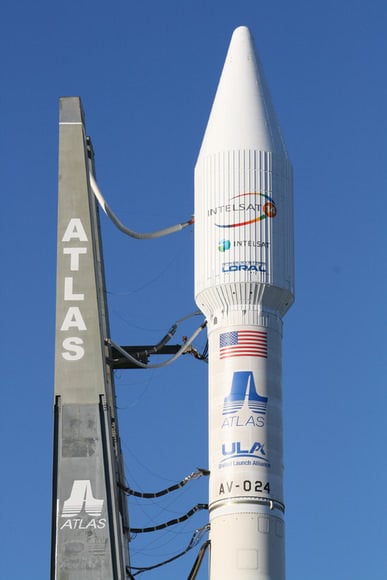
(Editor's Note: Ken Kremer is in Florida for Universe Today covering the current launch attempts of the space shuttle and Atlas)
Image caption: The Atlas 5 will orbit the commercial Intelsat 14 communications satellite. This photo shows upper portion of rocket and umbilical cord connections leading from mobile launch platform to the decaled 4 meter wide white colored payload fairing and Centaur upper stage. The flight is designated as tail number AV-024. Credit: Ken Kremer
Shortly after midnight on Saturday November 14 the launch of an Atlas 5 rocket poised at Complex 41 and bathed in xenon lights was suddenly halted when engineers discovered a power dropout with the ORCA, or Ordnance Remote Control Assembly.
[caption id="attachment_45058" align="alignnone" width="580" caption="Atlas 5 rocket sits atop mobile launch platform at launch pad at Complex 41, Cape Canaveral, Florida on a cloudless day just a few hours prior to the scheduled post midnight launch on 14 November 2009. Note lightings masts at left and Vertical Integration Facility at right where rocket components are assembled. Credit: Ken Kremer"]

[/caption] The Atlas was due to blast off at 12: 48 AM EST into the cloudless and calm sky above Cape Canaveral, Florida carrying the commercial Intelsat 14 communications satellite into orbit. I was observing from the Kennedy Space Center press site along with other media representatives as weather conditions were near perfect and gremlins intervened. My vantage point at KSC provides a clear and direct view to the base of the Atlas rocket and launch pad.
The scrub was called less than half an hour before the scheduled liftoff time and after propellant loading of the first and second stages had been successfully completed. Engineers will need to troubleshoot the cause of the temporary power interruption to the ORCA electronics component which is used to control the critical flight events on the Atlas booster.
Technicians must obtain access to the electronics box within the rocket and remove it for further investigation of the technical glitch. Since there is no access at the pad to gain entry and accomplish this task, the Atlas vehicle must be rolled back off the pad about 1800 feet and into the 30 story tall Vertical Integration Facility. Therefore the launch team executed the standard detanking of propellants to safe the rocket following the scrub. [caption id="attachment_45056" align="alignnone" width="580" caption="Atlas 5 rocket at sunset surrounded by 4 lightening masts at pad 41. Multiple tanks of compressed gaseous nitrogen at 4800 psi in foreground. A technical glitch with the ORCA electronics unit critical for flight control forced a scrub for what would have been the 19th flight of an Atlas 5. Credit: Ken Kremer"]

[/caption]
Atlas 5 rocket at sunset surrounded by 4 lightening masts at pad 41. Multiple tanks of compressed gaseous nitrogen at 4800 psi in foreground. A technical glitch with the ORCA electronics unit critical for flight control forced a scrub for what would have been the 19th flight of an Atlas 5. Credit: Ken Kremer
The launch is being conducted for Lockheed Martin Commercial Launch Services by United Launch Alliance (ULA). A new launch date has not been set at this time, a ULA spokesman told me. As a result of the postponement and rollback, the STS 129 flight will proceed without delay as the countdown clock is ticking towards blast off on November 16 according to NASA officials.
Just hours before the planned Atlas liftoff, I visited pad 41 on a special media tour for close-up photography and remote camera set up. The twilight sun was setting to the west behind the mighty bronze colored rocket topped by a white colored nose cone which protects the valuable satellite payload from aerodynamic forces as it pierces through the atmosphere. [caption id="attachment_45057" align="alignnone" width="387" caption="Ken Kremer with the Atlas launch vehicle at Pad 41 which will fly in the 431 configuration with 3 solid rocket boosters attached to the first stage and a single engine white colored Centaur upper stage. The Atlas 5 was rolled out to launch pad on Nov 12. Note tracks at center. The Intelsat satellite is encapsulated in a 4 meter wide extra extended payload fairing. A similar Centaur stage impacted the moon as part of the LCROSS mission."]

[/caption]
Ken Kremer with the Atlas launch vehicle at Pad 41 which will fly in the 431 configuration with 3 solid rocket boosters attached to the first stage and a single engine white colored Centaur upper stage. The Atlas 5 was rolled out to launch pad on Nov 12. Note tracks at center. The Intelsat satellite is encapsulated in a 4 meter wide extra extended payload fairing. A similar Centaur stage impacted the moon as part of the LCROSS mission. See my LCROSS photos here.