Bringing WIMP Theory into Question: Is There Another Dark Matter Explanation?

by Ian O'Neill on December 13, 2008

Want to stay on top of all the space news? Follow @universetoday on Twitter

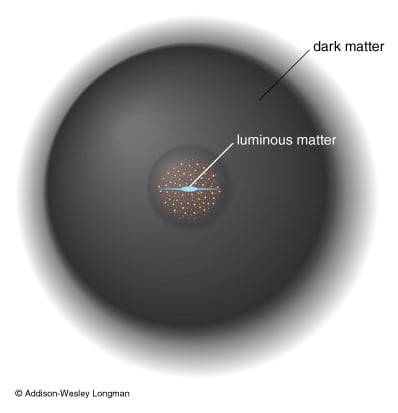
The mysterous dark matter is used to explain the characteristics of galaxies, but are WIMPs overrated? (Addison-Wesley Longman)

The mysterous dark matter is used to explain the characteristics of galaxies, but are WIMPs overrated? (Addison-Wesley Longman)

Weakly Interacting Massive Particles (WIMPs) are thought to dominate dark matter and huge efforts are under way to detect them. By their definition, WIMPs are massive theoretical particles, and they are very weakly interacting with normal matter. WIMPs are therefore notoriously difficult to detect, if they exist that is.

However, some physicists aren’t so confident that WIMPs are key to the hunt for dark matter. In a new study, two US researchers have re-opened the debate about dark matter, suggesting the bulk of it could be composed of heavier, strongly interacting particles, or possibly smaller, even more weakly interacting particles than WIMP theory. The physicists also go as far as suggesting that the Universe would be an even more interesting place where WIMP-less dark matter dominates…

We know little about dark matter, since we can’t measure it directly,” said Jonathan Feng, a physicist at the University of California, Irvine. “But there are theories and models. WIMPs are attractive because they happen to appear in many popular theories of new particles and interactions. But what if there are other well-motivated possibilities for dark matter besides WIMPs?

Feng, with co-author Jason Kumar, published a paper in Physical Review Letters called “Dark-Matter Particles without Weak-Scale Masses or Weak Interactions,” and the results have called into question the validity of focusing on WIMPs as the main component of the dark matter thought to make up the majority of mass in our Universe. The problem with dark matter, as stated by Feng, is that we cannot measure (observe) it directly and we therefore have little clue what it is. We know it’s there, the motion of galaxies and galactic clusters indicate a gravitational influence of something other than what we can see (i.e. luminous matter), but dark matter does not interact via the electromagnetic force, making it a particularly difficult entity to study.

There are strong theoretical reasons to believe WIMPs are at the centre of dark matter studies, but Feng and Kumar have composed models that suggest other weakly, and strongly, interacting particles can explain some of the phenomena we are observing.

WIMPs are a very specific example of dark matter, but there is a broader class of particles,” Feng added. “We found that some of the models also predicted the right amount of dark matter for the universe, but with dark matter that was much more strongly or weakly interacting than WIMPs. We are wondering if almost-exclusive attention for WIMPs is really warranted.”

Indeed, a lot of attention is focused on WIMP theory, what if dark matter researchers are being blinkered by one theory at the detriment of a more subtle explanation? One of the key points raised is that there is strong evidence supporting dark matter candidates with a mass of around 1 GeV. This finding comes from the DAMA (Dark Matter) project at the Gran Sasso National Laboratories, Italy, that investigates the signal from possible dark matter interactions in the galactic halo. WIMPS are far bigger, with a mass of 100 GeV. Could this signal be from a far lighter weakly interacting dark matter candidate?

There are also suggestions from other research that strongly interacting particles are annihilating all the time, generating high energy photons that can be observed pervading the entire Universe. Although this is theory, Feng is optimistic about energetic photon experiments.

However, re-analysing the WIMP dominance over dark matter creates some interesting scenarios for the Universe. By considering WIMP-less dark matter, some rather exotic explanations begin to form.

There are theories that there is a shadow world behind ours. It is a mirror world that is like ours, but doesn’t interact with ours,” Feng said. “With WIMP dark matter, that possibility is remote.”

WIMP-less dark matter requires new forces that we don’t really know much about. If you could have evidence of this type of dark matter, it might be a hint that this shadow world exists.”

A shadow world may sound a little eccentric, but it is also built of viable theories just as the generally accepted WIMP theory is. This new study is certainly a reminder that dark matter is an unknown quantity, and researchers should be open to other particles and not just WIMPS

Publication: Physical Review Letters
Source: Physorg.com

About

[Follow me on Twitter (@astroengine)]

[Check out my space blog: Astroengine.com]

[Check out my radio show: Astroengine Live!]

Hello! My name is Ian O'Neill and I've been writing for the Universe Today since December 2007. I am a solar physics doctor, but my space interests are wide-ranging. Since becoming a science writer I have been drawn to the more extreme astrophysics concepts (like black hole dynamics), high energy physics (getting excited about the LHC!) and general space colonization efforts. I am also heavily involved with the Mars Homestead project (run by the Mars Foundation), an international organization to advance our settlement concepts on Mars. I also run my own space physics blog: Astroengine.com, be sure to check it out!

  • tacitus

    It would be funky if the spiritual world existed in Dark Matter

    Hmm. Sounds like an idea for my next book (if I ever finish my first one, that is!).

    Mind if I steal it?

    (just kidding).

  • http://apnea.cz trux

    Something does not add up with WIMP’s and other Dark Matter theories. Well, I understand we cannot really directly observe or sense it, because it is not interacting enough with the electromagnetic field, but it still interacts with normal matter through gravitation. That’s why we “know” it is there. Now if the Universe is really made mostly of DM, I’d expect that there would be plenty of it everywhere around us too. And that there would be much more of it around any massive object, because it would trap the DM gravitationally. Or oppositely that the DM objects would bind visible massive objects and that they would then orbit around them. However, AFAIK, we did not observe anything like that. And despite the fact that the DM is not observable, a close amassing of DM or a flyby of a huge DM object (or a cloud) around visible objects would be well measurable even with today’s technology. If the DM makes for 60% (or 90%, or whatever) of the Universe mass, then I would expect a rather frequent flyby’s of DM objects around or through the Earth and other planets in our Solar system, or in other solar systems in the Galaxy. Why doesn’t the Earth have a dozen of DM moons? Or DM rings? And do not tell me it would not be detectable! It would.

    Well, the only explanation is that the DM is internally bound with much stronger forces than the gravitation, and actually does not create any gravitationally bound objects, and does not amass in the way visible matter does, and rather creates a mesh (like a sponge) through which the visible objects move freely. If it is so, then the theory about the DM being formed by strongly interacting particles does not make sense to me.

    Anyway I admit I am ignorant as for DM goes, and know about it as little as the experts studying it :)

  • Geko

    To the people responding to the likes of ‘Bill’ and ‘OilsMastery’…..can you please stop feeding the trolls?

    Just listen to the sheer stupidity of these people, but being the optimist i am, i think the best explanation is that these are trolls…they are more than 14 kinds of wrong, and they know it….troll’ism at its best.

  • tacitus

    trux, whatever dark matter is, it’s too diffuse on a local scale to affect normal matter enough for us to measure it’s gravitational effect. If the Earth happened to travel through a large volume of diffuse gas, we would barely notice it, and it would not automatically collect together into rings or moons, so there is no reason why dark matter should, especially since it is even less dense and interactive.

    I think the best you can hope for is that there is a very slightly greater concentration of dark matter in and around more massive normal objects like stars, but even then it would be like finding a very, very slightly more dense area of gas, not a ring or a moon of DM.

  • Matt

    “To the people responding to the likes of ‘Bill’ and ‘OilsMastery’…..can you please stop feeding the trolls? ”

    I’m not responding for the trolls sake, but there may be readers here who are interested in why the atmosphere doesn’t form layers and don’t know the science involved. Ignoring dumb ideas may work in academia where the harshest thing is being ignored by your peers. We’re on the internet though.

  • Paul Eaton-Jones

    I’m all in favour of far out theories and speculation and have always loved the idea of WIMPs, axions, gravitinos, super-symmetricdal partners to the usual family of bosons etc. However, proposing particles that are even MORE weakly interacting than the ones we haven’t yet seen is pushing the envelope just a bit too far. Experimentalists just hate it when theoreticians come up with ideas that are on the far shores of possibility.
    Still it’s a wonderful read. More please.

  • http://oilismastery.blogspot.com/ OilIsMastery

    Anyone who still believes in the Newtonian God’s divine gravity should get one of these for Christmas: http://www.teachersource.com/ElectricityAndMagnetism/ElectricityAndMagnetism/Anti-GravityGlobe.aspx

  • Bill L.

    Oh, shoot, I have the same name as the crazy dude…

    Anyways, the post with the included link to xkcd, that was me. Nutty tangent about Obama, definitely not me.

    Man, this sucks. I can’t just go with my first name anymore… Thanks for ruining my day, Crazy-Ass Bill.

  • Icecycle

    I have been wondering about this.
    If gravity spent much of the cycle out of our brane then we might expect otherwise normal matter to be capable of oscillation along the same plane.
    Non coherent ions with this (fruitloop?) energy level would of course not interact* with each other.
    I have still not worked out what a coherent (machine) object would be capable of; strange things, I am sure.

    *very much; one would expect a Fred Hoyle style continuous creation thingee to be visible at some level; a very low level.

  • Emission Nebula

    Bill L. ,

    The artist formally known as Bill L. ?

  • Bill Davis

    Perhaps I am on someone’s troll list. I am well fed, though, so I will throw out food for thought. One of the underpinnings of the dark matter conjecture is the pie-plate rotation of spiral galaxies. That is, by Newtonian mechanics we expect the closer-in stars to orbit the center of mass of the galaxy faster than those farther out. In fact the galaxies rotate as if they were a single object. Thus the conjecture arose that they are embedded in a larger structure of invisible gravitating mass. There are a number of alternative explanations, though, for instance: the conjecture of MOND (modified Newtonian gravity). Not to mention EM forces, whose responsible particles create forces (both attractive and repulsive) that are 10^34 times more powerful than neutral gravitating particles (attractive only). So we are far from the final chapter in the discussion of DM. Let the troll-calling begin.

  • Bill Davis

    Looking further back (I had neglected to go to page one comments) I see I am not the troll reference, I thought someone had taken offense at a prior post of mine. That Oil guy has some mashup of uncorrelated thoughts. As for the other bill…BillO of Fox – lurking? Bill Illis – you’re onto it…Occam’s razor got rusty on this issue, there are known forces and alternate theories that are candidates for the DM effect, that should be seriously considered in lieu of invoking entirely new, conjectural, possibly imaginary entities.

  • LONONe

    Not shadow world, ” shadow universe ” It exists beyond the speed of light.

  • dmlp

    A layman’s question: Could dark matter be explained as the gravitational influence of matter existing in a different dimension or universe? That it is not actually matter that exists in our universe?

Previous post:

Next post: