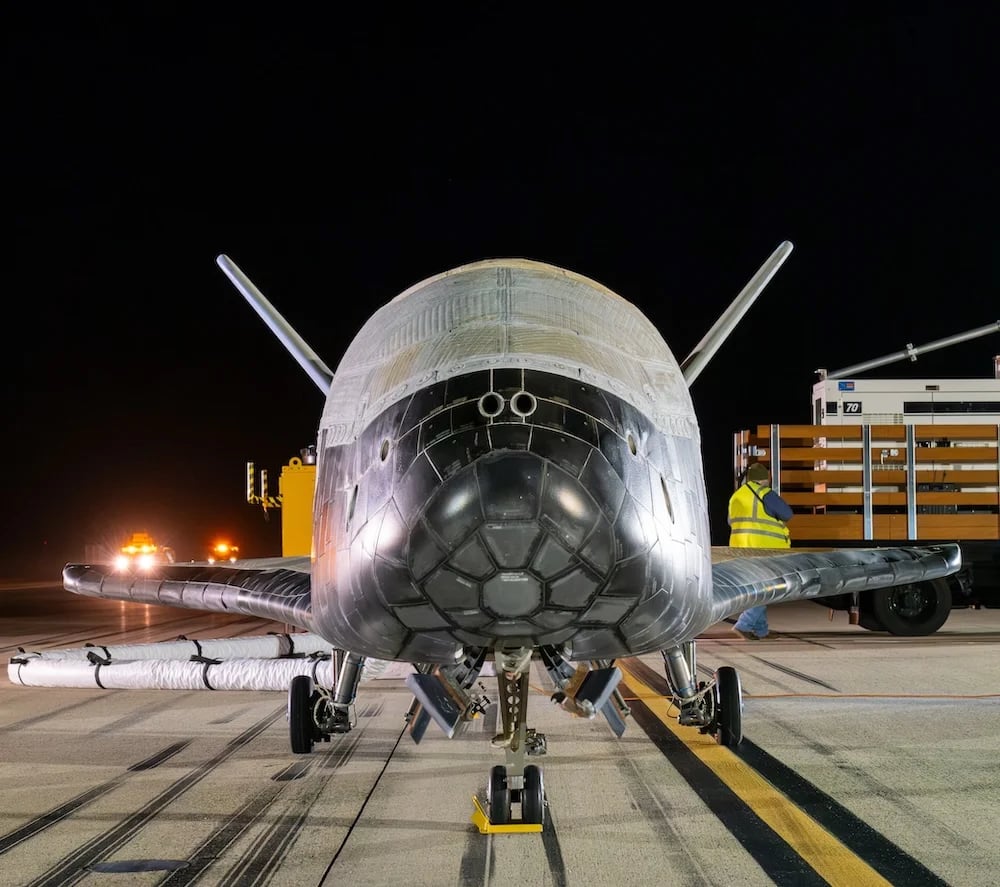
Lunar Missions Postponed by US Military X-37B Spaceplane Launch
Written by Ian O'Neill
It looks like a US Air Force robotic orbiter will push back the planned launch date of NASA's Lunar Reconnaissance Orbiter (LRO) and Lunar Crater Observation and Sensing Satellite (LCROSS). The double satellite launch, originally set for November this year, will now take place sometime early 2009. They will make way for the test flight of the orbital Boeing X-37B spaceplane, commandeering the Atlas V rocket flight originally intended for NASA. According to the Air Force, the November X-37B test flight will be a study into "risk reduction, experimentation, and operational concept development for reusable space vehicle technologies." (There might also be some urgency due to the Shuttle decommissioning in 2010…)
The X-37B's predecessors have undergone exhaustive testing. Based at Edwards Air Force Base, California, the US military has been testing automated spaceplanes for many years. NASA has also been heavily involved in the program. Originally tasked with developing a Space Manoeuvre Vehicle (SMV) that could either be launched by the Shuttle or by rocket, the US Air Force wanted an automated orbital vehicle that could carry out a multitude of tasks in space for up to a year. The X-40 design evolved and by 1998, the vehicle was being dropped from helicopters and allowed to land like a conventional aircraft (automatically). The X-40 military program was then passed to NASA to use as the basis of the X-37 program. After a long period of development, the X-37A was used in conjunction with Scaled Composites WhiteKnightOne (pictured below).
Now the brand new Boeing X-37B is ready to be launched to begin its first automated orbital operations, re-enter and land conventionally. The Atlas V rocket will blast off from Cape Canaveral and the X-37B will hopefully land on schedule at Edwards Air Force Base. The X-37B is 27 ft (8 m) long with a 15 ft (4.5 m) wingspan and resembles a blindfolded mini-Shuttle (it really does! See the picture at the top of the article).
Although there will be a lot of anticipation for the X-37B test flight, it is a shame for the lunar mission scientists who are currently preparing the LRO and LCROSS for their trip to the Moon. The LRO's objective is to orbit the Moon, analysing the surface to aid future manned missions. LCROSS has something a little more spectacular planned; it will create two impact plumes during it's kamikaze mission in aid of detecting present water in the lunar rock.
Sources: Gizmodo, Aviation Week, Design Systems

Filed under: Space Flight


August 1st, 2008 at 5:51 pm
I think LRO ran into delays on their own and had to postpone. X-37 has always been there.
August 1st, 2008 at 5:51 pm
Your title seems a bit misleading. My understanding is that the switch in launch dates has a lot more to do with easing the schedule for LRO and LCROSS which were at risk of delays, than it does the X-37 pushing its way forward.
August 1st, 2008 at 5:52 pm
Have I already mentioned that I love Ian O'Neill articles…?
Ian - Don't take it personally… I'm serious.. I do.. Looking forward to more. You always seem to make me come back for more…
I think this site is a notch above all of the rest, and you (Ian) a contributing factor….. Sincerely..
August 1st, 2008 at 5:53 pm
So… this is a new space shuttle?
Granted, its autonomous. But in light of the space shuttles retirement it sounds a hell of alot more interesting than that lunar probe.
August 2nd, 2008 at 1:10 am
It's more like European ATV (Jules Verne) than space shuttle.
Funny tho… Without war against terrorism, USA would have 2 or 3 new shuttles already in operative use… But no, mr Bush had to cancell the whole thing.
August 2nd, 2008 at 5:13 am
Can a X-37 stack reach orbit if launched by White Knight Two ?
August 2nd, 2008 at 6:16 am
does the USAF really need another weapons delivery platform??? Im surprised the article doesnt mention that role at all…
August 2nd, 2008 at 7:47 am
I'd be surprised if they bought a system that couldn't launch weapons… although I'm fairly certain its not that they want to use it for.
The problem is they have a vast fleet of satellites to tend to but do not want to have all their operations covered on the TV news.
The size, cost, and age of the shuttles have made them obsolete and less than ideal for air force work.
What they want is a ship that can go up, run an extended mission, and then return to some nameless airfield with as little attention as possible.
What they have now might be just the thing.
A secretive spacecraft project is being moved from a darpa hanger to the launch pad, and the news media does not seem to give a damn.
If they didn't cross paths with the LRO, even space watchers may not have known the X-37 was going operational until after the fact. We would have just been told it was another "weather satellite".
Discretion is the name of the game, and the Airforce appears to be winning.
August 2nd, 2008 at 10:14 am
"But in light of the space shuttles retirement it sounds a hell of alot more interesting than that lunar probe."
It's not a cheaper, faster, or safer way of getting into space, it's a way for the military to service their satellites without compromising security. I doubt the Shuttle has the slightest bit to do with it…it's always had extremely limited capabilities in terms of the orbits it could reach, and we've been unwilling to use it to even those limits after Colombia, almost abandoning the Hubble telescope because the Shuttle wouldn't have been able to reach the ISS if it needed to following a Hubble service mission.
So overall, I'd be far more interested in the moon probe. It's much more relevant to our future.
August 2nd, 2008 at 12:57 pm
Servicing satellites? The only thing of any consequence I can think of is this thing could lift a satellite out of a decaying orbit. I'm sure this is going to save us a lot of money versus replacing expensive military satellites. But… I bet ya the secret to this thing is that they launch it with a man or two on board. Certainly not for a long mission like a year, or even a month, but how else are they going to do a complex servicing mission?
August 2nd, 2008 at 6:07 pm
They can do a seemingly complex mission by designing the target satellite to be modular and serviceable with a robot arm.
Hooking up hoses and swapping out blocks of instruments and consumables would extend the life of a satellite, and not require the use of human hands.
With its flight range being so long (9 months?) I suspect they can also rig the shuttle itself as a reconnaissance satellite. One with aerobraking and return abilities.
Turning it into a space bomber is not out of the question, but they could do that with the current launch systems easily enough.
Its all based on technology born for nuclear war, after all.
August 3rd, 2008 at 4:17 am
ASM's would be cool too - anti-satellite missles.
August 3rd, 2008 at 4:06 pm
Hmmm - I think I saw this on Discovery, but it's been years, so forgive my ingnorance:
Wasn't there an X-design with lifting body + aerofoil decent designed and tested about a decade ago? It was decomissioned back when Space was not considered economically interesting - much like now, really.
It looked a lot more elegant than this thing.
August 4th, 2008 at 5:37 am
l mc
My thoughts as well.
While officially the role of this craft may be to service satellites, reconaisance etc, there is no doubt a huge amount of operational utility data will be studied as well for future designs.
A rather scary thought for any nation is a LEO constellation of these crafts full of cruise missiles. An aggressive orbit change out of radar range could provide near zero warning of an attack and at speeds far above any defensive reaction time.
I can think of quite a few military platforms this item could evolve for.
A little shocking the Russian Government has a problem with defensive missiles in Europe, but hasn't really made a sound about this. Could we be seeing a Russian version soon?