
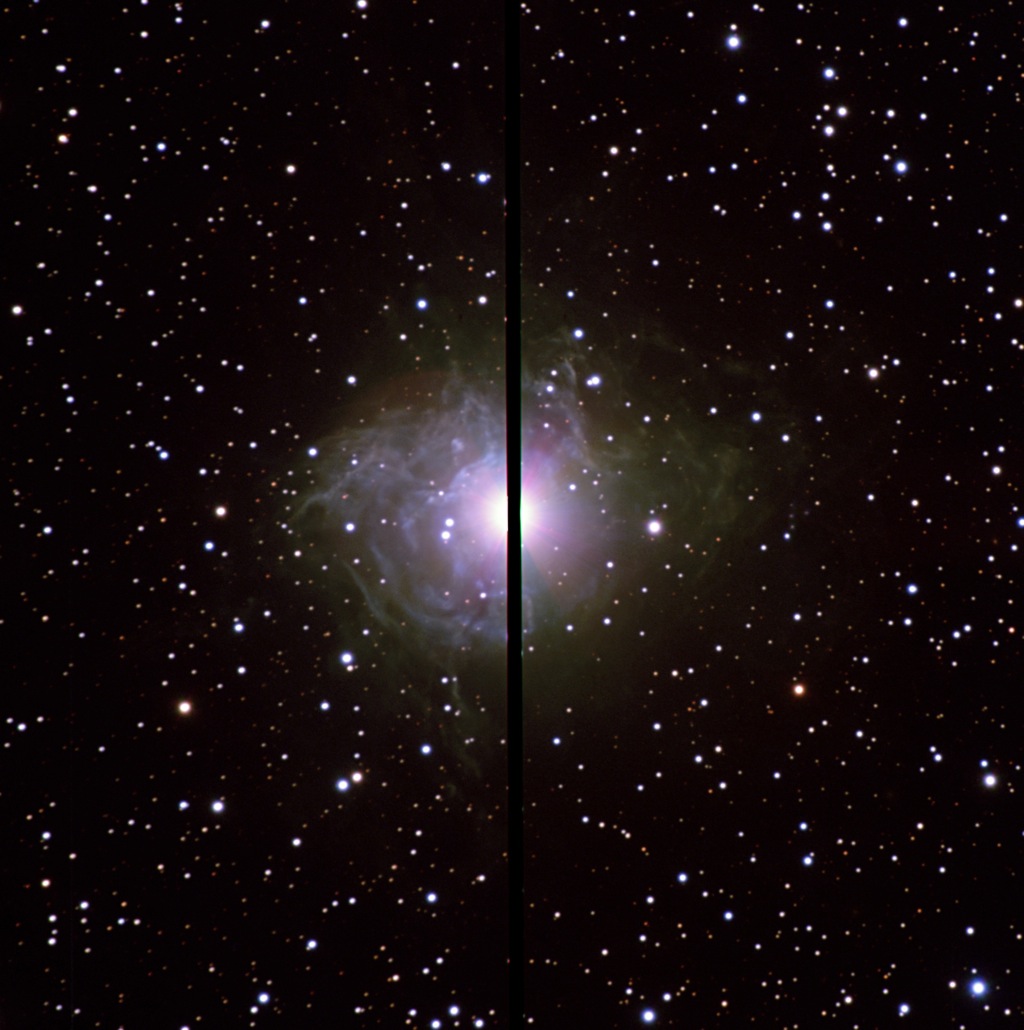
Because stars are just points of light in the sky, it’s very difficult to know how far away they are. Astronomers use several techniques to measure distance, but they’ve got a new one now. By measuring echos of light bouncing off a distant nebula, researchers have fine-tuned their accuracy to an amazing level of precision.
Astronomers used ESO’s New Technology Telescope at La Silla to perform detailed observations of a star called RS Pup. It’s a member of a group of pulsating stars known as Cepheid variables. RS Pup changes in brightness by a factor of 5 every 41.4 days. It’s 10 times more massive than the Sun, 200 times larger and puts out 15,000 times more light.
You can look through these books and instructional materials from Amazon.com for more information about stars.
Because Cepheids pulse at a rate in proportion with their size, astronomers can measure how far they are by how often they pulsate.
But this only tells you how far they are relative to one another. So astronomers use a different technique called parallax to measure distance as well. If you want more info on this, check an episode of Astronomy Cast where we measure different techniques to measure distance in the Universe.
Now astronomers have come up with a second technique to measure distance to a star like RS Pup; to confirm that the Cepheid variable technique is correct.
They did this by watching how light moves through the nebula of material shed by RS Pup in the past. Since light is going 300,000 km/s, it takes time to pass by various blobs of gas and dust in the nebula.
The researchers calculated the light curve from an event on the star, and then watched as that same curve passed different parts of the nebula. It was then a relatively straightforward calculation to determine how far away RS Pup is.
To really appreciate what’s happening, check out the video, where you can see pulses of light move through the nebula. I’ll warn you, it’s a 3.4 MB download.
According to their calculations, the star is 6,500 light-years away, give or take about 90 light years. It’s the most accurate distance to a Cepheid ever captured, with a 1% level of precision.
Original Source: ESO News Release
I get it – it took hours. Scientists measure the ARC in the field of view that’s created by measuring between the peaks of two waves. The speed is constant, the time is constant and the arc is established and distance figured.
Wow. What a video too!
1. They are only absolute if you already know the relationship between their distance, variable period, and average brightness. The distance ladder that we calculate the scale of the universe depends on the parallax, which is reliable only to approximately the distance of the closest Cepheid. This introduces uncertainty in the Cepheids’ distance. That this particular one, the only one, embeds in a nebula gives us a means to verify their triple relationship.
Hi Frazer,
Cepheid variables give absolute, not just relative distance, using the distance modulus formula. Once period is known, absolute magnitude is known, and by comparison to apparent magnitude, we have distance.
What is the meaning of the statement, “But this only tells you how far they are relative to one another.” in your article?
Thanks,
Ken