
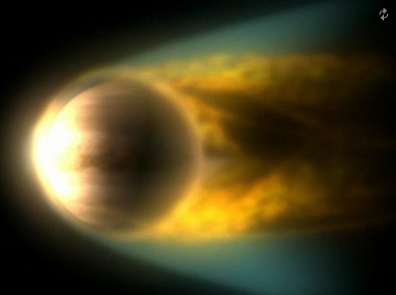
[/caption]
We’ve heard about the possibility of extraterrestrial life arriving on Earth from another planet, asteroid or comet, but the mode of transport usually includes a chunk of rock falling through the atmosphere as a meteorite. But there could be another form of interplanetary transportation. What if there are microbial forms of alien life floating in the upper atmosphere of Venus (the planet’s clouds contain compounds that could indicate presence of micro organisms)? Could they make the trip to Earth? Apparently it is possible, if Earth and Venus are correctly aligned, the solar wind may carry microbes from the upstream Venus to downstream Earth in a matter of days…
Earth and Venus are often referred to as ‘sisters’ as their size and geology are very similar. Although the Venusian surface may appear unsuitable for life to thrive (the temperature and atmospheric pressures are very extreme), it may be possible that microbial life exists in the clouds. As Nancy pointed out in her recent article about colonizing Venus, the environment 50 km above the Venusian surface is the most terrestrial-like in the whole of the Solar System (except Earth of course).
So it should come as no surprise that some scientists believe this may be a good location to search for the most basic forms of life. Two such scientists are Prof Chandra Wickramasinghe and Dr Janaki Wickramasinghe from the Cardiff Centre for Astrobiology, UK, who believe the chemical composition of Venus clouds are consistent with the presence of micro-organisms. Their research uses data from Venus Express (launched by ESA in 2005) which is currently orbiting the planet, trying to understand why Venus is so different from the Earth after 4.6 billion years of planetary evolution.
So the Wickramasinghe’s think that Venus and Earth are not only geologically similar, they may be biologically similar too. “Venus and Earth have often been referred to as sisters because of their geological similarities. Our research proposes that the two sisters may be biologically interconnected as well,” Chandra says. But they don’t stop there. If life does exist in the Venusian cloud tops, perhaps these micro organisms can survive the trip through space, seeding the terrestrial atmosphere. Naturally, this can only occur if the planets are in alignment, so the solar wind can erode the Venus atmosphere, transporting microbes as it does so.
However, the life on Venus theory has its critics. “The idea of life on Venus, particularly the clouds where the temperature and pressure are similar to the Earth, has been floated around for a while but is not really very likely,” says Prof Fred Taylor, a planetary scientist at Oxford University.
This is however an interesting field of research that may go to some way in explaining the phrase and book title: “Men Are From Mars, Women Are From Venus.” So, looking for life on Mars and Venus doesn’t seem so outrageous after all…
(A thank you goes to my friend Ross Fenion who sent me the lead to this story and made the “…Women Are From Venus” link, it wasn’t me…)
Source: BBC
Wickramasinghe is Hoyle’s acolyte, so forgive me if I don’t hold my breath. Hoyle and W. believed that because dust existed in space, and because it seemed to give off Hydrogen spectra, it was indisputably bacterial life.
Ian O’Neill articles are my favorites… 🙂
“trying to understand why Venus is so different from the Earth after 4.6 billion years of planetary evolution.”
Let’s see… Could it have anything to do with the fact that Venus is 25 million miles closer to the sun?
I think this is very, very far-fetched, quite frankly. And there’s a problem with the whole idea:
Let’s assume there is life on the upper layers of the venusian atmosphere and that venusian microbes do make it to Earth on a regular basis. This implies that either they die when they reach us (unlikely, since they have already survived a trip through interplanetary vacuum), or that they thrive, and in all likelyhood, we’ve detected them already.
Now, all life on Earth has a very limited group of closely related substances to pass along genetic information. Therefore, if we have among us venusian microbes that means life on Venus would also use the very same substances.
This is very unlikely, unless life on both planets had a common origin. And since it’s Venus that is “upstream”, as Ian puts it, that origin has to be in Venus. The only possibility for the opposite journey is an Earth impact sending microbe-rich debris towards Venus, a trip that should last many thousands or even millions of years. So, life would be originally venusian.
However, as far as I know, the Earth has always been more hospitable to life than Venus. Cue Occam’s Razor, and the whole idea… nah!
How about the other way around. Microbes and live form from Earth to Venus or celestial bodies?
I am happy to see the latest NASA pictures on their home page. That is the way they are supposed to be.
Very satisfied. If they only did the same with a bunch of previous crummy ones we are good.
Universe Today has selective hearing.
Intergalactic germs can fly here in days but the arrival of the Anukai is beyond the laws of physics.
Let’s define “days” as 5 days for the purpose of argument.
So… 25 million miles between and Venus. Organic matter–scratch that–LIFE gets swept up by the solar wind to infect our planet and cause general trouble at… wait for it…
208,000 mph.
Life exposed to brutal radiation, extreme ranges of temperature, high speeds and, ultimately, the physics of hitting earth’s atmosphere…
Dorks.
Life arriving at 208,000mph… nothing violates the laws of physics there.
And if you think the Annukai could somehow arrive here with conscious decision making and technology, you’re crazy.
Ok. Glad we cleared that up.
I find this to be an interesting theory. Highly improbable though. The odds of this happening must be incredible. However, I do still buy lottery tickets so there is always hope. I wonder though, if this has happened or happens occasionally, could it account for the horrible, deadly and drug resistant diseases that have sprung up throughout history? Maybe Venus holds the cure for cancer and aids.
RetardedFishFrog, that doesn’t account for even a fraction of the differences between Earth and Venus. You don’t sound smart, just a nice blend of arrogant and ignorant.
Jorge:
Life wouldn’t be passed over to Earth on a daily basis. Only when the two planets and the sun are in a line together (I’m not sure how often that is, but definitely not daily. No more than once a year, probably?) The rest of what you said is pretty logical, though.
Joker, the fastest I’m seeing the solar wind going is 750 km/hr. Where’d you get your speed from?
We obviously can’t say yes or no or to whether life is on Venus (even though it does seem kind of improbable. And even more improbable that it’d end up here on Earth. But then again, lots of things in the universe are improbable), but I think we should keep it lower on the priority list of things to look into. Maybe if that solar-powered Venusian airplane ever becomes a reality, it’ll have a life-detecting mechanism…
I’ve been lookng into the “microbes thru space” theories for the last few years and they really deserve some serious attention….in fact the apparent lack of serious atttention added to the intense ridicule makes one very suspicious. Microbes survive in hot smokers on the ocean floor and in clouds – how high they get is still an actual unknown to science. How ridiculous is that? We still don’t know, in 2008, how high microbes get by natural forces. This is the biggest driver for the research that took place for “Imminent Discovery”. My paper was covered in NewScientist, but most of the original theory should be attributed to Dr. Svante Arrhenius – a Nobel prize winner. If you want to mock the theory, go ahead, but it’s no joke, and it explains a lot of things. I suppose people mocked continental drift, too, and an Earth that wasn’t flat.
Here’s a link to the NewScientist article.
http://space.newscientist.com/channel/astronomy/astrobiology/dn9601
James, go read what I wrote. I wrote “regular”. Regular != daily.
As for how often Venus and Earth are in conjuction, that’s pretty easy to estimate. Venus’ year lasts about 225 days, which means it moves 1.62 degrees per day; Earth’s, as we know, lasts 365 days, i.e., Earth moves 0.98 degrees per day. Since they both move in the same direction if you subtract the two you’ll see how faster Venus moves relative to the Earth, about 0.64 degrees. Since two conjuctions happen at 360 degree intervals, you just have to know how long it takes to go 360º. That’s about 563 days. Regularly. 😉
(I’m simplifying here, don’t take this as an accurate value: not only there are some rounding issues, there is also some stuff dealing with de difference between solar and sideral days that I didn’t take into account. Still, the accurate value is pretty close to this, and if you want to know how often conjuctions happen between two bodies you can always follow the same reasoning)
The astronomy is very interesting for me, but some articles are very fantastic or incredibles, because sometimes you talk like if the transportation of the life was very simple, Are you forgetting the extreme difficulty of surviving in the space for the human life? So, which is the difference about the other kind of organisms?
I don’t think microbes surviving (or even moving along a trajectory towards) Earth is far fetched. We’ve taken extraordinary precautions to ensure that Earth-based microbes don’t “contaminate” places like Mars. We’ve seen how microbes survived amazingly hostile conditions (missions to the moon come to mind). It is a hypothesis that remains disproven….
Ian does write terrific articles, but the idea that microbial life could travel from Venus to Earth on the solar wind is a real blast of hot air.
Doesn’t Earth’s magnetic field deflect most of the solar wind? That should prevent solar wind borne microbes from reaching Earth.
If there is microbial life in Venus’s atmosphere (which I doubt), it’s more likely to get blown to places like Mars. It might actually help that Mars is further from Venus than Earth is. The plume of material blown off Venus would spread out to a greater area as it moves away from the Sun and you wouldn’t be so dependent on a perfect alignment between the two planets. The plume would be more sparse, but Mars would pass through it more often.
Yes it is possible; there is a theoretical proposition that the manly Olympus Mons was once muck bigger passing earth orbit and ebbing on Venus’s cloud top. There are even evidence of a solar system wide floods to support this. Hence the explanation for the phrase:†Men Are From Mars, Women Are From Venus.”
TD, regarding that new scientist article: Could eukaryotes get around by the same mechanism? IIUC they’re typically about a thousand times more massive than prokaryotes.
I am far more surprised in this article that the word “panspermia” does not appear in the article nor in the replies – unless I’m missing something..
IMO, surely the origins of life on Earth is more likely the Earth, with the less likelihood of the panspermia origins (in decending order) being the nearby planets, Mars, Venus, the Solar System, and then interstellar origins.
1) The true origins our Earth-based microbial life is significantly constrained on the creation and stability of amino acids, solely based on general chemistry and the interactions of these biochemicals in water (or some other) solutions. In the argument of life’s origins beyond the Earth, I really do fail to see why these particular building blocks are any best placed, say on Venus, or Mars (or elsewhere) than the earth itself. So until the initial environmental constraints elsewhere can be proven to show that amino acids changing into life, then the Earth logically remains the most likely place for its beginnings.
As Jorge said; “Cue Occam’s Razor.”
2) Venus’ present atmosphere is far too hostile. Even if Venus were similar to the Earth 4 billion years ago, the survival of early Venusian organisms is made worst because the planet lacks a significant magnetic field – fried to a crisp by the relentless solar radiation.
3) The transport mechanism from the Earth to Venus needs to be far better explained and proven. For example, How material interacting with the Earth’s magnetic field, then survived atmosphere descent without being destroyed or even recombining. There are of course other possibilities, like the amino acids (or other organic molecules) being transported to Earth, to then form life here.
Most of you guys sound like whining babies..who are you to say whats probable for life or not.We simply dont know enough to state even the probable..So maybe you should tone it down a bit and realize life itself is far more diverse than what we know.We dont even know how life is made. I say we keep looking with an open mind becuase to close it so prematurely when weve only found a surface to scratch is upsurd.
Even if ‘life’ was possible on Venus (or even Mars), it should be blown to smithereens before they could come here and pollute us with their evil, godless philosophies! Who do they think they are, for crying out load !!?
Here’s my answers to some of the questions that have been raised. Evidence of life has been found on Earth dating from hundreds of millions of years after the crust solidified, but it took another 2 billion years for anything more complex than the simplest bacteria to form. What does this suggest? Throw out Occam’s razor. From wiki : “The principle (Occam’s razor) states that the explanation of any phenomenon should make as few assumptions as possible. ” Did Life evolve from rock in less than a few hundred million years? Or did it take billions, take advantage of known physics to move thru space, and fall here? Either one has assumptions, but the 14th century thinker who proposed Occam’s razor is probably not going to help answer this question. After doing the physics, it’s easy to see that life most likley didn’t start here. It arrived here. But only the simplest (prokaryotes) get moved by the spores-thru-space theory, not eukaryotes which, as Dave W. points out, are much more massive. This would tend to suggest that some version of Nobel-winner Svante Arrhenius’ version of panspermia is correct, since mass to charge ratio is important in that theory, (but the size of the microbes would not matter in the life-via-meteor-impact theory). I hate to use the word “panspermia” because it is ridiculed by folks far, far in excess of its implausibility. In reality it’s a fascinating area deserving much further study. I hope the NewScientist article I referenced earlier and our book “Imminent Discovery” (www.Lulu.com) help generate some interest.
Good Luck Phoenix! (Finding microbial life on Mars, and then confirming the basic life mechanisms and DNA, would go a long way to defuse the ridicule).
TD: I too am working on a paper on this. Is yours available online?
Best,
Duncan.
Hey, maybe we’ll find out in 2012!!! LOL
That’s when the next transit of Venus will be.
TD stated; “After doing the physics, it’s easy to see that life most likely didn’t start here. It arrived here.”
I really don’t understand the relationships presented here. Surely life starting anywhere is based on principles of either biology and chemistry, and is clearly not a matter of physics.
If life already exists now on Earth, and seemingly devoid on either Venus or Mars, isn’t it logical that the origin of life is Earth and not Venus? As to origins of panspermia, isn’t it also likely that the early beginning of life on Venus, Earth and Mars formation could have been equally seeded from either a interstellar or another interplanetary source?
The implausibility for me is that seeding of planets by some panspermia mechanism avoids the more fundamental issue of
original way these self-energising and growing simple organisms went from simple inert organic molecules by a physical process into organisms that display evidence of expiration and replication.
Futhermore, Occum’s razor is in some ways perfectly applicable – especially as we already know life exist on Earth now, and billions of years ago, and as far as we know, life doesn’t seem to exist there now, nor do we have any evidence that it once did.
If this is a scientific argument based on both observation and evidence, then therefore these speculations of Venus are unfounded – not because of the reality (or not) of the mechanism of transfer of biological or non-biological material between Venus and the Earth, but that no direct evidence of organisms exists anywhere else than on Earth.
As you said; “Finding microbial life on Mars, and then confirming the basic life mechanisms and DNA, would go a long way to defuse the ridicule.” Until science can actually understand the way life began Unfortunately, the search by “Forearmed is forewarned” is not usually a universal scientific principle even under the observation that Occum historically is mostly correct.
General comment:
For life to form on either Earth, Venus or Mars, means the conditions for amino acids to form early organisms are by similar means or not. If, as you argue, life didn’t start on Earth, then why is more probability more likely for Venus (or Mars, for example), than Earth? (Either article doesn’t really say).
If say, micro-organisms could now (or once were) lie in Venus’ atmosphere, but the far more difficult question is how they got there in the first place. If we assume this, isn’t it therefore more realistic to say that such life formed once on the surface of the early Venus, then when the planet got to hostile (and destroyed all life and usable amino acids), the only feasible place organisms can remained is atmospheric.
I was interested in support in Tammy Polotner’s article in Universe Today of 2nd April 2008 “Venus’ Variable Evolution”, where Prof. Fred Taylor of Oxford University is paraphrased as stating “Biological evolution could never happen”, based realistically that the water once there was rapidly lost in a very short geological time scale.
Sadly, we also presently cannot test the first postulate here, but testing the Venus atmosphere could be made by article “Cruising the Cloud Tops” Universe Today article on 10th July 2008 by Nancy Atkinson. Without being cynical, this article does sounds like a drumbeat for searching for life on such a mission. I pray this isn’t such motivation!
So IMO. Since we can already produce the majority of basic amino acids required for life in a simple laboratory experiment by sparking electricity into basic organic molecules to for an organic soup or goo. We must therefore show that here on Earth this same organic soup did not then turn into life (and why), before we search for alternative credible explanations for life elsewhere.
Correction: the paragraph that says;
“Futhermore, Occum’s razor is in some ways perfectly applicable – especially as we already know life exist on Earth now, and billions of years ago, and as far as we know, life doesn’t seem to exist there now, nor do we have any evidence that it once did.”
Should read;
“Furthermore, Occum’s razor is in some ways perfectly applicable – especially as we already know life exist on Earth now, and billions of years ago, and as far as we know, life doesn’t seem to exist there now on Venus (or Mars) , nor do we have any evidence that it once did.”
Otherwise, it doesn’t make any sense. Sorry.
TD stated explanation attributed to William Occam’s razor;
“Occam’s razor. From wiki : “The principle (Occam’s razor) states that the explanation of any phenomenon should make as few assumptions as possible. ” ”
This is slightly misleading, and really avoids the scientific application of reductionism. I think the better interpretation of this principle (as a positive instead of a negative connotation) is that;
“The principle of Occam’s razor, is where all things being equal, the simplest explanation is usually the right (or the best).”
Note : I think Jorge earlier comment was meant; that this Venus article here seems more to advocate the theory of “norminalism” (not Occum’s razor per se – Ie. Adopting a universal process that seems to have no place in the reality of proof or the reality.
I assume the conditions existing on Venus – now or in the past – are less likely to harbour life than Earth,
AndJames wrote :”The principle of Occam’s razor, is where all things being equal, the simplest explanation is usually the right (or the best).”
Sorry, but for me, for one of the biggest questions that mankind has ever faced (is there life off the Earth?) cannot be answered by old phosophies that contain a a “usually” in the definition. If life – the simplest form – originally took billions of years to form, then it didn’t start on Earth Period. As for Venus’ atmosphere and Mars having microbial life – no one knows. Period. If you know differently (that these planets are sterile), then please explain how you know, because it’s not based on science the general public is aware of.
As far as my comment on the “physics”, it has to do with computing the battle of force of electric field on a charged microbe (as reported in papers) vs. the force of gravity. Once you do the math and see the forces, the implications are profound.
I like to use the analogy of an island being viewed by telescope from the continental shoreline. Does one say, I wonder how life originated there? No, one wonders how life got there – usually ocean currents or air currents. I think the transfer of life between planets is similar, but with different physics, and much poorer conditions between the planets.
Then you start asking other questions. Do microbes survive cold, heat, dessication, vacuum, radiation of space, etc. The answers are yes, at least to some level.
And then you find that a nobel-prize-winner proposed the essentially same theory in 1908 (Svante Arrhenius), and, right or wrong, you’re hooked for life investigating.
Although I have no data of my own to prove it, I also have a gut feeling that life was introduced to our planet.. Via comets (water).. I believe that it is possible that it all started with amino acids here on earth, but I must admit that I believe it is more likely that microbes hitching a ride on comets is more likely.
It is my understanding that Apollo astronauts recovered a few sensors from a satellite that landed on the moon years earlier and found a cold virus from an engineer of that satellite and were able to cultivate it… Hence, the virus survived for years in the vacuum and cold of space. I don’t believe the ‘Venus’ thing, but I sincerely believe that the most logical ‘answer’ is that life came from somewhere else… Probably comets… But where did that come from?.. I don’t know… Possibly built from amino acids many light years from here… Who knows?
TD,
I really have not problems with your dissertations on the origins of life, nor of the involvement you seem to have have in investigating the problem. I don’t think I’ve really questioned your “physics” background here, but I’ve just made the obvious statement that most of the investigations about life are mostly questions of biology and chemistry – the life sciences – surely a necessary overview in an open forum like this one.
The difficulty here is in assessing the terminology and the real problems of identifying the chances of all these questions – especially among mostly novices. When there are many unknowns or uncertainties, philosophical or historical precepts are sometimes the only way to assess incomplete or complex issues with seemingly untenable answers. It might be misguided, but it surely it is at least experientially based.
As far ; “If you know differently (that these planets are sterile), then please explain how you know, because it’s not based on science the general public is aware of.”
I’ve never made the assertion either way, nor can I. However, I can be sceptical or base judgements or logical or scientific probabilities based on realistic limitations. Saying micro-organisms exist in the upper atmosphere of Venus does mean zip unless has little or no evidence to support it. Ego, until there is actual evidence to the contrary, it remains a unsubstantiated theory. Most think Mars has a better chance of finding life existing (or now extinct) than Venus – and this is based on the nature of Mars and the seemingly better conditions for biological and biochemistry to be effective to nurture or sustain organisms.. (in the case of Occum;’s razor, is this latter question more based on evidence or by its likelihood? If I have half-a-billion dollars riding on an experiment to prove life exists and have to select between Venus and Mars, for example, would I not choose Mars as the better probability of success? Yes Occum’s razor might be old hat and probably some form of gambling – but it is a general scientific way via reductionism and just reflects the hope of using fewer steps to achieve ones aim. Sure it’s a tool, but it is not the only tool, nor is it absolutely infallible.)
However, my own point is that we can base the origin of life on the constraint of the chemical organic compounds – especially alpha-amino acids; and the constructs of more advance structures like RNA, DNA or basic proteins.. For example,
– Most amino acids are destroyed (decomposed) between temperatures of 200C or 300C. Therefore, any created organism cannot begin or survive in regions that exceeded this value.
– All of the amino acids are soluble in water, but are insoluble in hydrocarbons or organic solvents. This means water needs to exist in liquid form for the amino acids interact with each other to disassociate and interact with polar solvent.
– Creation of catalytic enzymes to make more specialised proteins. Basic proteins have to pre-exist for the life to activate the process. etc.
In Venus’ case, these conditions are presently questionable As many have alluded here, because of the hostile conditions during any known period of planetary evolution.
While transport mechanism, and the physical constraints of the environment that living cells needs to survive are important and necessary to know (and clearly fascinating), it is not the sole part of the story., Doesn’t it also makes sense do chemical or biological constraints as well, and assess the real probability that the condition could induce life. From what I’ve read, Venus seems highly unlikely place to find either the origin of micro-organisms (spores) or the original source of earth-bound micro-organisms.
As for; ” If life – the simplest form – originally took billions of years to form, then it didn’t start on Earth.”
Isn’t this really a very broad assumption to base you whole argument upon? Where is the scientific evidence to prove or disprove that this is true?
Note: I have no real questions regarding “Do microbes survive cold, heat, desiccation, vacuum, radiation of space, etc.”, as these can be scientific experimented in both space and in the laboratory.
As for Arrhenius, didn’t he win a Nobel prize in chemistry? I think his work on the dissociation of organic and inorganic compounds in solutions was among his greatest works. Its funny, but the way organisms exist and thrived on Earth is based on these very principles, especially in the interactions of polar amino acids as they forming various complex molecules.
AndJames – thanks for your thought. I’m not really trying to convince people that one of the theories of microbes-thru-space is true, only that they have a legitimate enough foundation to not be ridiculed as intensely as they are. I agree that no one knows how long it took life to form, but if it took a billion years (and I mean “if”), then it certainly could not have originated on Earth. Since life took about 2 billion years to take the step from bacteria to more complex one celled creatures, it seems reasonable to me that it took more than a few huindred million years to form in the first place. I know that’s not proof, but it seems reasonable. As for Mars or Venus, I really don’t know if Venus has life in its clouds…..but if Mars, with all the observations of seasonal changing colors/shades (Slipher), spectroscopic evidence of organic compounds (Sinton), and seasonal polarization change of small opaque particles (Dollfus), if it turns out to be sterile, I’ll never write another book. Hopefully Phoenix will turn up something promising.
@ Al Hall : The virus and Apollo, is very exciting, and the first I’ve heard of it .. do you have a reference at all or any more info ?
Cheers,
al.
The Apollo 12 crew brought back samples from Surveyor 3, after 950 days on the Moon. One out of 33 swabs taken from the TV camera, back on Earth, produced a growth of Streptococcus mitis bacteria. Contamination in the receiving lab is possible. (‘Germs on the Moon’, Spaceflight, 12, 11, 451, Nov. 1970.)
TD
Thanks for your response. No ridicule was ever intended by me.
A long time ago the sun was much smaller and its influence on the planets wasn’t as far reaching. Let us look at that for a second. The sun is smaller and the temperature on venus is much less. The water has yet to boil away causing the thick acidic cloud we see today. This planet(Venus) now becomes very hospitable for not only microbe life but even Humans to live as well. Suppose just for a second that intelligent life existed on venus and was aware of the suns growth as we are. What planet would have been on the verge of sustaining life? The answer Earth.
my Grandpa is Neil Armstrong the first american on the moon. he has told me many different stories about alien life in space. to this say, is still believe in life on another planet and im 25yrs old
First American on the Moon? First human on the Moon!