
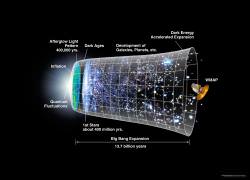
Early stars that began to form about 200 million years after the Big Bang were strange creatures. From observation, the earliest stars (formed from coalescing primordial gas clouds) were not dense enough to support fusion reactions in their cores. Something within the young suns was counteracting the collapsing gas clouds, preventing the core reactions from taking place. Yet, they still produced light, even in absence of nuclear processes. Could dark matter have had a part to play, fueling the stellar bodies and sparking early stars to life?
New research indicates that the energy generated by annihilating dark matter in the early universe may have powered the first stars. How? Well, the violent early universe will have had high concentrations of dark matter. Dark matter has the ability to annihilate when it comes into contact with other dark matter matter, it does not require anti-dark matter to annihilate. When “normal” matter collides with its anti-component (i.e. electron colliding with positron), annihilation occurs. Annihilation is a term often used to describe the energetic destruction of something. While this is true, the annihilation products from dark matter include huge amounts of energy to create neutrinos and “ordinary matter” such as protons, electrons and positrons. Dark matter annihilation energy therefore has the ability to condense and create the matter we see in the Universe today.
“Dark matter particles are their own anti. When they meet, one-third of the energy goes into neutrinos, which escape, one-third goes into photons and the last third goes into electrons and positrons.” – Katherine Freese, Theoretical Physicist, University of Michigan.
Katherine Freese (University of Michigan), Douglas Spolyar (University of California, Santa Cruz) and Paolo Gondolo (University of Utah in Salt Lake City) believe the strange physics of the early “dark stars” may be attributed to dark matter. For a star to form from stellar gas cloud to a viable, burning star, it must cool first. This cooling allows the star to collapse so the gas is dense enough to kick-start nuclear reactions in the core. However, early stars appear to have some form of energy acting against the cooling and collapse of early stars, fusion shouldn’t be possible, and yet the stars still shine.
The group believe that early stars may have passed through two stages of development. As the gas clouds collapse, the stars go through a “dark matter phase”, generating energy and producing normal matter. As the phase progresses, dark matter will slowly be used up and converted into matter. As the star becomes sufficiently dense with matter, fusion processes take over, starting the “fusion phase”. Fusion in turn generates heavier elements (such as metals, oxygen, carbon and nitrogen) during the lifetime of the star. When the early stars’ fuel is used up, it will go supernova, exploding and distributing these heavy elements throughout space to form other stars. The “dark matter phase” appears only to have existed in the very first stars (a.k.a. “population three stars”); later stars are supported by fusion processes only.
However, this exciting new theory will have to wait until the James Webb Telescope goes into operation in 2013 before population three stars can be observed with any great accuracy. Light may then be shone on the processes powering the first “dark stars” of our early Universe.
Source: Physorg.com
How do we know there was a big bang at all?
Just because something is expanding does not mean that it started in a single point. You cant always just press RW on the remote and figure out everything for billions of years. This ain’t a VCR…
Dont even bother with dark matter, we know nothing about it and have not documented that it even exists yet. How can we speculate that it was in early stars?
This is an interesting hypothesis, but as for the hard and fast rules of dark matter… it’s all speculative. It’s still nearly impossible to describe dark matter with our current understanding of quantum physics, much less be so certain of it’s properties.
As yet, the only reason we believe it exists is because we can’t account for the accellerating expansion of the universe without it. However, for something which purportedly makes up the majority of the universe, the fact that we have not been able to observe it or produce it experimentally means that far more research is needed before we can have any real certainty of it’s properties.
M-Theory suggests that so called “dark matter” does not exist at all, but it’s described “effects” in the universe could be the result of “leakage” of energy across interdependent membranes between parallel dimensions.
The jury is still out.
Wow about the universe is expanding from energy gain from another universe? We have a short observational period, sort of hard to draw conclusions when the light we see is so old and we’ve only begun to study it in relatively short span of human science. How do we know the universe is still expanding? Maybe it’s our observation that makes us think that and it’s not really the case. Also, why does it expanding mean it came from one spot?
spelling. Meant to say “What about”, not “Wow”, but hopefully meaning is better than my spelling. Sorry about that.
Chris wrote: “How do we know the universe is still expanding? Also, why does it expanding mean it came from one spot?”
We know that it is expanding because the furthest galaxies are red-shifted, which means they’re moving away from us, in all directions. Moreover, the important thing is that we know the expansion is still accelerating.
As for it coming from one spot, that really is not the way the Big Bang works. According to Einstein, space and time are woven together. In the first billionth of a second after the Big Bang, the Universe –meaning ALL 3-dimensional space in this continuum– was no bigger than a grapefruit. As the universe expanded, it cooled, and elemental particles clumped together to form matter, which in turn warped sections of space-time creating what we think of as the “force” of gravity. But gravity is not technically an energy, it is a measurement of the curvature of Space-Time. the bigger the mass, the more the curvature, the greater the gravity.
But the universe expanding refers not just to matter moving out in all directions, but the conceivable boundaries of Space-Time expanding as well. In other words, space and time are being stretched outward as well.
M-theory and it’s correlaries (which at this point are purely in the realm of theorhetical cosmology and mathematics, as a combination of multiple string theories and Supergravity) suggest that the Universe is like a bubble in a sea of other bubbles, representing nearly infinite parallel universes, and that it is possible for events on the surface of one bubble to affect events in all the surrounding bubbles.
That’s a oversimplified explanation, but since I dropped out of that calculus class in college, I really can’t do the math myself.
But M-theory is some astonishingly elegant math, and –more importantly– it succeeds in describing events prior to the Big Bang, where all other theories fall apart.
Well, why not bother?
If we do not ask questions, we will never get the answers…
As far as population III stars, the problem is there should be some of them still around and there aren’t any (listen to what Pamela said in the last podcast) .
So, we have to start with something..
None sais this is the last word about dark matter (or whatevet it is or it’s not).
Alex: “How do we know there was a big bang at all?”
Well, Alex, when we look into space, we are really looking back in time, because the energy we can detect travels at the speed of light or slower, so when we look at somtehing a million light-years away, we are looking at an image of how it WAS thre million years ago, bec ause that’s how long it took for the image to get here.
So, we point a very sensitive telescope at an area not obscured by stars and galaxies in space, and we can actually detect the energy of the explosion of the Big Bang itself. it’s everywhere, beyond all the visible matter in the universe. In fact the guys who discovered it got the Nobel Prize for their work, so it’s pretty reasonable, from a scientific standpoint, to say that we KNOW there was a big bang, and in fact just exactly how long ago it was.
Alex: “Dont even bother with dark matter, we know nothing about it and have not documented that it even exists yet. How can we speculate that it was in early stars?”
Well, Alex, that’s the point, and that’s how science works. We observe something. Then we try to describe the simplest explanation for what we see. Then, we do experiments which will wither support or disprove our explanation. Mathematically consistent models derived from what we DO know about the Universe pretty convincingly suggest that all of the stuff in the universe we can account for… stars, planets, gas, dust, light, everything… still doesn’t make-up nearly enough matter to explain the gravitational effects we can observe in the universe. So, we suppose that there is matter which exists, but which for some reason, we are not yet able to observe. This is what is being called “dark matter.” Predictions based on this supposition have yeilded supporting evidence that “Dark Matter” exists. So, physicists very carefully speculate about what it’s nature could be.
Yes, in many cases, it’s just speculation–but it’s how we determine what to look at next to gain a better understanding. In this case, it’s VERY well informed explanation. In my original post, I was simply saying that Dark Matter is one of several possible explanations, and one of the more sexy and elegant explanations can be found in the mathematics of M-Theory.
M-Theory, unfortunately, may be absolutely right, but is currently almost impossible to experiment on because it doesn’t make many predictions that can be tested with our current science.
That is why I said the jury is still out. Still, the further we look into space, the more we speculate, and the more we look for evidence about our speculations, the more we discover and add to our knowledge.
Humans are very curious by nature. If we were more inclined to say “why bother,” then we would still believe the Earth was flat, and that the whole universe revolved around the Earth. Personally, I’m comfortable with admitting that there is much we still don’t know, and I for one would like to find out… if only for the sheer wonder of it all.
Ho-Hum. Just more physics babble; no science.
since some scientists have said dark matter/energy makes up 95% of the mass in the universe, than wouldn’t all this dark matter have enormous gravitational pull?
And if it is on the edges of the universe pulling it out, than there must be something beyond the dark matter pulling the dark matter outwards. Since the idea that there is an infinite number of layers holding everything together is ‘impossible’ than dark matter (if it exists) would have only volume and zero mass.
In order to fully understand this though, I must know, is it the lack of mass in the univese that is our reason to think up dark matter? or the expansion of the universe?
could an equation be shown?
I assume that when they speak about dark matter having the ability to annihilate with itself, they are referring to the specific case of the properties of supersymmetric particles like the neutralino, no? It’s all pretty speculative then, seeing we aren’t even sure that supersymmetry exists yet, and if it does, that the Lightest Supersymmetric Particles are actually what we call ‘dark matter’ after all.
That isn’t to say that it’s not a worthwhile direction of research – just that there are a number of pretty big ‘if’s’ in the research at present… But interesting none-the-less.
OK I have given the scientific community a lot of slack regarding dark matter since it has recently been discovered, but are you kidding me here?
Dark matter is it’s own anti-particle? You can’t directly observe it, we have found clouds of what we think is dark matter, so according to this theory there should be a massive output from these clouds… but there is… wait for it… wait for it… NOTHING.
Katherine Freese, shouting “Look at me! Look at me!” does nothing but make you look like a complete fool. You are the first theorist when it comes to dark matter that I will publicly laugh at and call your theory COMPLETE bull.
W. Scott, please help. You say that since the universe is expanding, it came from one spot, the size of a grapefruit. What if our universe is gaining energy from another universe and is having phase shift much like an atom has when it gains energy from neighbor atom. In the case of atom gaining energy, the electrons increase orbit. What if our universe, the galaxies are gaining distance from center to take on more energy? I dont doubt the universe is expanding, but i do doubt it came from one spot the size of a grapefruit. Also, we see light from millions of light years away. How d we know the objects still exist that created the light? I really don’t see how our short lived observations tell us what we think we see. I’ll go with the simple, that our universe is one of many and it’s gaining energy from another universe. that makes sense to me.please explain if that is not plausible and why.
I never had a doubt tagging dark matter with the term “dark” was going to cause many problems. Then the term was again hung on dark energy, which is not related to dark matter in any viable relationship. Hence, mass confusion and I include me in that category because the more I learn the more I know I haven’t got it right in my head.
Here’s how I try to keep it straight:
Everything we’ve seen, or will see in the universe is matter. Yet all of that accounts for only 4% of the universe. Yes, just 4%.
Dark matter accounts for 23% of all matter in the universe. So, that means there is approximately 6 times the amount of dark matter as there is visible “normal” matter.
Dark Energy is actually the bulk of the universe and is estimated to be 70% of this universe.
Don’t ask me about the remaining 3%, damned if I can recall. Maybe its White Holes and White Energy or pink elephants.
Beyond that, I’m waiting on proof.
Just make up the properties of Dark Matter – that’s the ticket. All this is fantasy so far. Dealing with facts and reality should be more fruitful.
I don’t see how “multiverses” or M theory make any more sense than Dark Matter.
Multiverses and M theory are all the result of math. There is no way we could ever observe the effcts or the other universes themselves.
Dark matter has been detected, and it is a simpler theory. There’s stuff out there that we can’t see. With the naked eye, we can’t see most of the stars in our own galaxy (M-stars). Does that mean that they didn’t exist until the telescope was invented? Of course not.
We cannot directly detect dark matter, but we can see it’s effects. We can’t actually “see” wind with our own eyes, but we know when tree sway, that wind is blowing.
The universe did not originate from a spot the size of a grapefruit. The entire universe *was* the size of a grapefruit. We know the universe is expanding, and if it is, then is must have been smaller than it is today.
Figure out the rate of the expansion, and go backwards, and you eventually get to the “grapefruit”. Besides, cosmic microwave background radiation basically proves that the big bang occured anyway.
May I suggest that the missing energy is infact tied up in black holes. From what I understand we do not know how many black holes there are so we can not know how much is locked up in them, so why look for something that is not missing. Or have I completely missed the point.
I’ve oten wondered if something like osmosis was the reason that the universe is still expanding. The “pressure” of the universe is causing space-time to expand to where it “isn’t”.
Of course, there would be no way to test this, but at least it doesn’t introduce other items, such as multiverse’s which I believe are the product of circular reasoning.
Why do all these folks have this desperate need to pigeon-hole everything, categorize and “make sense of”?? Science is an ON-GOING study of reality. We just discovered “dark matter” in the last ten YEARS! Give it a CHANCE! There were lots of doubters of human powered flight, particles smaller than an atom and any number of scientifically proven advances. As humans, we’re pretty much locked into only being able to “understand” basic Newtonian physics. Our minds just don’t have the depth to grasp (in a simple one-view sample) the complexities of space-time, of multiple universes, or of “Dark energy”. If you think you should be able to then you have much to learn and a bit of humility might be nice too. Some of these concepts will eventually be proven and become part of our general understanding of our greater environment. Some will be disproven and be relegated to Scientific history. You don’t have to “believe” something right now…just keep an open mind and keep reading and listening. Believing is for people who need an answer NOW and that is hubris and desperation.
Dark Gnat has a nice handle on how to approach this subject.
Modern physics is the laughing stock of all sciences. Stop making stuff up and do some real science.
It irks me to have news stories that quote scientists as if they know the nature of dark matter. Dark Matter splits into three components? What? Bad journalism. The scientist should know better than to state ideas with no good evidence as fact. Journalists should not quote such statements without indicating that it is conjecture. It’s just misleading. MHO.
Dark Matter is a theoretical construct at present only.
Likewise speculation about the behavior of DM
especially at some early stage in cosmic evolution
is exactly that – speculation. But that ‘is’ what
theoretical specialists do, in case observational
data later might steer one one theoretical direction
vs. another. Then, what is the role of “Dark Energy”
and where does this fit in? We are slightly overhwelmed with jargon in this Media rush for
something new to say, I think.
More to the point it is very likely the early cosmos
had an evolutionary cycle where the basic forces
and fundamental particle families themselves
came into being, either evolved or sprang out full
born? Nobody knows. And ‘this’ is where deep
observational research can shed light and will.
Those are very important issues.
Whether these hard issues will lead to DM or
wherever is anyone’s guess, but nobody knows.
Most especially me! (smiling)
Thanks,
Yermiah
Dark Gnat, Peter K., My sentiments exactly!
Science requires an open mind and only advances thereby.
All I know is that you shouldn’t shoot a Holtzman shield with a laser … thats bad.