
I’ve said it many times, but it bears repeating: regular matter only accounts for 4% of the Universe. The other 96% – dark matter and dark energy – is a total mystery. Wouldn’t it be convenient if we could find a single explanation for both? Astronomers from the University of St. Andrews are ready to decrease the mysteries down to one.
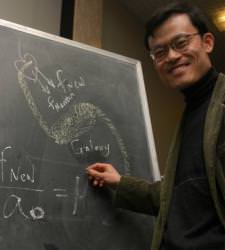
Dr. HongSheng Zhao at the University of St. Andrews School of Physics and Astronomy has developed a model that shows how dark energy and dark matter are more closely linked than previously thought.
Dr Zhao points out, “Both dark matter and dark energy could be two faces of the same coin. “As astronomers gain understanding of the subtle effects of dark energy in galaxies in the future, we will solve the mystery of astronomical dark matter at the same time.”
Just a quick explainer. Dark energy was discovered in the late 1990s during a survey of distant supernova. Instead of finding evidence that the mutual gravity of all the objects in the Universe is slowing down its expansion, researchers discovered that its expansion is actually accellerating.
Dark matter was first theorized back in 1933 by Swiss astronomer Fritz Zwicky. He noted that galaxies shouldn’t be able to hold themselves together with just the regular matter we can see. There must be some additional, invisible matter surrounding the regular matter that provides the additional gravitational force to hold everything together.
And since their discoveries plenty of additional evidence for both dark energy and dark matter have been seen across the Universe.
In Dr. Zhao’s model, dark energy and dark matter the same thing that he calls a “dark fluid”. On the scale of galaxies, this fluid behaves like matter, providing a gravitational force. And in the large scales, the fluid helps drive the expansion of the Universe.
Dr. Zhao’s model is detailed enough to produce the same 3:1 ratio of dark energy to dark matter measured by cosmologists.
Of course, any theory like this only gains ground when it starts making predictions that can be tested through observation. Dr. Zhao expects the work at the Large Hadron Collider to be fruitless. If he’s right, dark matter particles will have such low energy that the collider won’t be able to generate them.
The paper was recently published in the Astrophysical Journal Letters in December 2007, and Physics Review D. 2007.
Original Source: University of St. Andrews News Release
Can we create the stuff?
Does it already exist around us, and if it does, can we measure it?
Let’s see now. There’s got to be ‘dark energy’ and ‘dark matter’ because our theories say so. And of course our theories have always proven out to be correct. No other explanation apparently. Now if we could just do more than discover it, like maybe, actually find out what it is. Personaly, I’d be embarassed to have a ‘theory’ wherein 90% of the stuff is actually unknown. Oh well, back to our GUT theories. Maybe that new grant will come through!
E=mc^2 works, so why not ED=md^2 ? my point being if there is a known relationship where matter and energy are known to be the same, then same is true for dark energy and dark matter. And for all those who still believe in the big bang, your are idiots. the universe is going through phase shift just like an atom does when it gains or loses energy, from say a neaby universe.
I still believe in the Big Bang so I guess I’m an idiot.
Geez, here we go again. Another picture of some PhD standing at a blackboard… Put down the chalk and get back to real work. Even stop to think that the ‘dark’ stuff you’re looking for may actually be one of those extra-dimensions you physicists seem to have proven exist — we never know what it is but can only infer its existence by its effect on our universe. Oh how I love writing physics-babble…
How i love to watch people attack physics–the most provable and disprovable science around. But I’m an idiot for believing the Universe began from a single point called the Big Bang. So let me know the real truth, you physics haters.
I agree with Chris. If regular energy and mass are interchangeable why couldn’t the dark stuff do the same
It seems to me that people who agree with someone else, are agreeing with themselves using different names…at least sometimes.
I agree with idiot. DOH!
“But I’m an idiot for believing the Universe began from a single point called the Big Bang.”
The Big Bang Theory, as I understand, its not an attempt to explain the origin of the universe. The Big Bang was not an explosion. It just states that the universe has been expanding from a super hot, super dense state ~13 billion years ago.
It is simply, the apparent expansion of the universe.
Saying “we came from the big bang” is therefore, in a sense, like saying “life on earth came from natural selection.”
It just bugs me when people talk about the big bang theory or the theory of natural selection in the context of origins (of the universe/life, respectably).
Why is it that the internet is FILLED with people leaving passive/aggressive, smug, smart (bleeped) comments instead of constructive critisism, let alone anything insightful and/or intelligent?!? This covers the gamut from science sites such as this, to political, economic, computer gaming, et al…
I didn’t think I was being rude, I was just making a point.
Feel free to correct me. I consider that constructive.
But about the article, it is an interesting thought. I’d like to read more about this “fluid” and how it drives expansion on the largest scales but acts as a “pull” on galactic scales. Very counterintuitive.
But isn’t it always?
We searched for and rejected the idea that there is a fabric or medium, call it the aether, over a century ago.
Let’s start by dismissing the term particle as too specific to human sensory perception and instead call the collective observed phenonena – masses – instead just behaviors or functions.
Dark whatevers (mass and or energy) becomes the framework within which the observable functions operate.
Like the layers of abstraction that build up from machine language in a computer (read here dark whatevers or the medium) the observable behaviors of masss (e.g. inertial and weights) , etc. and energy become application layers on top f an operating system.
Gosh, aether is back!
Maybe this dark stuff is a force that is kind of like antimatter and so it would accelerate things such as matter. just as matter causes friction and slows things down (decceleate), this stuff would speed things up (accelerate) things.This could also explain wormholes.
I’m trying to understand this as best as possible, being only in high school, but if it was antimatter and actually had the ability to lessen the friction between matter, how would it hold things together? Or does antimatter have a gravitational pull all it’s own? From what I gather from the article, this dark matter is something that can hold a galaxy together. I can see from your standpoint how it would accelerate the expansion of the universe, but I still don’t see how it would affect a galaxy. Wouldn’t the galaxy disperse if it was accelerating as fast as the universe?
Dwight, I like your point about the dark energy/matter actually being the higher dimensions. I’ve been thinking about that myself, I think we are just too small to observe them but yet all matter and energy that we see is nestled in this, whatever the stuff is!
I wonder if there is research out there on this.
I think the suggestings made by of N. Stone are interesting concepts. Didn’t Einstein theorize the existence of something in his ToR beyond gravitional relationships of mass on mass?
Cosmology is a far cry from physics with regards to certainty. Of course the nature quantam mechanics still gives classical physicists headaches. Any physicist would cringe at a scientific discipline that has to invoke entities such as dark matter and dark energy to keep its theories from sinking. These concepts still seem a bit far fetched to me and I, like many others, would like to see either of these detected and measured for the first time before I am satisfied that everyone is on the right track. A little bit of reserved judgement and skepticism is always healthy. I always find it amusing how cosmologists can become absolutist when someone questions the existance of these entities which have yet to be independently observed and measured. To such people I ask is this a religion or a scientific dicipline?
Unfortunately, much of the “I’m right and the rest of you are idiots” stuff comes from intuitive thinking.
It has long been known that intuition can be thoroughly misleading in physics – especially on very small or very large scales. Let’s all keep open minds on this. There’s a lot we don’t understand, and it could be some time until we do (if ever).
I think i would have to say the some of you actually have valid points, Dwight, yes i can agree with you that this stuff might just be another higher dimension but what is it growing from?
My best guesstimate would be from everything that the black holes in our universe are eating up. I mean it has to be going somewhere right? And when this alternate universe fills up with too much matter then POOF another universe is so called born from our point of reality.
All I was meaning is that if the universe is expanding (which it is) and at an accelerating pace (whch it is), that is similar to what happens in an atom during phase shift. the electrons increase orbit to take on energy or decrease orbit and expel a photon. i believe the universe is one of many and ours is taking on energy from a neaby universes. i dont see why an expanding universe leads people to only one conclusion that it started from one spot. we can observer at the atomic level the same thing the universe is doing, but do atoms originate from one spot? make sense? i could be wrong, but i believe that in my heart.
Dr. Bill,
You got it right!!
Why does anyone assume that with their limited knowledge and understanding that they should be able to comprehend the greatest mysteries of the universe? Not even the scientists working on this think they know how it works. There are some working theories and suggestions only. If anyone here thinks that they can actually understand alternate universes as put forward by string theory, then you live in a overwhelmingly simplified universe or you are kidding yourself. They are, at best, mathematical concepts without even a hint of what they might mean to us in a visual or Newtonian physics way. We are babes in the woods in this field.
In response to Cloy: don’t think of antimatter, but of a new kind of vector field, like the magnetic field fridge magnets create. (A vector is an arrow, so a map of wind speeds and directions is another example of a vector field.) Dr. Zhao seems to be saying that he can mathematically define a vector field that has positive pressure (and thus positive gravity) in and near galaxies, but negative pressure (which accelerates the universe) in regions far away from galaxies. The difference between those regions is the acceleration of gravity – relatively high near galaxies, relatively low far from galaxies – and at a certain acceleration his `dark fluid’ changes its behavior. It predicts 2.25 times more ‘dark energy’ than ‘dark matter’, not far from the factor of 3 observed; that plus some other predictions make it more than just a mathematical curiosity. We’ll see if it holds up to testing…
There appears to be much confusion, even amongst many science and math teachers, about the so called ‘Big Bang’. The ‘Big Bang’ is not a theory! It is a description on the present behavior of the universe that arises as a consequence of Einsteins ‘General Theory of Relativity’, and supported by many astronomical observations.. It does not concern itself with the beginning of the universe: it predicts an absurdity – a singularity – at some point in the distant past. This is a long recognized constraint on the description, and possibly on the theory: hence attempts to overcome this problem by formulating ‘Cyclical’ universe hypothesis, ‘string’ and ‘M’ theory, etc.
As to the topic of this article, the possible unification of dark energy and dark matter is intriguing but I am still uncomfortable with these mysterious ‘dark matters’. Dark energy may seem to be necessary because of oversimplifying our models of the universe: It reminds me of the story of the physicist asked by a dairy scientist to help him improve the milk yield of his herd. The physicist began “we will assume and spherical, isotropic, and homogeneous cow”,
Other explanations for the observed phenomena are not, at present, in fashion but seem to me to be worth much more consideration. For example; The paper by Nan Li, Marina Seikel and Dominik J. Schwarz (arXiv:0801.3420v1 [astro-ph] 22 Jan 2008). “As to the problem of dark energy and dark matter, their unification: Is dark energy an effect of averaging?” In place of assuming that unknown dark matter and dark energy are the dominant contributions to the cosmic energy budget. They review the logic that leads to the postulated dark energy and present an alternative point of view, by properly taking into account the influence of cosmic structures on global observables.
Mustapha Ishak, James Richardson, Delilah Whittington, David Garred (arXiv:0708.2943v1 [astro-ph] 22 Aug 2007) “Dark Energy or Apparent Acceleration Due to a Relativistic Cosmological Model More Complex than FLRW?”. Their work appears to support the possibility of apparent rather than real acceleration.
And David L. Wiltshire has taken an alternative approach to this problem for many years. For example in “VIABLE INHOMOGENEOUS MODEL UNIVERSE WITHOUT DARK ENERGY FROM PRIMORDIAL INFLATION” (Xiv:gr-qc/0503099v5 11 Jul 2005)where, from his abstract “A new model of the observed universe, using solutions to the full Einstein equations, is developed from the hypothesis that our observable universe is an under dense bubble, with an internally inhomogeneous fractal bubble distribution of bound matter systems, in a spatially flat bulk universe….”
Perhaps it is time to begin to question the very existence of dark matter!
If Big Bang existed , so where was is come from ? . If there were extra dimesions , then who made them . Don’t tell me that is God , and don’t tell me it works itseft . Nothing in this universe has no its reason , even God .
To the article , I think Dr Zhao’s point is right and the explanation of Chris Paino is reasonable .
Ok, so I sorta get it.
Though I do have a couple questions.
How far apart are galaxies usually? and what lies in between them? Floating stars or something? It does make it hard to believe that there isn’t anything in-between galaxies besides dark matter. And I hear researchers trying to figure out what lies beyond the universe’s boundaries, but not a single one trying to figure out what lies in the center. In a galaxy it’s easy to see the center of it is either billions of stars or one massive one (whichever it is, is hard to tell when just looking at a picture of one) but is the center of the universe the same? One massive collection of stars/gravity/dark matter? It’s all very confusing.
Thanks Phan An. Assuming accelerated expansion means only one conclusion, that things started in the middle, we dont have enough informationt o draw that conclusion. another analogy would be if someone had a train going toward them and they opened their eyes for 1 millisecond and closed them, during that 1 millisecond observation, they would not even realize the train was moving. the observation period is too short. as we observe the universe, its from the perspective that it must be expanding from some beginning location in the middle. if we observe it long enough, it may start to contract back for all we know. thats what i think is going on. thanks for thinking it’s plausible that we don’t know something we think we do. (big bang).
It just seems that what happens at atomic level is similar to solar system level and galaxy level and universe level. for my whole life, i thought there has to be stuff in middle of galaxy because there was stuff in middle of atoms. science didn’t teach that when i was in shcool, it just seemed to make sense. Then, they find out middle of galaxy has large black hole. I wasn’t surprised to hear that. I wont be surprised when they find the middle of the universe has something in it. Perhaps we can’t see it, but something’s got to be holding the universe together. In any event, i just see things as repeating pattern..atom, solar syste, galaxy, universe(s).
I am reminded of the deaths of stars…the outer layers being repulsed by the collapse of the core.
It’s hard to visualize how something could simultaneously expand and contract (oversimplified? well of course), but thats too be expected. Our brains are much better at comprehending the accumulated effects than all the variable causes (which tend to get lost or meaningless in the grander scope of things, e.g. chaos theory).
I like it when ideas like this set up camp in my thoughts and won’t be ignored.
hmm. I see what Chris Paino is saying (about patterns of atoms/solar systems/galaxies/etc.) but now I’m wondering why the middle of the galaxy glows brightly like it does. Almost like a star in itself. If this is, as you say, a black hole, why doesn’t it seem like one that is smaller and already in the galaxy it’s creating? I heard black holes were just dark spaces with immense amount of gravity (could this contribute to dark matter?) so why is the center of a galaxy look more like a giant star? Furthermore if the relation between atoms, solar systems, galaxies, and universe(s?) exist then if the universe is expanding, then why doesn’t the galaxies, solar systems and atoms expand too? or do they at a lower rate of speed? sorry for all the questions, but they’re really bugging me.
> How far apart are galaxies usually?
Big galaxies are about 5 million light years apart on avg.
> and what lies in between them? Floating stars?
Mostly just ionized hydrogen and helium gas, plus dark matter (most astronomers think).
> And I hear researchers trying to figure out what lies
> beyond the universe’s boundaries, but not a single one
> trying to figure out what lies in the center.
That’s because the universe has no center. It’s easy to understand if you imagine a universe of two space dimensions (instead of three) plus one time dimension. The two-dimensional universe is curved like a balloon – but remember, you can only move in two dimensions – on its surface. The third dimension (the “radius” of the balloon) is time – so the balloon-universe expands in time, not in space: it had a higher (surface) density in the past, but it never had an edge or a center in space, just a beginning in time – the Big Bang. Now, it’s harder to picture the same thing in 3 space dimensions + 1 time dimension, but that’s roughly what Our Weird Universe (as I like to call it) is like.
You lost me.
> You lost me.
No problem – it takes some getting used to!
Try this: in which direction – North, East, South or West – would you drive a car to get to the center of the Earth? Well, you can’t drive in any of those directions and reach the Earth’s center; you need to move in a 3rd space dimension.
And no matter what direction in space you move in our universe, you’ll never reach a ‘center’.
So, instead of the Earth’s surface (a 2-dimensional surface plus a 3rd dimension of space), imagine a balloon where the 3rd dimension is time. Then you have a 2-dimensional universe expanding in time. The “center” of that balloon universe is a point in time – the Big Bang. The balloon universe, like ours, has no beginning or end in space, just a beginning in time.
Sounds weird, I know, but the difference between that balloon universe and our 3-D universe expanding in time is just slightly different math.
There’s another description of all this here:
http://www.ucolick.org/~mountain/AAA/030209.html#expansion
salineman,
I take no offense at your remarks. In fact, I seem to agree. The reason I use pen names like “idiot” and “not as smart” is my inability to articulate as well as most folks on here. If I understand you, the Big Bang wasn’t really an explosion, but a sudden flux and expansion of which we know nothing of what came just before it.
That’s a great mystery–the “what caused the Big Bang?” Anyone Know?
So if we were able to find a way to use this “3rd dimension” in the universe, would that be sorta like “time-travel”?
It’s hard to picture something like time being able to fill the space inside the universe if the universe was like a balloon because that makes time seem like a form of matter that is pushing against the sides of the universe, making it expand.
It certainly would be weird and awesome (the archaic form of the word) to be floating inside that if ever we found a way to.
Also, if a point inside the “balloon universe” is a point in time, would it be recorded like a fossil in a rockbed? If that’s the case wouldn’t we look at the universe like (shrek reference coming) an onion?
It wasn’t a Big Bang, it was actually a Big Tug caused by the Gravitational Force provided by the Dark Matter that existed in the surrounding “Pre-Universe” back then. That Dark Matter is the same DM we now believe exist. I postulate the Universe existed prior to the “Big Tug” but in a totally different form. Not enough room here for the whole theory.
And I call myself idiot. ha ha ha!
just joking. i know you’re joking.
You know, Newton discovered this inverse square Law, based on a simple algebraic equation. He used math to explain his Law, and math is a theory, The Theory of Numbers… Hmmm, this is getting interesting. Maybe there is some Imaginary Universe, like, U i = (U(-1)). Hey, maybe Universe has a trigonometric identity that makes it seem different, but it is actually the same thing. What if the Universe is a Sum of Riemman (or Riemann, wathever) of an infinite amouth of Universes, and so, of matter, wich, by the way, implies that matter could be created or destroyed…. Oh, what da’ I completely lost it, HAHAHA! I’m saying that classic Physics is wrong because its laws are based and explained by a theory. Man I’m not making sense at all…right???
Sorry to poke your Einstein for a dull moment.
Sorry for the misspelling. AMOUNT it should say.
Seems to me that super string theory provides an approachable explanation as it posits the existence of all things, matter, energy, particles, waves and space/ time itself as manifestations of variations in string vibrations. If this line of reasoning is followed, it becomes possible to reconcile what appears to be contradictory into a unified description of “how stuff works” and what stuff is. It still leaves open the ultimate question of the origin of any and all of it. However, it is likely that the end of all inquiry will be but to arrive at the place whence it began.
If the Big Bang really was, then before it happened, it must have been the biggest-baddest black hole ever. And if it was indeed a big black hole, then why did it destabilize and explode, or eject all of its contents? Is this ‘ejection’ finished? The contents and distribution of the universe suggests that this ‘ejection’ is ‘still’ going on, depending on the time scale due to light speed. Does this indicate/suggest that black holes (as we currently know them — they suck and do not spit) can explode or eject matter? And if they do explode or eject, is the result of this the start of a galaxy?
I asked sorta the same thing a couple weeks ago, John. Apparently we (myself included) say that the universe was started, not in space, but in a certain time.
This is from what I understand.
Think of the universe like a balloon. The “air” inside and around this balloon isn’t a place in space, but a place in time (the inside being the past and the outside being the future). When the balloon started swelling, that was the beginning of time. But as you know, balloons are hollow and the elastic isn’t found in the exact center of the balloon. All that’s inside it is air, or in this case, time. If your black hole, or an explosion existed to begin with, is not really likely unless the explosion expanded like a balloon.
To answer your galaxy question, a supernova is what you’re thinking of. The intense explosion/implosion of a superstar scatters matter all around the universe, but due to the immense energy/gravity of the implosion, it then creates a black hole. Since the matter surrounding the black hole is traveling at an incredible velocity, it somewhat gets caught by the gravity and fights to be freed. Thus you get rotation and the birth of a galaxy. I understand that might not be quite the whole process, but thats the gist of it i guess. Someone correct me if i’m wrong.
I believe that the smallest possible space “particles” are actually the bosons of the gravitational field. It would explain many divergent theories. Space “particles” overlapping under massenergy density would explain space-time curvature, it would give a mechanism for gravitational waves and would unify general relativity with quantum mechanics. It’s really neat.
Dr. Murad Shibli with the Aamerican University of Sharjah has proposed a new theory on dark energy and has been publihsed at IEEE and entitled as “The Foundation of the Theory of Dark Energy: Einsteinapos;s Cosmological Constant, Universe Mass-Energy Densities, Expansion of the Universe, a New Formulation of Newtonian Keplerapos;s Laws and the Ultimate Fate of the Universe”. For more information please visit the following link.
Dr. Murad Shibli at the American University of Sharjah has proposed a new unified model on dark energy and dark matter. This model will b epresented at INTERNATIONAL CONFERENCE ON RENEWABLE ENERGIES AND POWER (ICREPQ 08 ) in Spain on March 12-14, 2008. The article presents a proposed equation of state of dark energy and dark matter as one unified entity. Such an equation is derived based on the assumption that dark
energy and dark matter behave as a perfect fluid, the ideal gas equation, Boltzmann constant and the energy-mass
principle of Einstein. As a result of that, it is found that dark energy and dark matter are not distinct, on the contrary, both dark energy and dark matter represent one
unified entity. This agrees with the recent observations of NASA that dark energy and dark matter has close density values and in the range of 10^-26 kg/ m^3. The ratio between the energy density (in Joules) and the mass density (in kg/ m^3) are proportional to the Square of the Speed of
light. Moreover, this ratio is found to be equal to the product of the space temperature and the dark energydark matter parameter (as a perfect fluid). An alternative presentation shows that the ratio between the dark energy
and dark matter molecular density is proportional to Boltzmann constant. Furthermore, this approach might be
useful to utilize the free source of energy associated with dark energy and dark matter at high temperatures. Finally, simulation for our milky way shows the validity of these results
If dark matter really existed, the amount of dark matter mass necessary to cause the observed irregularities would logically preclude the rapid expansion of the Universe that we now have. Furthermore, I cannot conceive of such a mass that would not have pulled itself together forming very large bodies. May I suggest that our observed irregularities could be “Space Time Warp Proportional Factor”; depending upon how close a body is to the center of the Galaxy? Gerald Blancett
Maybe dark energy is continuely birthing dark matter. The dark matter in turn could be slowly coalescing into visible matter. And just maybe this mysterious dark energy and material could be the actual stuff of the “big bang.” Who said the “big bang” happened in a fraction of a second? Could it be the “big bang” was nothing more than this dark energy chaotically converting into invisible and than into visible matter in our part of a boundless universe and continues today? That might explain blue-shifted galaxies and the mind-bending hodgepodge of all that we see in the universe.
is it possible that the universe began with a dark matter implosian?
there is no universe. there is no matter. there is no energy. we are all just living in dreams.
Electron Mass Me=9.1093818872e-31
Proton Mass Mp=1.67215813e-27
Neutron Mass Mn=1.6749271613e-27
Difference in mass of proton and neutron is 2.7690312999999995e-30 (possibly the mass of an neutrino or quark. )
1/3 mass of an electron is:
Mx=3.0397576194394586
Integerizing this slightly we can see the mass of a proton is very close to the mass of a neutron minus the mass of an electron, the rest can be possibly explained by energy release as some form of EM radiation and the kinetic energy required to keep the electron spinning around the nucleus, which may well be faster than the speed of light as if you read more carefully and correctly the equation E=mc² (wether correct or not is not the debate here) is possible as the speed at which all matter becomes energy is c² (not c as popularly misconstrued.)
Mn/Mp=1.0016559625853087
Is this the ratio of elementals in each particular particle.
IF electron is base unit(1) then should be integer number within proton.
Mp/me=1835.6439006576552
IF electron is base unit(1) then should be integer number within neutron.
Mn/me=1838.6836582770947
Could actually say fractional part is due to error at this level and for ease of sums say:
No. of electrons per proton is:1836
No. of electrons per neutron is:1839
As measurements increase in accuracy, there is a slight upward trend in the value of mn,mp and me but this is such that
The trend suggests mn/me tends towards 1836 while mp/me tends towards 1836. As increase in descrepency on mp is greater than that in me This is only a difference of only 3 units which as postulated by Quark theory that an electron is a group of 3 quarks(-+-) grouping is rather suprising, that is to say that by removing the same 3 basic units of an electron from a neutron you’d get a proton.
Even without rounding the figure is only:
1835.6439006576552/1838.6836582770947=-3.0397576194395697 or to put it another way accounts for a pretty accurate 99.83467750932817% of the mass of the electron, considering the errors that could creep in on such small scales this is pretty damn fantastic I’d say and so far involves no special case maths and quite possibly simply follows the same rules as the rest of the universe!
In fact these slight errors could be easily dismissed as errors in magnitudes of 10 from the true number of particles within each subatomic particle.
For example would the same hold true to the figures if the unit of mass of the absolute small particle was not 1/3 of the mass of an electron… but by moving along the scale of the figure 3.03646062906… recurring, we could equally say this is 303 particles and the 0.646062906666..7 is the error. Would it still hold true for the rest of the workings to the same level of accuracy in that
The proton+electron = neutron. AND neutron/mass of particle AND proton/mass of particle are whole numbers (near enough) and that these hold true to the numbers above in that
particles/neutron = particles/proton + particles/election. And also that if particles/electron is odd then particles/neutron=even and particles/proton=odd.
In a C program this could be written as fullfilling the requirements.
(ParticlesPerNeutron==ParticlesPerProton+ParticlesPerElectron) &&
((ParticlesPerElectron & 1)==(ParticlesPerProton&1)) &&
((ParticlesPerElectron & 1)!=(ParticlesPerNeutron&1))
This I will not go into here as there is no need, for the basic rule should follow of all the groups and subgroups within whatever particles are found until the ultimate singular particle is found (if indeed it ever can or will be and isn’t some singularity as some suggest blinking in and out of existence).
In theory other conditions could be met too, such as ParticlesPerParticle should be able to fit in a perfect equal sided lattice of perfect spheres in each case, that’s assuming they are to be spherical and all equal in size, as there a lot of gumph on sub-atomic physics and it seems almost anyone can make it up but irrelevant of this I think it is most likely that the very very basic building block, no matter what it is would be spherical in overall effect as particulate form.
Not spherical objects would defy most common sense of equal distribution due to equal forces throughout the singularity which is at least possibly the one thing most physisists can agree upon when dealing at the level of a single unit with no outside influences at all except its own internal binding, however completely unlikely or indeed impossible such a possibility would exist anywhere in the universe!
A similar theory was postulated by the man who predicted the existence of quarks!
The reason the “Dark matter” was invented is in fact that scientists are arrogant enough to think they can estimate the mass of the universe when they do not even know what percentage of it they can yet see, much like answering the conundrum:
“On the other side of a piece of paper is a length of cotton, through a small hole you can see only 2 inches of the cotton, how long is the cotton in total and what percentage of the cotton can you see?”
The whole problem with quark theory is how do you arrange only + and – in a clump so that there are no ++ interactions and no–interactions… when there is not another force at this “primary” level in fact it is theoretically and practically impossible.
Going along this line obviously facilitates the need for a neutral particle in the model so either there is +- and neutral or just a minus and a neutral (or a plus and a neutral for that matter)
In fact it feels better in the gut to think of a positron as having a “lack” of electrical charge than the opposite of it and so these are the neutral part. After-all it was at once standard scientific practice to measure the well know Volts as “Potential difference”.
In fact though simple is possibly the best explanation that we have at present.
An electron is thus a minus-nuetral-neutral combination as this is the only possible combination where there is no — repulsion from itself wherin it would tear itself apart.
A proton is in effect 1836 of these 3 bit combinations and A neutron is in effect 1839 of these 3 bit combinations in this simple model.
If we break this down further then the sum totals is 1839 (neutron):1839 (electron+proton).
The proportion of these particles in the universe is thus most likely to be 1:1 in the universe.
A “positron” is thus (N-N)
An “Electron” is thus (-N-)
A note on the apparent occurence of positrions in a Neutral-negative model. The effect of magnetism in one direction is the result on the interaction on a particle that is
-N- or where charge outweighs mass. Whereas under reverse conditions when neutral particles outnumbercharged particles then the effect is reversed.
Conclusion:For the above to happen all substances must have some effect under magnetism, even uncharged. [After looking this fact up]:This is found to be the case and so fits the results.
From these figures I would conclude that there is a 99.83467750932817% chance that the explosive composition of the big bang was a 1:1 mix of “neutral” and “charge”, though what as the name is just that it could be the neutral is a plus and then negative is a 0 if you catch my drift. Whichever perspective you take on that, the ratio will be 1:1 for one to the other overall.
Thus if you ask me, there are two points to be made, the big bang (if u believe in it) would of been a uniform explosion from that point of singularity. The quantity of mass in the universe would be about 1:1 charged to non-charged, including all forms (energy too I guess).
As for the 90% inaccuracy, isn’t it a bit pompous to think we can guess the mass of an unknown volume of mass and energy, maybe it’s the 90% we can’t see or calculate for and even with our best efforts we are still only a tenth of the way to knowing what scale we are really dealing with.
Time: Was einstein’s theory actually not trying to simply say, if something travels as fast or faster than light, it would APPEAR to do so instantaneously to us as viewers, well not instantly (wrong wording), we would not be visible until we reached our destination (that’s a better way of wording it)
If I’m sat on a ship at light speed and I travel for one second of my time, that time still passed for me. It still passes for you too, but you can’t see me until I slow down again below the speed of the very light that our primative eyes use to detect our 3D environment. We as a species are limited to light speed or far less at present because we have no direct thrust sytem that can approach the forces required to attain any greater speed for much larger than small particles.
Now at the quantum level we are told a similar ratio exists between pion and neutral-pions and still the theory holds true.
On the subject of time. Is it not true that all forms of radiation are emitted from our sun, so what effect would that have on an atomic clock as it passed into the earth’s shadow?
You would get a time “increase” reading on your clock in direct sunlight and this would be curved due to the simple fact that as your path approached 90 degrees to the stream it would cut through more of them (like rain in a moving car seems heavier effect). and then decrease again as you went into the shadows, peaking at an all time low directly behind the earth, but this effect due to distortion by atmosphere and earth’s mgnetic and gravitational effects would produce a non-circular distortion on our clocks reading if not continuously subtracting only the background influence on an identical counter at almost the exact same spot (or as near as can be).
This effect would mean that our atomic clocks would show an effect of time increase and decrease effects as if time were distorted by the earth’s shadow.
That would certainly explain a few “time” issues and the problems associated with the “time-gravity well” theory in that it does not quite fit!
In fact it’s a bit like re-inventing the sundial but keeping track of it digitally then wondering why it loses time overnight if you can imagine such a scenario.
LOL on time and how we change it as needed because it is an arbitary unit to measure our existence and events in it … time zones.
The server says posted 8:47pm whereas my PC clock here in the UK says 4:47am
Maybe the pre-universe void occupied by the present visible universe contained the “dark energy” of creation that is mystifying us. And the “dark matter” we detect currently could be a condensation of this primordial void energy into matter. Crazy? Maybe not! The estimated 3:1 ratio of “dark energy to matter” that probably existed at the start of the original “big bang” may explain the residual background heat detected today. Condensing the 3 of energy into the 1 of matter may be the case here and is still in progress, albeit, on a scale we simply can’t detect. The classic “bursting forth of matter from a single point” big bang theory is highly questionable. There appears to be entirely too much chaos in the universe for all matter to have “bursted forth from a single point.” A single point origination suggests there should be more uniformity of motion due to straight-line momentum. The accelerating expansion of the visible universe could be a “thinning our” of galixies resulting in a weaking of gravity producing the expansion effect. A bit like 32 fps/fps, only on a mind bending scale. Could be the universe hasn’t yet reached terminal velocity. I suspect we fail to see the simplicity of all that perplexs us in the visible universe.
I am only in high school and do not know very much about this kind of stuff but I find it very interesting when I find out more things. But what if the big bang, “bursting forth of matter from a single point”, really did happen but was caused by antimatter colliding into matter, because I heard that if that happens there would be a humungous explotion. If this is true that could explain why the universe is expanding. Maybe we only see it as expanding but it is only stretching out. This could be causing the acceleration of the universe because the gravitational pull of everything is thinning out. The “explotion” caused by antimatter and matter colliding could have also created the dark matter and energy. It could be a product of anti- and matter meeting.
A lot of what has been said has been very intriguing, although I have yet to see anyone mention a complete possibility. I offer an insight that has not been refuted to my knowledge.
Take, c = the past, b = the present and a = the future, then time, as we perceive it goes in the direction of c, b, a. Time as we all know, has been around before us and when we got here our ancestors, up to us, have always perceived time as c, b, a. I submit that the fourth dimension (time), is the catalyst. An example of this would be when you are sitting in your car in the center lane and there are two cars on either side of you. The two cars on either side of your car move slowly and simultaneously backwards, you will perceive it as if you were moving forward, even though you are sitting still. Suppose time’s natural motion is to move through space as a, b, c, (in our perspective, reverse). This could get a little complicated, being that this would mean that we all know what is going to happen after the present, (our past) but we would not know what is going to happen before our present, (our future). Gravity has been shown to be getting weaker and disappearing from our universe in our perspective, but in my concept, gravity would be getting stronger and everything in our universe would be coming together and in about 13 billion years we will have a big collapse (BIG BANG).
wow, really sounds like “and Gd hovered over the waters”
i don’t know guys, sounds like macroscopic electrochemicals to me. I like it.
Hey! Everyone slow down. Let’s look at the logic of all we a talking about. Let’s start with energy and matter. We know, or at least we think we know that energy is one form of matter and matter is a form of energy. So, it it reasonable to think that some form of energy just had to exist prior the big bang. Otherwise where did the building blocks of all that we see come from? The big bang may be as simple as this pre-universe energy morphing at some unknown rate into this mysterious stuff we are having trouble explaining.
OK, Chuck. But then there had to be matter at the beginning to create the energy that is now pushing the universe apart. Seems like chicken-and-egg to me. However, not being a science guy I could have read you wrong.
Dark matter & dark energy – is space matter between our expanding universe and the walls of the sphere in which our universe is located. Both their functions is to filter out the energy before going thru the wormholes into the next sphere that is wrapped around us. “The Creation of the Universe using the string theory and the reality of the gene.” You want to know ask me about it.
FWIW…Chuck Lam’s explanation matches that found in the Urantia Book’s chapter “Energy, Mind and Matter “(printed 1955… electronic version can be downloaded free)
If big bang had been making full of rotating objects, that must from random rotating bang center. Propagation galaxies must be one of this another random rotating seem like foams are happen in ocean of the dark matter. You know that pulsar or galaxy have planar rotating on 2 dimension, but center of big bang must have many rotating in space-time.
For UNIVERSE TODAY
I want to say that we know the Structure of atom, but do not know that how many photons are present in an atom in the form of energy? No one can give answer of this question as Planck constant that E = h? is the energy of some packet of photons. Again, I can ask question that how many photons are present in E when E = mc2? or what is the internal function of m when m is acting with c2 ? In what way the particle is producing energy in the form of photons? What is the structure of electron, EMR? In what way the Universe was created? What is the actual form of it? Lot of questions are there. I solved it and published book as given here: 1) Mystery of Origin of the Universe (1990), 2) Complete Unified Theory (1998).
But scientists are trying to establish the Dark matter and Dark energy. What is the mass of it? With out mass we can not think about energy. If E = mc2 is not obeying this rule, then why Einstein equation? Why matter, Why energy? Are matter occupies in the Dark space? What is the utility of dark matter? Is Dark energy can solve the birth of the Universe? If Dark matter and Dark energy are in together, then is it possible to write ED x MD = MD2 x c2 = (MD x c) 2 , it is showing the momentum of the particle. Thus the dark matter is not able to form energy until unless it functioned in the form of E = mc2. Again what is the mass of a Dark matter? Without knowing the mass, it is not possible to find the energy of it. So, no need to think over it, until we not know the accurate mass of a photon which is very practical. We can say, without light we see dark only. Light or photon is the all source of energy. At first it is require finding the mass of a photon accurately. The group of scientists or investigators are trying to find out the mass of photon experimentally, but obtained results are not tallying with other investigators. So, it is in the dark till now. I calculated the mass of a photon accurately and written in my book mentioned above. You can get my comments and hints on the complete unified theory / Mystery of origin of the universe from the website given bellow:
1) SAO/NASA ADS Astronomy (ABSTRACT: A scholarly treatise on the mass of photon or its properties which has been the source of many discoveries regarding the matter (Universe).
2) [email protected], 3) Experiments at CERN help us understand the world we live in …, 4) books search- The Library, The Abdus Salam International Centre …, 5) Scientists break the speed of light – Business – iTnews Australia, 6) Amazon.co.uk: Mystery of origin of the universe, 7) SB Berlin PK – Search Short List-[ Translate ], Andy Evans. … Complete unified theory / Nirmalendu Das. – 1. ed. …, 8) Table of Contents I-001 Microwave Applications in
File Format: PDF/Adobe Acrobat – View as HTML S-005 The Mass of a Photon is the Key of all Source of Energy & the Result of Complete Unified. Theory; It can Explain the Structure of Electron, …
Website -http://unifiedtheorynirmalendudas.synthasite.com
Thank you Universe.
Dated: 24/11/2008 Nirmalendu Das, Siliguri, West Bengal, INDIA
To,
The Head of the Authority of NASA,
Sir,
Kindly go through this page for the benefit of the scientific world.
As per different report received from Internet that NASA is doing lot of scientific works on physics & astrophysics. It requires to more improve on the subject of the creation of the universe. I want to give suggestion that you may go through “Mystery of Origin of the Universe” and “Complete Unified Theory” written by me and totally scientific work in which NASA can get many information and may discover that in what way particle, stars, etc can give energy; in what way the particles, stars, galaxies, universe created. We know that Einstein energy equation is E = mc2, but do not know that what is the internal function of m with effect of c2 during emission of energy E ? You cannot answer of this from our traditional theories. But you can get answer of this from my books. Also we do not know about “Unification of Physics” and “Complete Unified Theory” till now, scientists are trying for this from 1873, many theories like string, super symmetry, GUT, Big Bang etc came into the picture, but no theory can explain abut the creation of the actual form of the particle, universe. With the help of single theory “Complete Unified Theory”, it is possible to explain all phenomena from the particle to the universe. I found that the quantum circulation of Black Hole is 3.0440727×10⁻²⁶ m2 / sec , mass of a photon is 1.65961×10-54 gram; it can explain the structure of electron and can define the structure of electromagnetic radiation. There are till unknown to us. Likewise, lot of things is there which are most interesting.
You can search this book from Websites. So if you want to do work on this subject, may contact me.
Email: [email protected] , Mob: India 09475089337
Dated: 06-03-2009 Yours faithfully,
Nirmalendu Das
When solomon was dedicating the Temple to GOD, he says that our God dwells in the THICK DARKNESS. Is it possible that Dark Matter is a celestial curtain that hides Heaven just as there was a curtain that hid the Tabernacle within the Earthly Temple.
More thougts on a celestial curtain.
This dark matter takes up most of the universe,does it have gravity?If not,how comes that it can bend light?any thoughjts anybody.
Greg, said “These concepts still seem a bit far fetched to me and I, like many others, would like to see either of these detected and measured for the first time before I am satisfied that everyone is on the right track. A little bit of reserved judgement and skepticism is always healthy. I always find it amusing how cosmologists can become absolutist when someone questions the existance of these entities which have yet to be independently observed and measured. To such people I ask is this a religion or a scientific dicipline?”
I’m requoting so much of what he says because he says it well. I really enjoy the physics theories. I get a little weirded out, though, when physicists (or journalists) start quoting them as being simiply true. It may be a long time before we understand such things. And we need to keep open the possibility that we may never understand such things. A bunch of creatures with three-pound brains, located at what is essentially a single point in an astonishingly vast continuum, may have neither the opportunity nor the wherewithal to observe or explain all aspects of the cosmos. A little humility might be wise.
If you ask me Dark energy/matter is actually the finger prints of the super-strings that existed at the time of the Big Bang.