 Universe Today
Astrophysicists think that black hole masses are heirarchical. The largest are supermassive black holes (SMBH) like the one at the center of the Milky Way and other galaxies. Stellar mass black holes are born of collapsing stars, and are smaller. The smallest of all are the theoretical primordial black holes, which only formed in the weird physics of the early Universe.
Intermediate mass black holes (IMBH) are theorized to lie between stellar mass black holes and SMBH in the mass hierarchy. They have masses between 102 and 105 solar masses. The problem is, they've never been confirmed. Researchers found evidence of one in Omega Centauri in 2008, but subsequent research disputed that claim. As it stands now, the existence of IMBH is still unknown.
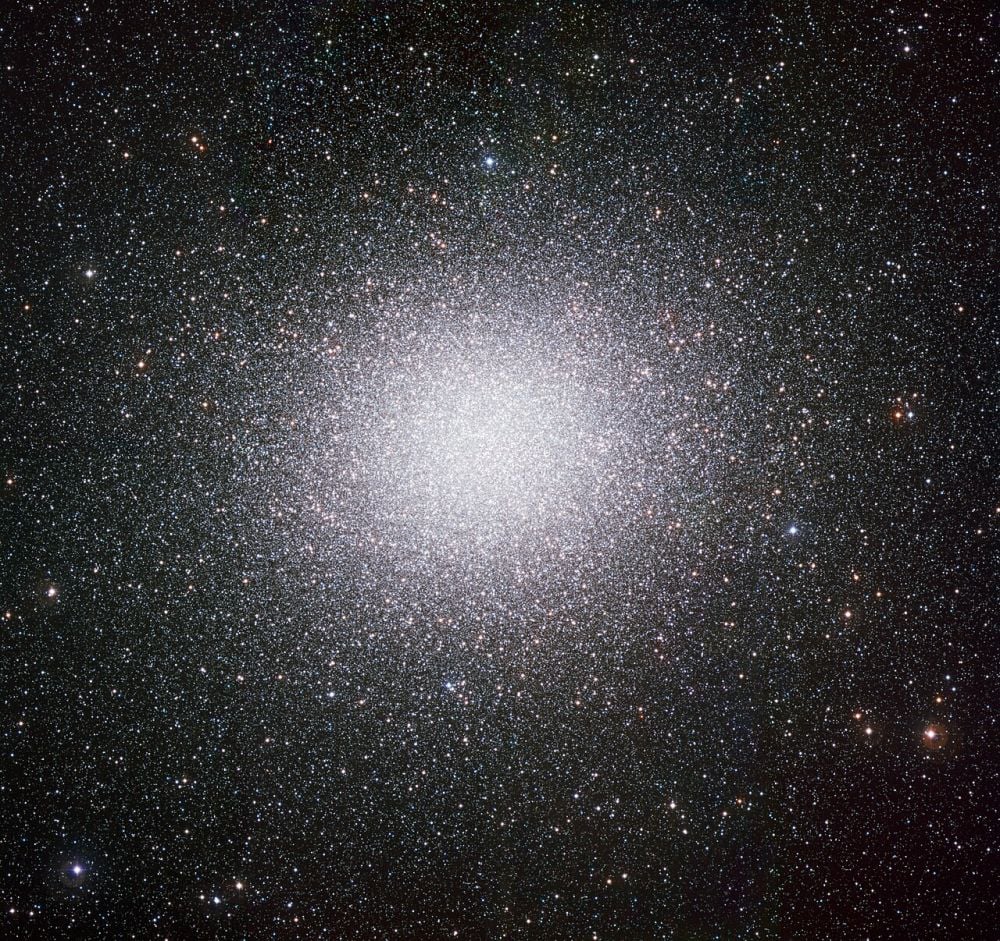 Some of the most compelling evidence of an intermediate mass black hole comes from the globular cluster Omega Centauri, the largest globular cluster in the Milky Way. Observations from the Hubble and the Gemini Observatory suggest there is one in the cluster's center, while follow-up research disputes these results. But theory suggests they're out there somewhere. Image Credit: By ESO - https://www.eso.org/public/images/eso0844a/, CC BY 4.0, https://commons.wikimedia.org/w/index.php?curid=6283919
If they're out there, new research proposes a way to find them. It's titled "Evidence for Intermediate-Mass Black Holes From Microlensing Signatures in CHIME/FRB catalog 2," and the lead author is Huan Zhou from the School of Physics and Optoelectronic Engineering in Yangtze University, China. The research is available at arxiv.org.
"Intermediate-mass black holes (IMBHs) are the missing link in the cosmic hierarchy of black holes, bridging the gap between stellar-mass black holes and supermassive ones," the authors write. They're also rare laboratories for testing what's called strong-field gravity, regions where space-time is severely warped by extreme gravitational forces. "However, IMBHs are a population that has remained notoriously difficult to detect," they explain.
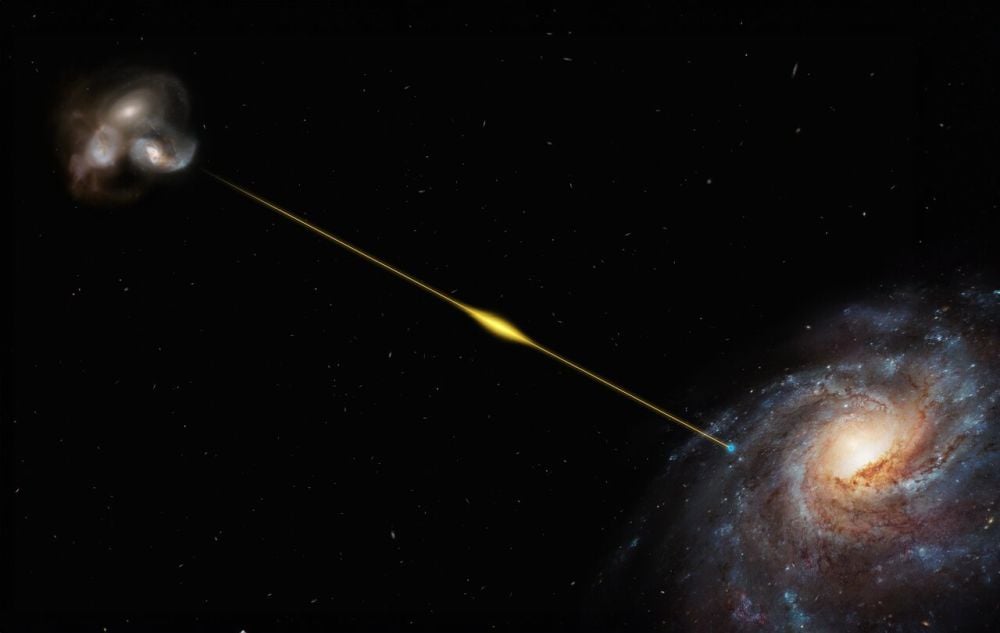
The researchers propose that IMBH can be detected through gravitational microlensing of Fast Radio Bursts (FRBs.) FRBs are transient radio waves that last for as little as a fraction of a microsecond and up to about 3 seconds. They come from a high-energy astrophysical process that is so far not understood or identified. "The microlensing effect of fast radio bursts (FRBs) can serve as a clean and powerful method to probe IMBHs," the researchers explain.
The Canadian Hydrogen Intensity Mapping Experiment (CHIME) has generated a catalogue of FRBs that the authors worked with. They found two microlensing signatures that could be IMBHs.
"Among FRBs, the most likely to contain lensing signals are those with clear multipeak structures," the authors write. "The light curve of a microlensed FRB will have an echo superimposed on it."
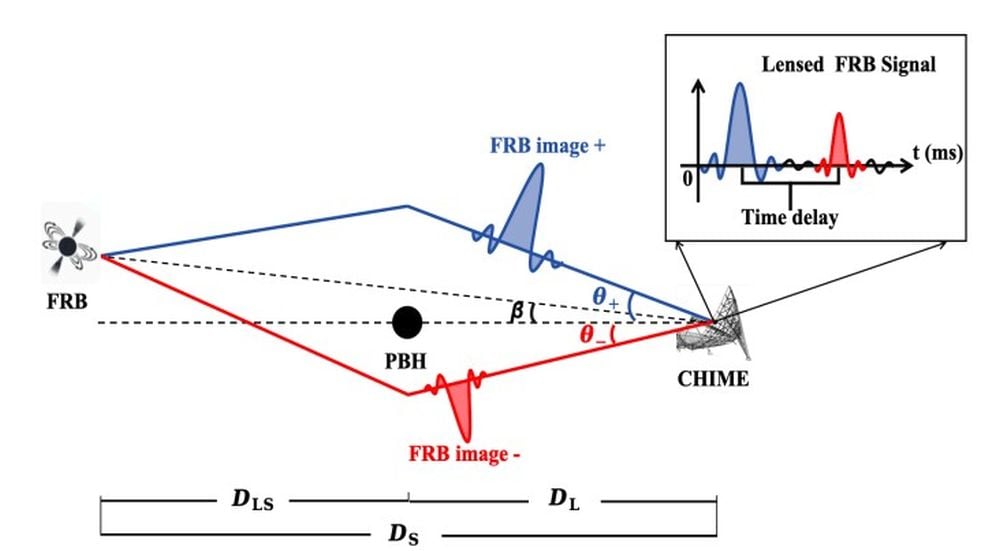 This schematic illustrates some of the research. It shows the FRB being lensed considering PBH as point-mass lens. An FRB with multipeak structures will appear as two distinct bursts. Image Credit: Zhou et al. 2026.
"The inferred lens masses for these two signatures are ∼ [539−609] solar masses and ∼ [1544−2571] solar masses, respectively," they write. They're both in the correct range for IMBHs.
The authors explain that if there are no intervening structures like galaxies or galaxy clusters along the line of site, then the IMBHs may be primordial in nature. This is because they're isolated and not inside any galaxy. They refer to them as PBH in parts of their paper.
Scientists theorized that PBH could be a significant part of dark matter, maybe all of it. In this case, all IMBH in the two mass ranges that these two sit in could make up ~4% of dark matter. If these detections aren't actually IMBH, these results still tell scientists something. In that case, IMBH in these two mass ranges can't account for more than 13% of dark matter.
"On the basis of the primordial origin, we obtained a preliminary constraint on the PBH dark matter fraction: 1) these PBHs would constitute ∼ 4% of the dark matter in the mass ranges ∼ [539, 609] solar masses and ∼ [1544, 2571] solar masses; 2) if these candidates are not true gravitational lensing signals, the abundance of PBHs with masses > 300 solar masses could be constrained to ∼ 13% at the 95% confidence level," the authors write.
But these interpretations only apply if these are real microlensing events and the detected pair of IMBH are isolated and not inside of a galaxy or galaxy cluster. To determine if that's true, we need a better understanding of Fast Radio Bursts.
"Therefore, more comprehensive observational information for FRBs, together with a deeper understanding of whether the intrinsic emission mechanisms of FRBs can produce lensing-like signals, will be crucial for establishing this effect as a powerful tool for probing (primordial) IMBHs," the authors write.

