Universe Today

Hidden behind veils of interstellar dust lies Westerlund 1, the most massive, luminous, and nearby super star cluster in the Milky Way. Despite being a stellar powerhouse just 12,000 light-years away in the constellation Ara, it remains invisible to the naked eye. Yet this stellar congregation has just revealed something remarkable: it’s actively blowing an enormous bubble of gamma rays into the space beneath our galaxy’s disk.
The discovery, published in Nature Communications, represents the first time astronomers have traced such an outflow from a galactic star cluster using gamma-ray observations. Led by Marianne Lemoine-Goumard from the University of Bordeaux, the research team sifted through seventeen years of Fermi data to isolate this previously hidden structure.
 Artist impression of the Fermi Gamma ray observatory (Credit : NASA/Aurore Simonnet, Sonoma State University)
Super star clusters like Westerlund 1 contain more than 10,000 times the Sun’s mass packed into a relatively small volume. These stellar giants live fast and die violently, unleashing powerful stellar winds and supernovae that push ambient gas outward while accelerating cosmic rays to nearly the speed of light.
Cosmic rays pose a unique observational challenge. Because they’re electrically charged, magnetic fields deflect them, scrambling information about their origins. Gamma rays, however, travel in straight lines. When cosmic rays collide with matter, they produce gamma rays at the impact site, creating a luminous signature pointing directly back to the action.
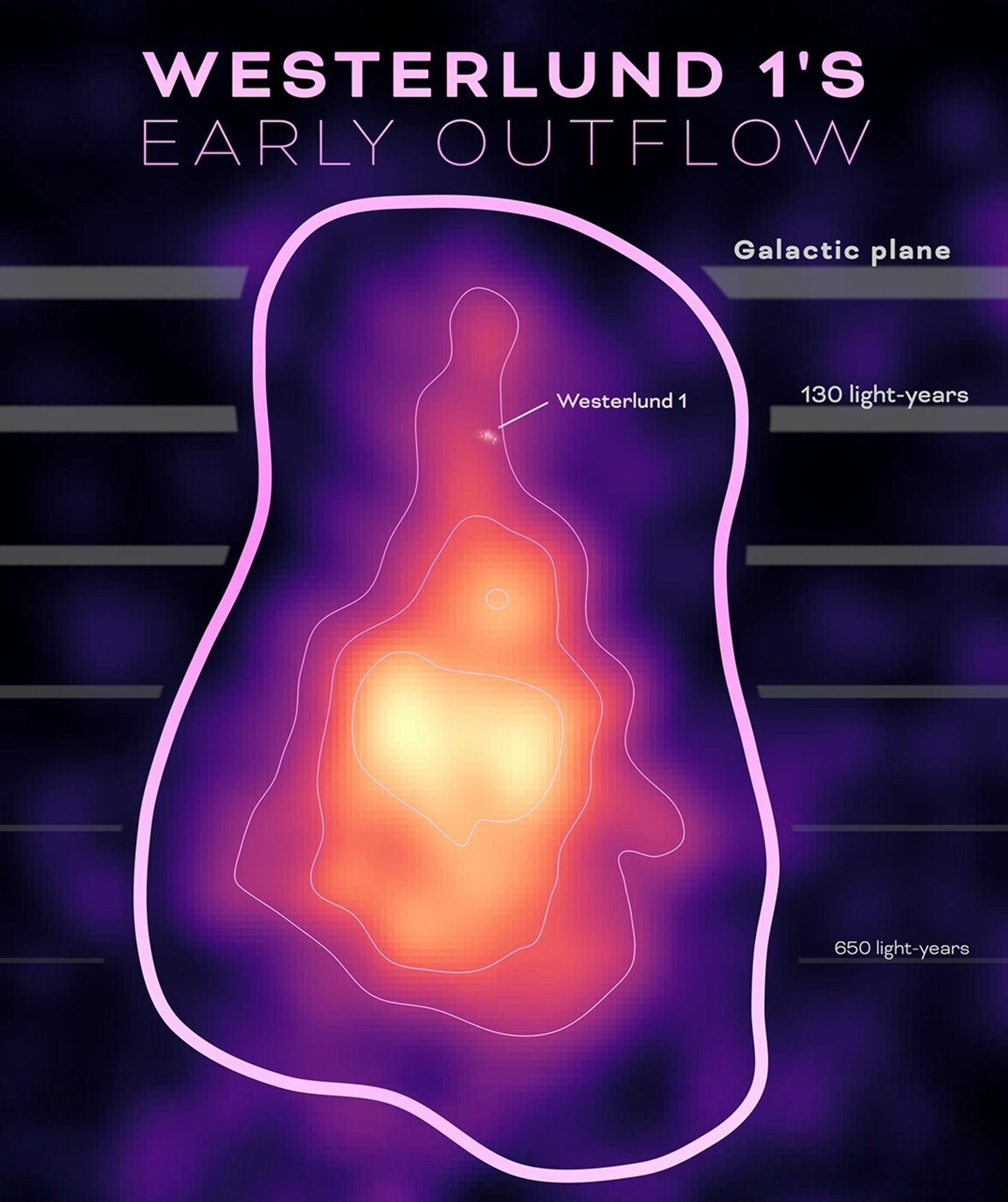 Data from NASA’s Fermi Gamma-ray Space Telescope reveal the budding gas bubble of star cluster Westerlund 1. Brighter colours indicate a stronger likelihood that gamma rays arise from specific types of point sources, notably two pulsars located at centre and in the brightest portion of the image. Pink contours denote steep changes in likelihood. An underlying orange-magenta feature extends down the image, starting from the cluster’s location, and represents the nascent outflow. The grey lines indicate distance below the galactic plane (Credit : NASA/ESA/CSA)
Building on a 2022 discovery by telescopes in Namibia, Lemoine-Goumard’s team carefully filtered Fermi data to remove contaminating sources. What remained was extraordinary: a bubble of gamma-ray emission stretching over 650 light-years from the cluster, extending downward from the galactic plane. This bubble is roughly 200 times larger than Westerlund 1 itself and represents a nascent outflow recently launched by the cluster’s massive young stars. Westerlund 1 sits slightly below the galactic plane, so the outflow preferentially expands downward, following the path of least resistance into regions of lower density beneath the disk.
Such cosmic ray outflows carry enormous amounts of energy and likely play crucial roles in regulating star formation, driving galactic-scale winds, and distributing heavy elements throughout the galaxy. The research team now plans to search for similar features around other star clusters, though Westerlund 1’s unique combination of mass, brightness, and proximity makes it an exceptionally favorable target.
Source : NASA’s Fermi Spots Young Star Cluster Blowing Gamma-Ray Bubbles