 Universe Today
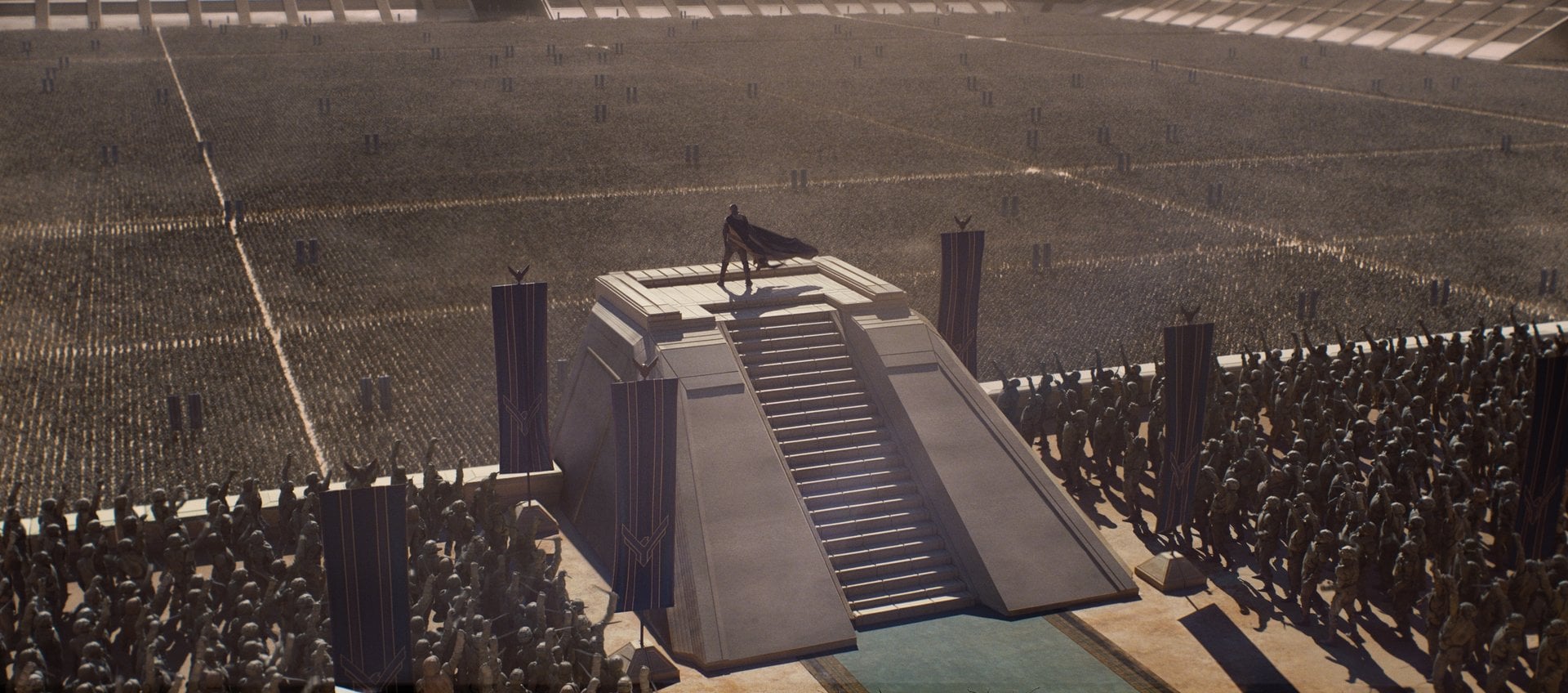
When we make our home on other worlds, who will be in charge?
Will it be an emperor, like the main character in “Dune: Part Three,” the final movie in a trilogy based on Frank Herbert’s sci-fi saga? Or a billionaire, like the space mogul who plays a key role in setting up a Mars base in “For All Mankind”? Or a rebel alliance, like the revolutionaries in “Star Wars” and “The Moon Is a Harsh Mistress”?
Jacob Haqq Misra, an astrobiologist who literally wrote the book on space sovereignty, suggests that it’ll be none of the above, at least during the initial phases of extraterrestrial expansion.
“You’re going to have Earth cultures represented, and ideas about Earth governance represented, and what will emerge is sort of a mishmash legal framework of agreements for how to coexist peacefully,” he says in the latest episode of the Fiction Science podcast. “That’s maybe not even so bad.”
During our podcast chat, Misra laid out what sounds like a sensible perspective on the future of space politics, based on earthly precedents rather than starry-eyed assumptions about the final frontier.
Fiction Science podcast: Politics on other planets
For more than a decade, SpaceX founder Elon Musk has talked up the prospect of building a city on Mars — and more recently, a base on the moon. But who would be in charge? That’s an open question even for Musk, who joked at a 2016 tech conference about being declared “king of Mars.” In a more serious vein, he said the future form of Martian government was likely to be “a direct democracy, not representative.”
“It would be people voting directly on issues,” Musk said. “And I think that’s probably better because the potential for corruption is substantially diminished in a direct vs. a representative democracy.”
Musk also had some novel ideas about the legislative process.
“It should probably be easier to remove a law than create one,” he said. “I think that’s probably good because laws have infinite life unless they’re taken away. So, I think my recommendation would be something like, let’s say, 60% of people need to vote in a law, but at any point greater than 40% of people can remove it. And any law should come with a built-in sunset provision. If it’s not good enough to be voted back in, maybe it shouldn’t be there.”
Misra, who is the chief operating officer and senior research investigator at Blue Marble Space, explains in detail why it wouldn’t be that easy to create a Martian government in a book titled “Sovereign Mars.” The reason has to do with the Outer Space Treaty, a nearly 60-year-old agreement signed by more than 110 nations, including the United States, China, Russia and all the other space powers.
The treaty declares that all nations have the right to use the moon and other celestial bodies for peaceful purposes, but also says no nation can claim sovereignty or ownership of extraterrestrial territory. Moreover, governments bear responsibility and legal liability for their national space activities, whether carried out by public agencies or private ventures. Which means the treaty would keep Elon Musk from being the king of Mars, even if SpaceX builds its own city.
At least that’s the way Misra sees it. Robert Zubrin, the president of the nonprofit Mars Society, sees it differently. In his view, the treaty’s provisions mean the signatories “have explicitly signed away their rights to interfere with Mars settlement.” But how long would it take for a Mars settlement to stand on its own, without governmental assistance?
“There are a lot of challenges to living on Mars that make it more difficult,” Misra says. “And that’s what I think is valuable about thinking about governance on Mars: not that it’s a place to start over, but it’s a way to challenge our ideas to the extreme. Maybe we never live on Mars full time, but we challenge our ideas and apply those back here on Earth.”
Misra sees plenty of earthly parallels to the sorts of issues raised by the prospect of space settlement, and they get the full treatment in “Sovereign Mars.”
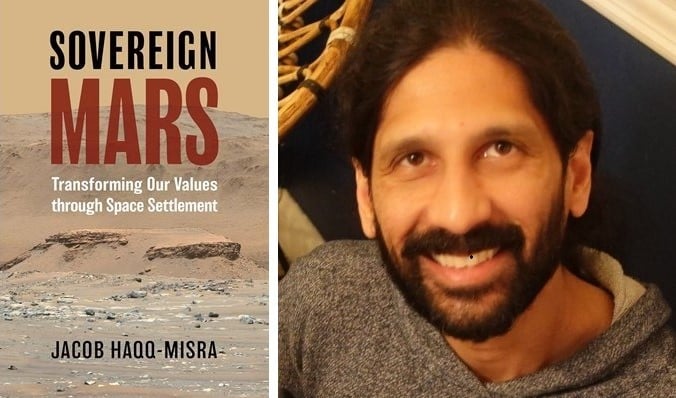 The author of “Sovereign Mars” is Jacob Haqq Misra, chief operating officer and senior research investigator at Blue Marble Space. (Book cover design by Karl Janssen; Mars photo via NASA / JPL-Caltech / ASU / MSSS; author photo courtesy of Jacob Haqq Misra)
For example, consider the Antarctic Treaty System, which was set up nearly 70 years ago. The 58-nation treaty puts a freeze (heh, heh) on territorial claims of sovereignty. Administrative decisions about international activities in Antarctica are made by a 29-nation grouping of consultative parties, assisted by a secretariat based in Argentina.
Will Antarctica become independent? Misra doesn’t think so — and he thinks the same line of reasoning would apply to Mars, at least in the early days of Red Planet exploration and settlement.
“To imagine a city of a million people on Mars — I’m not saying it won’t happen, but it’s very difficult to do so,” Misra says. “We don’t have cities that big on Antarctica. There doesn’t really seem to be an economically compelling reason for it, although there’s a lot of science on Antarctica. … So, the lesson from reality and from science fiction is: Don’t forget that it’s really, really hard to live in these harsh places.”
The U.N. Convention on the Law of the Sea serves as another instructive example. That treaty lays out principles for coordinating activities in the world’s oceans — including the establishment of exclusive economic zones that extend 200 nautical miles beyond a nation’s territorial waters. Within those zones, each nation holds sovereign rights to resource extraction, energy production and research while still allowing for free navigation and overflight.
Even though the United States never ratified the Law of the Sea Treaty, it follows many of the treaty’s provisions due to pragmatic considerations. Misra thinks a similar sense of pragmatism will guide the settlement process on the moon and Mars.
For example, if the United States and China both establish bases at the moon’s south pole, they could agree to establish exclusive economic zones surrounding those settlements.
“I don’t expect territorial conflict,” Misra says. “The moon is really big. It’s going to be a while before we run into the problem of two entities wanting to occupy the same place. I don’t know of any regions of the moon that are so desirable that only one actor, one space agency, could get there to the exclusion of others.”
But Misra doesn’t think there’ll be a new treaty to formalize a space governance system, or a new international authority along the lines of the United Earth Space Probe Agency in the fictional “Star Trek” universe. The United Nations tried unsuccessfully to go down that road in 1979 with an international pact known as the Moon Treaty.
“It’s on the books,” Misra says. “It has a number of signatories, but a very small number of signatories, none of which actually have their own independent launch capabilities. And so, many legal scholars consider it a dead treaty.”
Instead, Misra suspects that the world’s space powers will find ways to “cooperate in space in a way that preserves their joint sovereignty.”
“I think there will be new multi-actor consortiums that have relevance,” he says. “They might be outside the jurisdiction of the United Nations, for example, but they might be great things that aren’t just driving forward profits for private entities. They might really reflect cooperation for science and exploration.”
What might that look like on the moon and Mars?
“Probably what would be likely is something similar to maybe a hybrid of Antarctic settlements and the way the International Space Station works,” Misra says. “In Antarctica, there are various distances between the different outposts. Some might be closer than others, and each country’s laws apply to that module,” he says.
The arrangements on the International Space Station are even more complicated, because each module hooked up to the outpost is the property of the nation that built the module. “You get these weird agreements where, when data is transmitted from one section to the other, it’s actually governed by several different nations’ laws along the way,” Misra says. “And if you are a Russian and you move down a couple of modules, you’re now a Russian visiting America.”
That’s likely to lead to a Martian mishmash. “I think you have to accept some degree of pluralism with what comes on Mars,” Misra says.
But does that mean space settlements will always be a mishmash? Not necessarily. There could be several ways to get around the Outer Space Treaty’s barriers to sovereignty. For example, an ambitious spacefaring nation could simply withdraw from the treaty, and then assert full sovereignty over the territory it controls. In 2011, space billionaire Robert Bigelow warned that China might do exactly that.
Loading tweet...
— View on Twitter
Another option would be for a company like SpaceX to move its base of operations (including its launch facilities) from the U.S. to a country that isn’t a party to the Outer Space Treaty.
In “Sovereign Mars,” Misra suggests a different route to extraterrestrial independence. The U.S. government, for example, could pass a law surrendering its territorial claim to an area under its control on the moon or Mars.
“If you get the blessing from Congress, then you’ve got the backing of a nation-state that says we agree with this long-term vision of establishing autonomy,” he says. “There might be a discussion about it at the U.N., but you know, if I had to guess, if the United States did that, we’d hear about China doing something similar in a few years.”
When it comes to determining the long-term future of Martian governance, Misra actually agrees with Musk.
“What I think is, the Martians should decide,” Misra says. “I’m interested to see what they would think works, because it might be different models than what we come up with on Earth, simply because living on Mars is different than living anywhere here.”
More from Jacob Haqq Misra on space sovereignty:
- Cooperative sovereignty on Mars: Lessons from the International Telecommunication Union and Universal Postal Union
- A pragmatic approach to sovereignty on Mars
- Can a referendum solve problems of shared sovereignty on Mars?
- A model for economic freedom on Mars
Other perspectives on space sovereignty:
- HumanMars.net: Mars colonization timeline
- Could a legal loophole lead to land claims on other worlds?
- Sorry, Elon: Mars is not a legal vacuum — and it’s not yours, either
- Democracy or what? Political system on Mars after its colonization
In addition to his work as an astrobiologist and an expert on space sovereignty, Jacob Haqq Misra delves into the mysteries surrounding unidentified anomalous phenomena, or UAP. He is a member of the UAP Science Advisory Council and the lead author of a study suggesting that a group of six small objects seen in a video recorded from a military aircraft near Kuwait was a flock of birds. Misra is also on the editorial review board for Limina – The Journal of UAP Studies and one of the editors of a forthcoming book titled “The Politics of Unidentified Anomalous Phenomena: Science, Security and Society.”
“Dune: Part Three” opens in U.S. theaters on Dec. 18.
My co-host for the Fiction Science podcast is Dominica Phetteplace, an award-winning writer who is a graduate of the Clarion West Writers Workshop and lives in San Francisco. To learn more about Phetteplace, visit her website, DominicaPhetteplace.com.
Stay tuned for future episodes of the Fiction Science podcast via Apple, Spotify, Player.fm, Pocket Casts and Podchaser. If you like Fiction Science, please rate the podcast and subscribe to get alerts for future episodes.