Universe Today
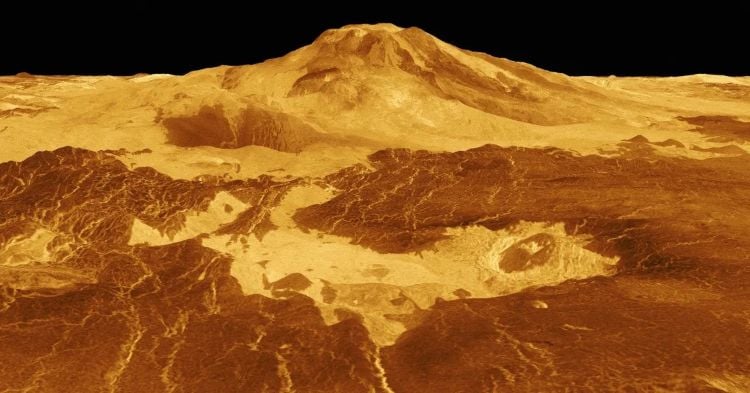
It’s 2050 and you’re living on Venus. This might come as a surprise due to the planet’s crushing surface pressures (~92 times of Earth) and searing surface temperatures (~465 degrees Celsius/870 degrees Fahrenheit), which is equivalent to ~900 meters (3,000 feet) underwater and hot enough to melt lead, respectively. But you’re not living on the surface. Instead, you’re safe and sound inside a lava tube habitat scanning data from the latest orbiter images while sipping on some habitat-made espresso.
This might be the future of human Venus exploration, as an international team of researchers recently explored potential sizes of Venusian lava tubes that could be similar in size to Earth lava tubes since Venus’ surface gravity is approximately 91 percent of Earth’s. This research is due for publication in the journal Icarus in May 2026 and could help improve our understanding of Venusian volcanic activity and even the potential for future human exploration.
For the study, the researchers used a common numerical method called Finite Element Limit Analysis (FELA), which is used to estimate a system’s load and risk of collapse. Essentially, FELA asks how much weight a system can carry before it fails (i.e., collapse). In terms of Venusian lava tubes, the researchers aspired to estimate the upper bounds of lava tubes sizes that could exist on the surface. In the end, the researchers found a wide range of dimensions that Venusian lava tubes could exhibit.
The study notes, “Our results suggest that lava tubes with widths of a few hundred meters may remain stable, and these dimensions are consistent with observed Venusian channel sizes. The study also indicates that future missions with higher-resolution imaging and geophysical investigation capacities should be able to detect possible surface expressions of lava tubes, such as pit chains, skylights, subsurface voids and gravity anomalies to further support their existence.”
This study comes as a wave of recent research has explored the possibility of active volcanism on Venus, including a 2025 study published in the Journal of Geophysical Research: Planets that modeled potential explosive volcanism on Venus, suggesting how atmospheric signatures could reveal active volcanism. Another 2025 study published in Geochemistry analyzed decades-old Magellan radar data that could suggest active volcanism on Venus today.
The reason Magellan data is used for analyzing the Venus surface is because it remains the last mission to globally map the Venusian surface at high resolution. Because of Venus’ thick clouds, radar has to be used to image the surface, which Magellan revealed incredible details regarding past—and potentially present—volcanic activity. This is slated to change as NASA is preparing to send two key missions to the second planet from the Sun, as the DAVINCI (Deep Atmosphere Venus Investigation of Noble gases, Chemistry, and Imaging) and VERITAS (Venus Emissivity, Radio Science, InSAR, Topography, and Spectroscopy) missions will conduct the most in-depth examination of Venus ever. DAVINCI will deploy a probe designed to plunge through Venus’ atmosphere while collecting data on water and sulfur chemistry, noble gases to learn about Venus’ history, and obtain surface images during its descent.
While DAVINCI is a one-way, short-lived mission, VERITAS is an orbital radar-mapping mission that will not only create the highest resolution global topographic maps of Venus ever done, but it will also have instruments capable of determining if active volcanism is occurring on Venus. DAVINCI and VERITAS are both currently scheduled to launch between 2030-2032 and no earlier than 2031, respectively.
What new insight into Venus lava tubes will researchers make in the coming years and decades? How will the upcoming VERITAS mission help identify and analyze new lava tubes on Venus? How could these lava tubes help future human missions to Venus? Only time will tell, and this is why we science!
As always, keep doing science & keep looking up!