 Universe Today
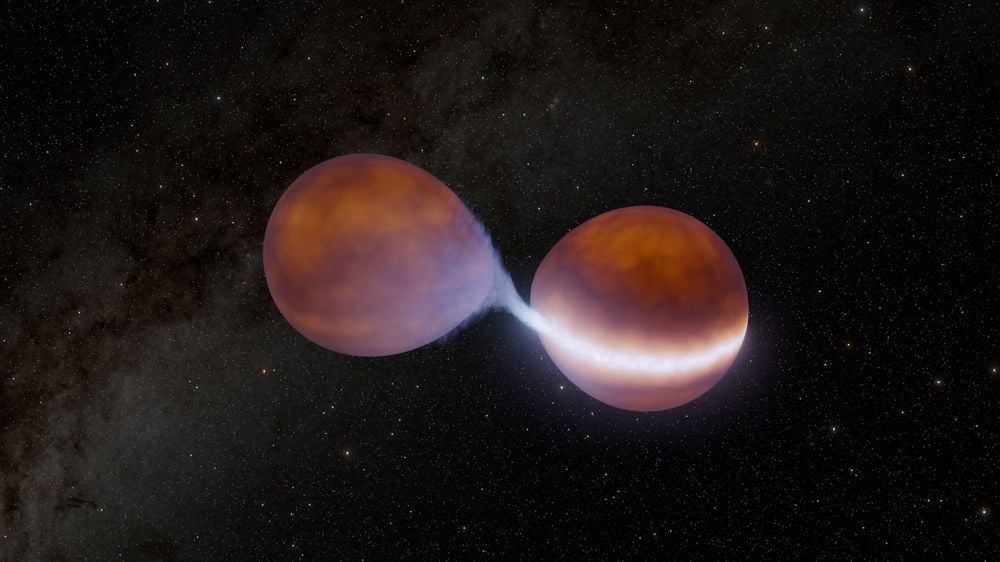
Binary stars are known to transfer mass to one another. In extreme cases, mass transfer can even cause a supernova explosion. That happens when a white dwarf draws matter from a companion.
But astronomers have never seen a pair of brown dwarfs transferring mass.
Brown dwarfs are stuck in a no man's land between planet and star. They're more massive than gas giants, but less massive than the smallest main sequence stars, red dwarfs. Brown dwarfs are sometimes called failed stars or substellar objects because they're simply not massive enough to trigger and sustain hydrogen fusion like main sequence stars do. Instead, they emit some light and heat due to deuterium fusion.
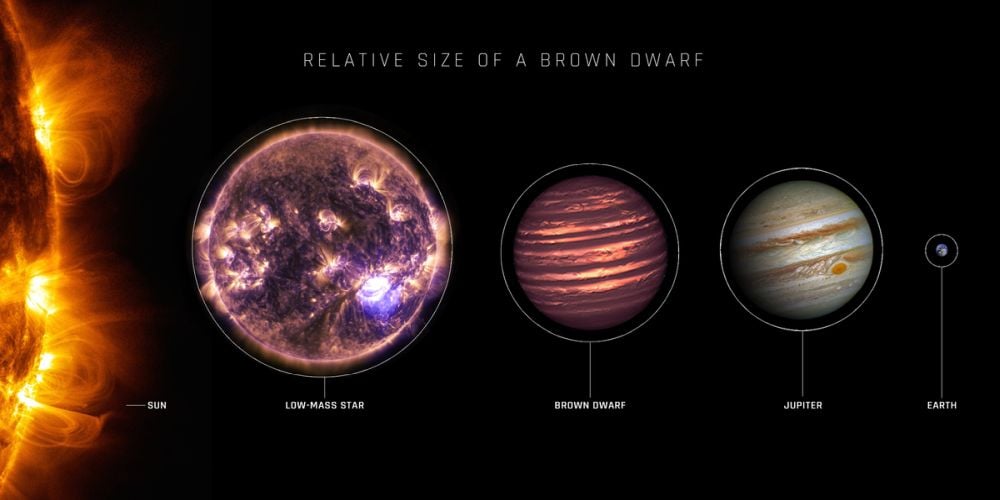 This artist's illustration shows the relative sizes of the Sun, a low mass star, a brown dwarf, Jupiter, and the Earth. The image is to scale. Image Credit: NASA, ESA, SDO, NASA-JPL, Caltech, A.Simon (NASA-GSFC); Designer: E. Wheatley (STScI)
Astronomers aren't certain how common brown dwarfs are because they're so dim and difficult to detect. But estimates suggest that the Milky Way could contain up to 100 billion of them. Like other stars, many of these billions of brown dwarfs are in binary pairs.
New research in The Astrophysical Journal Letters focuses on ZTF J1239+8347, a binary brown dwarf pair in an especially close orbit with one another. The research is titled "A Mass Transferring Brown Dwarf Binary on a 57 Minute Orbit," and the lead author is Samuel Whitebook. Whitebook is a grad student in the Division of Physics, Mathematics, and Astronomy, at Caltech.
The pair of brown stars has an orbital period of 57.41 minutes. That's an extremely tight orbit, and observations with NASA's Swift Observatory and other facilities show that the two brown dwarfs are in a stable mass-transferring relationship. The researchers identified a hot spot on the surface of the donor brown dwarf that moves as the pair orbits each other.
There are two possible outcomes for this arrangement.
In one scenario, the accreting BD will continue to gain mass until it becomes massive enough to fuse hydrogen. It will then be a main sequence star.
In the other scenario, the pair will eventually merge and become one. This will also result in a more massive, main sequence star. In both cases, there's an increase in luminosity.
"The failed stars get a second chance," lead author Whitebook said in a press release. "Brown dwarfs don't have internal engines like stars do, but this result shows they can exhibit very interesting dynamic physics."
Mass transfer between binary stars isn't a mysterious process. The more massive partner pulls on the atmosphere of the less massive partner. Eventually, the material overflows from the donor's Roche lobe and becomes part of the accretor.
"When one star's gravity is overcome by the other's, matter starts flowing from the less dense star to the denser star," Whitebook says. "It's like the matter sloughs off through a nozzle."
This is the first time astrophsyicists have detected mass transfer like this in a brown dwarf binary. In fact, it's so unusual that others in the astronomy research community are struggling to accept the findings. "These are very exotic objects," said co-author Thomas Prince, also from the Division of Physics, Mathematics, and Astronomy at Caltech. "We've told some of our colleagues about them, and they didn't believe such a thing exists."
The authors didn't believe their findings without hesitation. They considered other explanations for the observations. It's possible that one of the objects isn't actually a brown dwarf, but is instead a compact object like a neutron star. They rejected this because there would be brighter x-ray emissions.
A cataclysmic variable is also another candidate. It involves a white dwarf accreting material from a secondary star, in this case a brown dwarf. But the optical spectra goes against this, as does the hot spot. "Additionally, in this configuration, it is impossible for the hot spot to be on an irradiated BD, as the irradiating WD would be visible in the optical spectrum at all times," the authors explain.
They settled on an accreting BD binary because it fits the evidence best.
The system is also valuable scientifically because it can be a test case for mass transfer. "ZTF J1239+8347 provides a potentially valuable probe of the dynamics of stable mass transfer at the lowest detectable mass scales," the authors write.
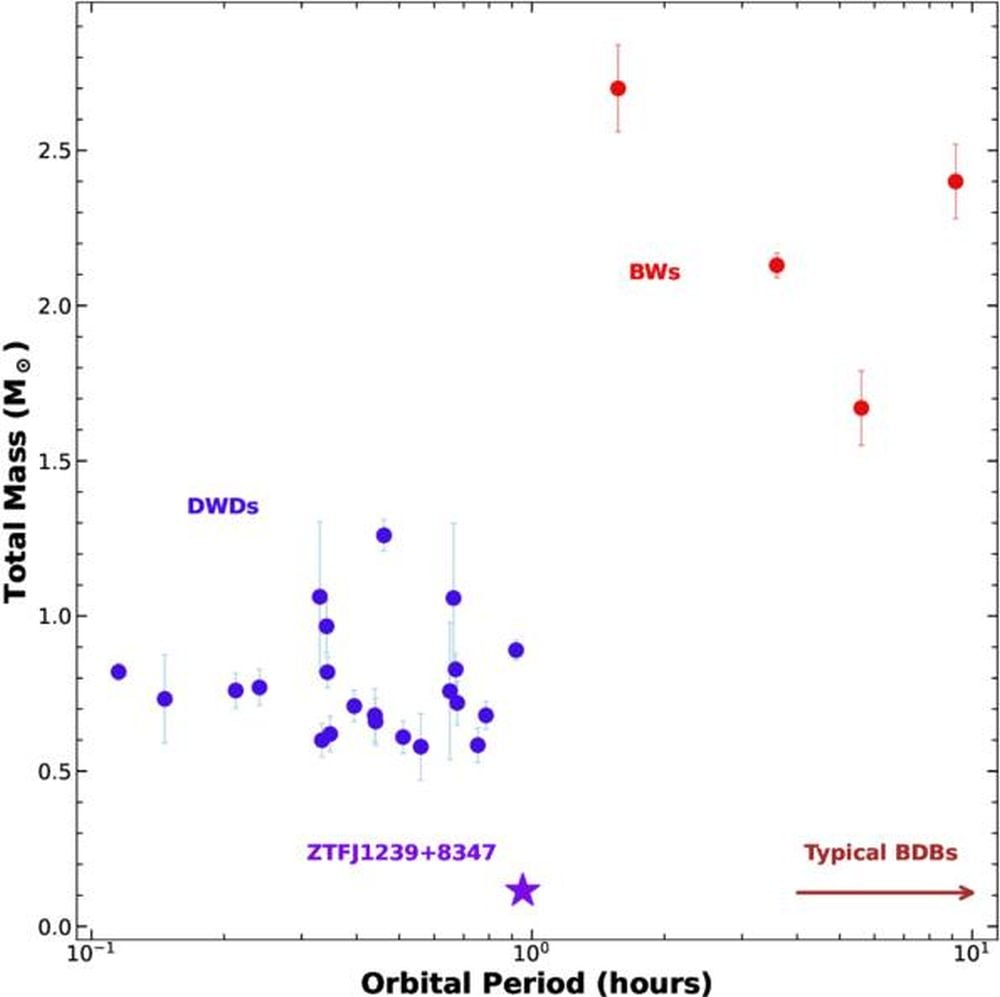 This figure compares ZTF J1239+8347's orbital period and mass to double white dwarfs (DWDs) and black widow neutron star—substellar object binaries (BWs). It also shows that typical brown dwarf binaries have longer orbital periods than ZTF J1239+8347. Image Credit: Whitebook et al. 2026. ApJL
ZTF J1239+8347 is pretty close, only about 1,000 light-years away. It's a good candidate for more observations with the JWST. "Future observations of the system with the James Webb Space Telescope (JWST) could constrain the temperature of the accretor atmosphere better and could detect the atmosphere of the donor system," the authors write. These observations would also give better measurements of the system's mass ratio. Better measurements of the hot spot would also provide constraints on the mass transfer rate.
But like many things in astronomy and astrophysics, finding more examples of a binary brown dwarf pair experiencing mass transfer will lead to a deeper understanding. Fortunately, the Vera Rubin Observatory will likely find more of these binary stars.
"We expect the Vera Rubin Observatory to detect dozens more of these objects," Whitebook says. "We want to find more to understand the population and how common it is. We predict this happens more than you think."

