 Universe Today
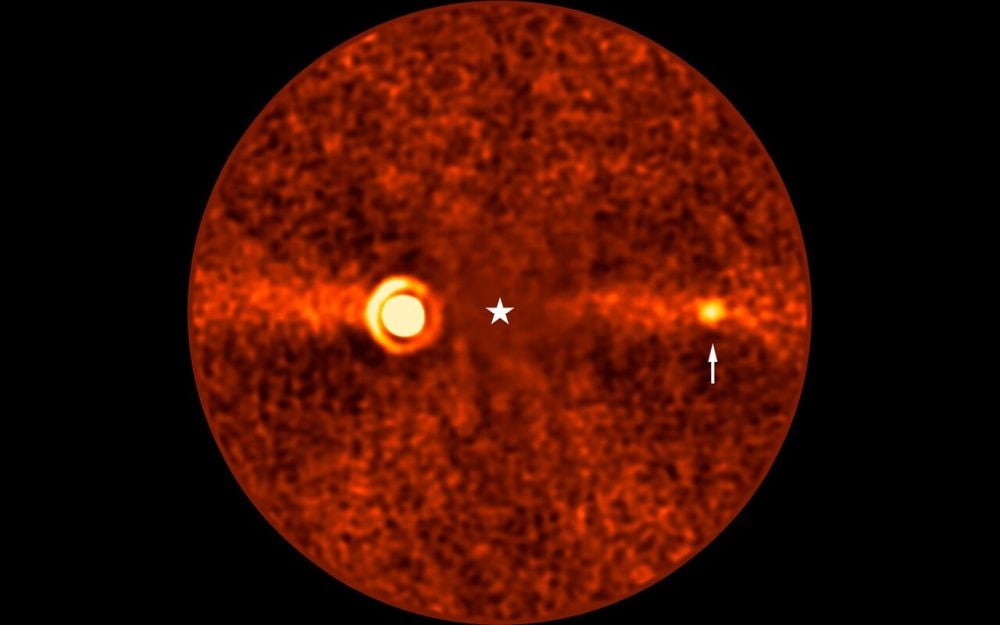
Astronomers have found a new exoplanet in the Beta Pictoris (β Pic) system. β Pic is about 63 light years away, and is notable for being the first star to have its circumstellar disk imaged in visible light. It's also notable because one of its exoplanets, Beta Pictoris b, was one of the first exoplanets to be directly imaged.
The new exoplanet, Beta Pictoris d, is the third planet discovered in the system, and is also the faintest planet ever imaged from Earth. For years, it was lost in the glare of the star, and obscured by its sibling, β Pic b. It took a combination of ground and space telescopes observing over multiple epochs to detect it.
“Planet d, it seems, has been playing a game of hide-and-seek with us for over a decade and only now can we say ‘found you!’” - Jayne Birkby, University of Oxford.
The discovery is presented in new research in The Astrophysical Journal Letters titled "Direct Imaging Discovery of Giant Exoplanet β Pictoris d: A Decade-long Game of Hide-and-seek." The co-lead authors are Ben Sutlieff, an astronomer at the University of Edinburgh, and Markus Bonse, an astronomers at ESO in Germany.
“This was a serendipitous discovery,” lead author Sutlieff said in a press release. “We initially wanted to look more at a known planet in the system, Beta Pictoris b, to see how it changed over time,” he adds.
The astronomers found β Pic d with the ESO's Very Large Telescope and its Enhanced Resolution Imager and Spectrograph (ERIS). They also used archival data from the JWST's Near Infrared Camera (NIRCam) and VLT/SPHERE. "Astrometric measurements over an 11 yr baseline demonstrate that it is consistent with a gravitationally bound source with orbital motion," the researchers write.
“‘There’s something else there, did you see it?’” co-lead author Markus Bonse recalls saying when he looked at the data.
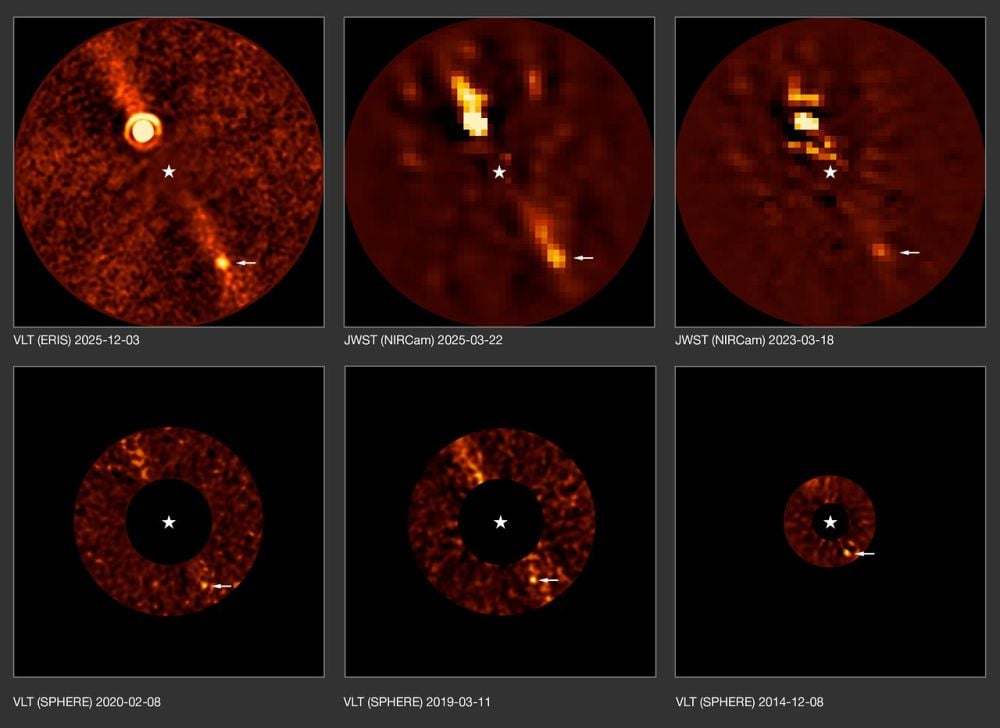 These images show how different telescopes and instruments observed β Pic d over the span of about 11 years. ERIS found it first, then archival images from the VLT's SPHERE instrument and the NASA/ESA/CSA James Webb Space Telescope helped confirm it. Image Credit: ESO/B. Sutlieff, M. Bonse et al.
“Planet d, it seems, has been playing a game of hide-and-seek with us for over a decade and only now can we say ‘found you!’” says Jayne Birkby, co-author of the study and astronomer at the University of Oxford, United Kingdom.
All three planets in the system are gas giants, though β Pic d is by far the least massive at about 2.4 Jupiter masses. It's also the furthest from its star at 26 au, compared to 2.7 au and 10 au for β Pic c and β Pic b respectively. β Pic d is also notable for its density. "β Pic d is among the lowest-mass exoplanets imaged from the ground," the authors write.
The Beta Pictoris system has attracted a lot of astronomers' attention, and this discovery leads to more questions.
"β Pic is an extremely well-studied and dynamically active system, comprising multiple giant planets, a warped debris disk, signs of recent giant collisions, and intense exocometary activity near the star," the authors write. "Our discovery of an additional, massive planet in the system naturally raises several dynamical questions."
One of the questions concerns the system's warped disk. Its inner disk is warped relative to its outer disk, and both of its siblings ascribe to that warp. What about β Pic d?
"Our discovery of β Pic d is consistent with this picture; the new planet shares the orbital plane of b and c, as required by the warp model," the researchers explain. They say it's more evidence that something happened to misalign the disks. They point to a past flyby or some other dynamical event.
Another question also concerns the disk and how the exoplanets are shaping it. This has been difficult to understand because from our viewpoint, Beta Pictoris is edge-on.
"Second, is β Pic d sculpting the disk's inner edge?" they ask. β Pic d's siblings are too close to the star to sculpt this edge, and researchers have inferred the presence of a third planet responsible for carving the edge in the disk. "Our discovery of β Pic d supports this picture," the authors write.
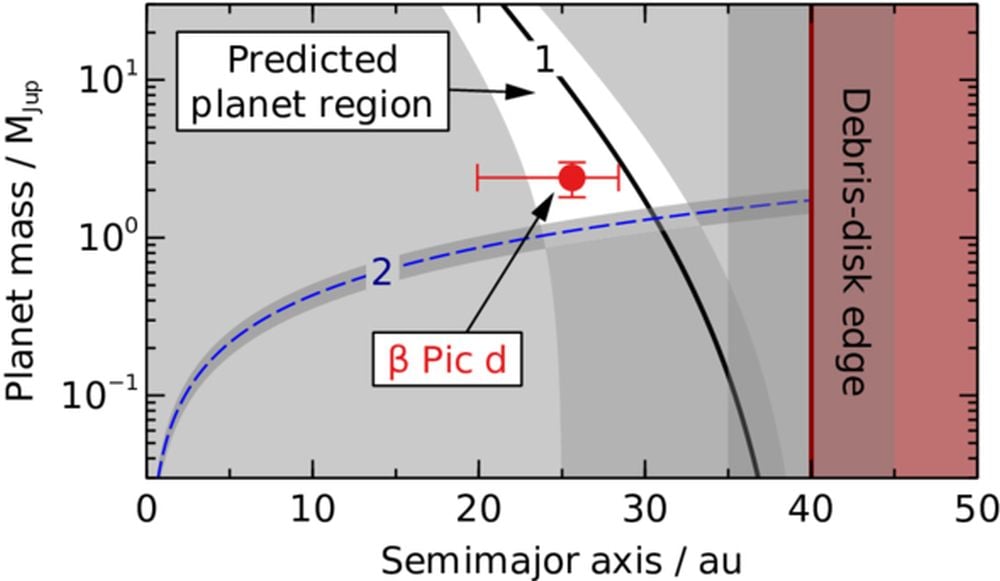 This figure from the study illustrates how β Pic d could sculpt the inner edge of the system's outer disk. The predicted planet region is shown in white and is from a 2022 study. Line 2 is the minimum planet mass required to sculpt the disk. β Pic d is both massive enough and in the right region to sculpt the disk's inner edge. Image Credit: B. Sutlieff, M. Bonse et al. ApJL.
The Beta Pictoris system is also known for its exocomet activity detected by TESS. A 2019 paper reported three exocomets, also known as falling evaporating bodies (FEBs). Other researchers predicted these exocomets, and the authors of the new paper ask if β Pic d is connected to them.
"β Pic displays significant exocomet activity, with star-grazing comets transiting every few days," they write. "This likely requires planets to drive comets from a debris belt inward toward the star."
One possibility is that planets b and c are responsible for disturbing objects from an inner asteroid belt at only about 1 au. Another possibility is that a more distant planet is disturbing objects from the outer belt at about 40 au. "β Pic d could do the latter; it appears close enough to the outer belt to scatter debris, some of which could be passed inward via planets b and c toward the star," the authors write.
Directly imaging exoplanets is a new frontier in exoplanet science. Now, Beta Pictoris joins HR 8799 as the only systems with more than two directly imaged exoplanets. "Systems with multiple directly imaged exoplanets are the ‘holy grails’ of discoveries, because they can teach us a lot about what different exoplanets are like in the same formation environment,” said Sutlieff.
When the Extremely Large Telescope (ELT) begins observations with its 39.3-metre-diameter, hopefully in 2029, it should directly image many more exoplanets.
“Planets seem to have friends,” says study co-author Beth Biller, an astronomer at the University of Edinburgh, “many of the famous directly imaged exoplanet systems seem to have multiple giant planets in the same system, and likely there are even more lower mass planets hiding in these systems that might be revealed with instruments on the ELT.”
"The discovery of β Pic d using a combination of ground and space-based observations demonstrates the complementarity of these facilities and the value of archival datasets for investigating and confirming newly identified companions, even in well-known systems," the authors explain.
"Future observations of β Pic d will characterize its atmosphere in depth, further constrain its orbit, and yield deeper insights into the architecture and formation of this young planetary system," they conclude.

