 Universe Today
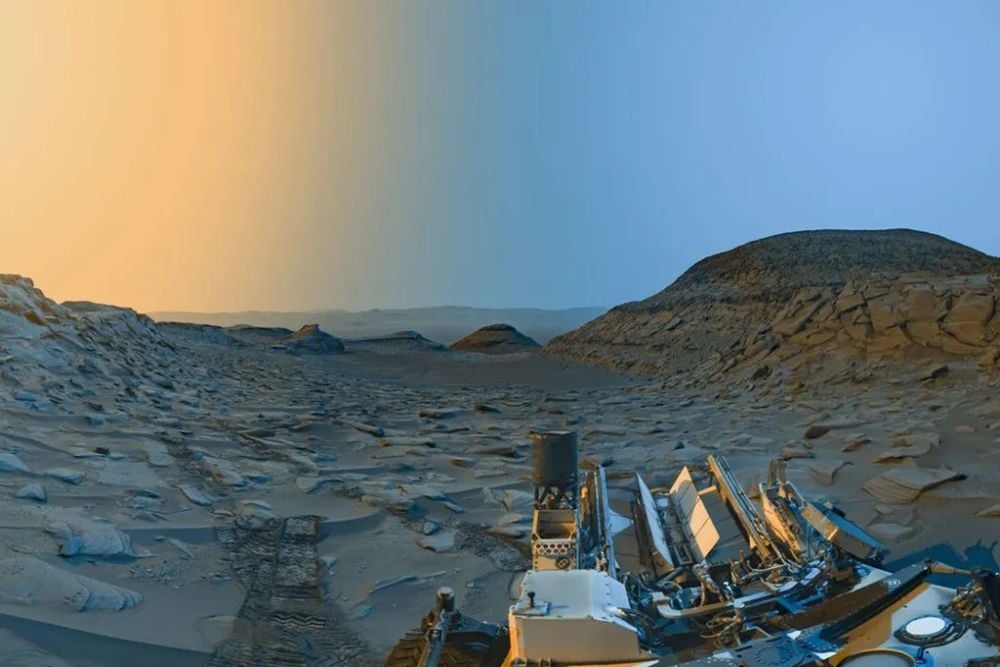
Part of a Mars rover's job is to detect anomalies. When something stands out from its surroundings, it indicates that something noteworthy has happened. NASA's MSL Curiosity has detected a metallic anomaly in Gale Crater, and that anomaly needs an explanation.
In 2022, the car-sized, plutonium-powered rover detected high levels of iron, manganese, and zinc in the Gale Crater, the highest levels ever detected there. They're in a feature called the Amapari Marker Band, a stratigraphic layer on Mt. Sharp, the peak in the middle of Gale Crater. Why are metals concentrated there?
New research in JGR Planets has the answer. In a paper titled "Amapari Marker Band Metal-Enrichments: Potential Mechanisms and Implications for Surface and Subsurface Water and Weathering in Gale Crater," the authors outline their case. The lead author is Patrick Gasda, a scientist on the team that manages Curiosity's ChemCam suite of instruments.
As evidence that Mars was once warm and wet has accumulated, scientists are asking more piercing, detailed questions. Exactly when did those transitions occur and how did they affect the planet? The timing of wetter and drier periods is part of Mars' long history, and understanding them is critical to understanding the planet's ancient potential habitability.
Mt. Sharp in Gale Crater is a 5 km high sedimentary mound. Its stratigraphic layers record Mars' change from warm and wet to cold and dry. The Amapari Marker Band is a feature that can be traced for tens of km around Mt. Sharp and is clearly seen from orbit. The metals in the Band were found in well-preserved ripples in the rock. Taken together, the ripples and the metals are evidence of an ancient lake.
“The metals were found in preserved ripples, which is the clearest evidence we have that a lake was present in Gale Crater. But what’s more surprising is that this lake existed high up on Mount Sharp, where the rover explored rocks that were deposited during an era on Mars when the climate was drying out,” said lead author Gasda, who is also a research scientist at Los Alamos National Laboratory. “Ancient Mars was much wetter, and lakes in craters were common then. It seems that as Mars became drier and colder, lakes that formed less frequently were very short-lived.”
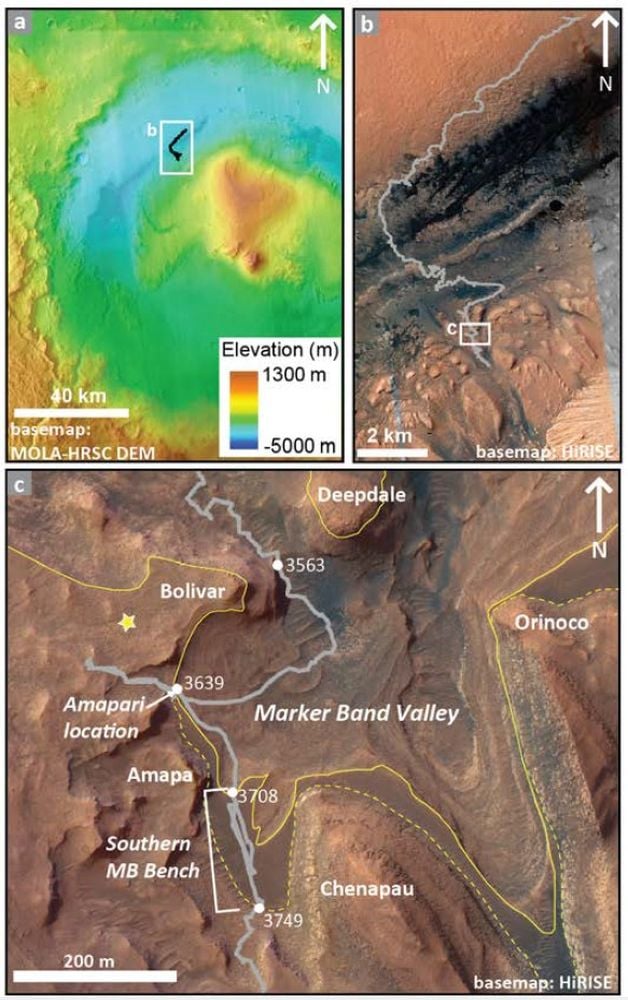 These images show where the Amapari Marker Band occurs in Gale Crater. Image Credit: Mondro et al. 2025.
These same types of metal-rich deposits occur on Earth, too. They're created by redox reactions which are everywhere in Nature and technology. Redox means reduction-oxidation, and the two types of reactions always occur together. In these reactions, one species gains an electron and its oxidation state increases, the other loses an electron and its oxidation state decreases.
Redox reactions can make metals precipitate out of water, and in Gale Crater's case, led to the accumulation of iron, zinc, and manganese in the Amapari Marker Band.
But there's more to this than just chemistry and geology. Microbes can mediate redox reactions, and in some cases create thicker deposits than abiotic reactions. So finding these metals is evidence that there was an ancient lake in Gale Crater. These same metals are also energy sources for some types of microbes on Earth. Their presence supports the idea that the ancient lake was habitable. "
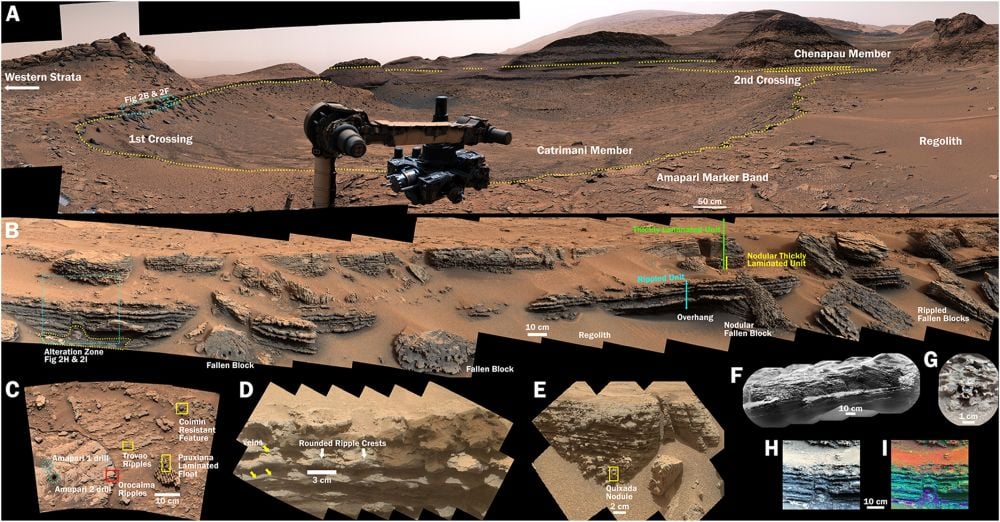 These images of features in the Amapari Marker Band were captured with Curiosity's Mastcam and other instruments. Different units in the AMB are labelled. (c) is a top-down Mastcam view of the rippled layers of the AMB at the Amapari drill site. Image Credit: Gasda et al. 2026. JGR Planets.
“Given the exciting astrobiological implications raised by the Amapari Marker Band, these types of materials should be prioritized for future Curiosity chemistry analysis or for returning samples from Mars' Jezero Crater, should the opportunity arise,” Gasda said.
On a detailed level, there are different scenarios that can explain the AMB. Ripples can only occur in certain circumstances, and their presence helps reveal details about the ancient lake. "A key constraint on these formation scenarios is the presence of ripples that would have formed in a shallow lake, followed by a deeper lake to deposit overlying layers," the researchers explain. "The ripple unit would have formed while interacting with the atmosphere in no more than 2.0 m of water; ripples would not form if the lake was covered with ice."
"Thus, what began as a very shallow lake became at least 10–100 s of meters deep," they write. "In summary, the sedimentary rock textures are consistent with a lake that became deeper over time."
There are still unanswered questions, and the researchers clearly state that other explanatory scenarios can't yet be ruled out. Mars likely experienced transient warming events on its long journey to becoming the cold dry planet is now. Water-to-rock ratios, lake depth, and atmospheric concentrations of O2 during transient events all make it extremely difficult to settle on a single explanation.
But even with the uncertainty, these results are exciting. The chemical fronts containing iron, zinc, and manganese are definitely there, even if scientists can't be absolutely sure about the conditions that created them.
"Chemical fronts within stratified lakes or lake sediments are habitable environments that host thriving microbial communities on Earth," the authors conclude. "Given the exciting astrobiological implications raised by the AMB, these types of materials should be prioritized for future Curiosity wet chemistry analysis or for Mars Sample Return from Jezero crater should the opportunity arise."

