Universe Today
SN 2025mkn is a Type II supernova and it wasn't supposed to be visible at all. The violent death of a massive star that had exhausted its nuclear fuel and collapsed under its own gravity sits at a redshift of 1.371. That places it roughly nine billion light years away. At that distance, an ordinary stellar explosion simply doesn't produce enough light to study in any useful detail. Yet astronomers can see this one with extraordinary clarity and we have gravity to thank.
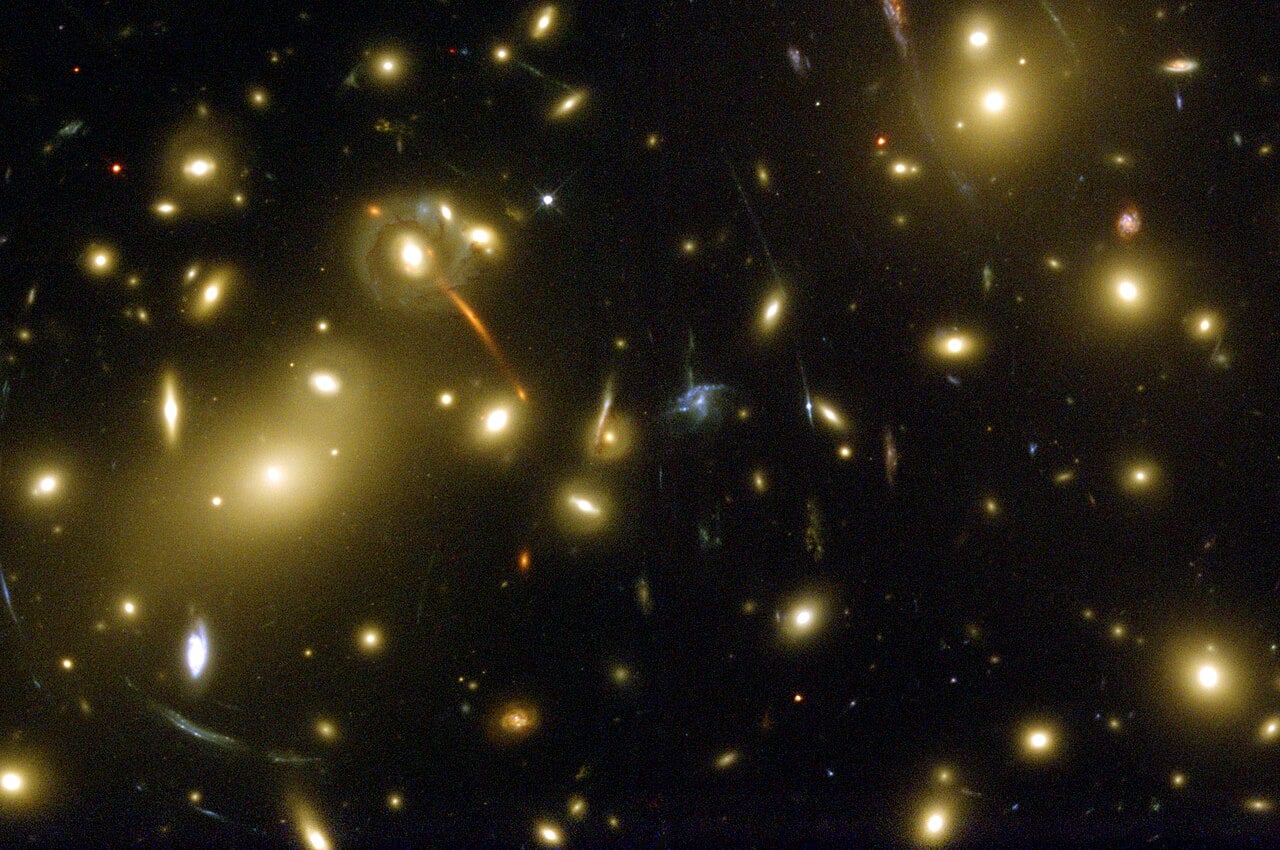 Galaxy cluster Abell 2218 and its gravitational lensing effect on distant galaxies (Credit : NASA/STScI)
Between us and the explosion lies an elliptical galaxy about five billion light years away. That galaxy is massive enough to warp the fabric of spacetime around it, bending and concentrating the light from SN 2025mkn toward us like a gigantic lens. The result is a magnification of at least a hundred times and quite possibly closer to 250, based on detailed comparisons with SN 2023ixf, one of the best studied nearby supernovae in the local universe.
The discovery began with the Zwicky Transient Facility, a wide field survey telescope at Palomar Observatory in California that scans the sky nightly hunting for anything that has changed. ZTF flagged a bright blue transient close to the foreground galaxy, and early spectroscopy revealed something immediately telling. It found that the light contained absorption features at two distinct redshifts. One set of lines belonged to the lensing galaxy itself, another sitting at a much higher redshift, pointed to something far beyond it…an object the foreground galaxy was merely masquerading as a host for. Follow up observations with the Keck telescope in Hawaii confirmed it as a Type II supernova at z=1.371, its early spectrum blazing at a temperature of around 27,000 degrees, most definitely the signature of a freshly exploded stellar core.
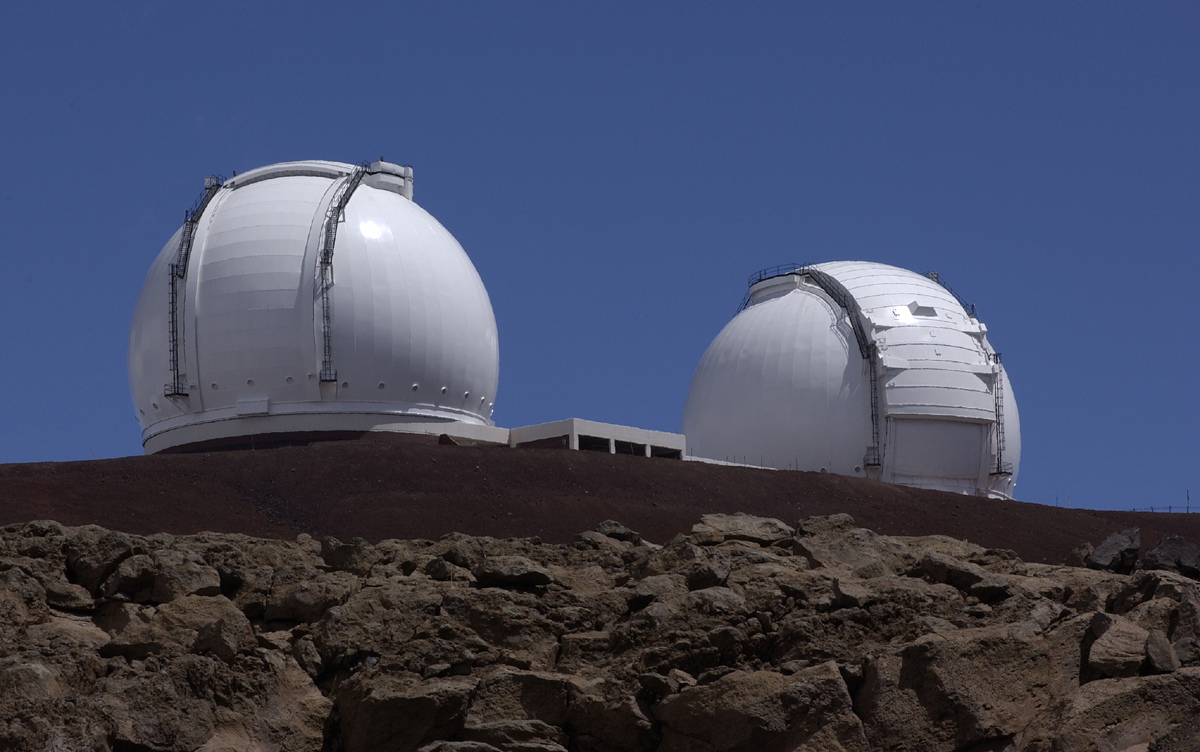 The twin domes of the Keck Observatory (Credit : T. Wynne / JPL)
When JWST turned its gaze on the system, the full complexity unfolded. What appeared as a single bright point resolved into something far more intricate. Image A (the bright source) turns out to be two extremely close images of the same explosion, separated by just 0.07 arcseconds, straddling the lensing galaxy's critical curve. This is the region where lensing reaches its most extreme, a narrow line in space where even a tiny shift in the source position produces an enormous change in brightness, and where two images merge into one at infinite magnification. A third, much fainter counter image sits on the opposite side of the lens, around 30 times dimmer than the bright pair. Lens models predict a fourth image may also exist, and a possible detection lurks in the JWST spectroscopic data.
One of the most intriguing details is the time ordering with the faint counter image arriving at our telescopes first yet it was too dim to register in ZTF's earlier survey data. It is spectrally more evolved, caught at a later phase of the explosion than the bright images, consistent with a time delay of several weeks between them. An upcoming analysis will attempt to extract a precise time measurement from the resolved JWST spectra and from that, a constraint on the rate of expansion of the universe itself. A stellar death nine billion years ago, it turns out, may yet help us understand the cosmos we live in today.
Source : A Natural ≳100× Telescope: Discovery of the Strongly Lensed Type II SN 2025mkn at z=1.37