 Universe Today
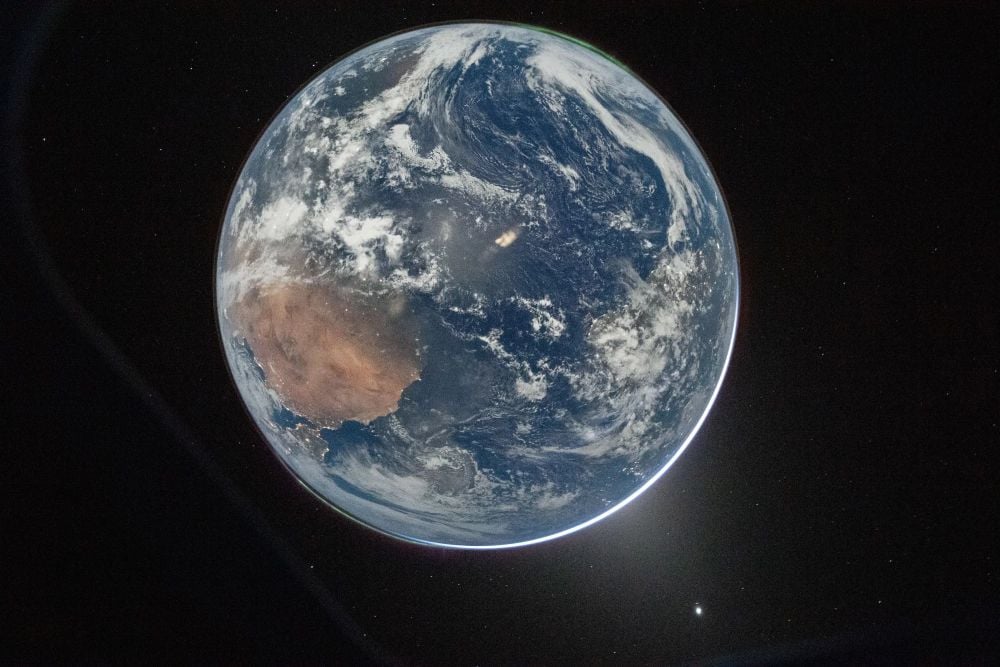
Piecing together the history of Earth's formation leans heavily on evidence from meteorites. Since the vast majority of meteorites come from asteroids, that means understanding asteroids can also lead to an understanding of Earth's formation. Together, asteroids and meteorites make up the population of debris left over after the rocky planets formed.
Asteroids and meteorites are denizens of the inner Solar System. Astronomers have wanted to understand how much of Earth is made of inner Solar System material, and how much is made of other material from the outer Solar System, beyond Jupiter. Since conditions are so different in each region, so is the material that originated there. Determining the relative contribution from each part of the Solar System will help explain not only how Earth formed, but how planets form in general. The carbon content of meteorites and asteroids plays a central role in this issue.
Scientists think that a substantial portion of Earth, between 6% to 40%, may have come from the outer Solar System. This can help explain how Earth got its water. Objects from beyond Jupiter typically contain more water ice. As Earth was accreting, some of the accreted material was from beyond Jupiter, or the Solar System's frost line, and when it joined Earth it brought water with ice with it. That's one hypothesis that explains Earth's water.
New research in Nature Astronomy examined the chemical composition of known asteroids and meteorites to understand how much of Earth's bulk composition came from the outer Solar System and the inner Solar System. By extension, it tests the idea of water delivery from beyond Jupiter. It's titled "Homogeneous accretion of the Earth in the inner Solar System." The lead author is Paolo Sossie from the Institute of Geochemistry and Petrology, Department of Earth and Planetary Sciences, at ETH Zürich in Switzerland.
"Meteorites are classified as either non-carbonaceous or carbonaceous, representing bodies that are likely to have formed in the inner or outer Solar System, respectively," the researchers write in their article. "Despite its location in the inner Solar System, the Earth is thought to contain either minor (~6%) or substantial amounts (~40%) of outer Solar System material."
A lot of understanding the origins of ancient rocks in our Solar System, whether meteorites, asteroids, or planets like Earth, comes down to isotopes. Isotopes are like different species of the same chemical element. They have differing numbers of neutrons. For example, oxygen has three stable isotopes: 16O, 17O, and 18O.
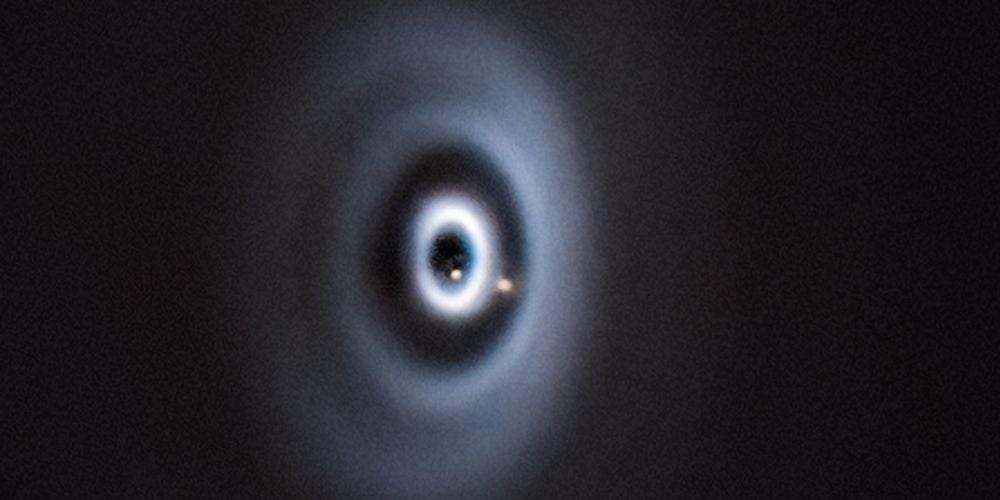 We'll never be able to see how Earth formed, but we can look at protoplanetary disks around other young stars and see the gaps and rings created by forming planets. This image shows two young planets forming around the star WISPIT-2. Image Credit: ESO / C. Lawlor, R. F. van Capelleveen et al. / Creative Commons BY 4.0
Isotopes occur in different ratios, and by measuring isotope ratios across multiple bodies, scientists can establish links between bodies that show common origins. Scientists have found isotopic systems that relate different families of inner Solar System objects to each other. But there's a problem.
Researchers have been studying isotopic systems for many years. The overall problem is that they've sometimes reached unclear conclusions because they haven't studied larger isotopic systems between more objects and families of objects. "Earth’s provenance remains equivocal," the authors explain, because the range of isotopic systems studied in previous research was small, often limited to one or two.
But in this work, the researchers used existing data to study ten isotope anomalies. "Here we examine variations in ten nucleosynthetic isotope anomalies among planets and meteorite parent bodies," the authors write.
Their results were surprising, even to the researchers themselves. The outer Solar System may have contributed only 2% of Earth's mass, and the number could even be 0 %. It's also surprising that Earth's composition doesn't match that of any chondrite, which are the most common type of asteroid and meteorite by far. "The Earth therefore formed exclusively from inner Solar System material whose composition did not vary over the course of accretion and was, on average, unlike that of any chondrite," the researchers explain in their article.
The idea that Earth is this homogenous is exciting and stands in contrast to previous understandings.
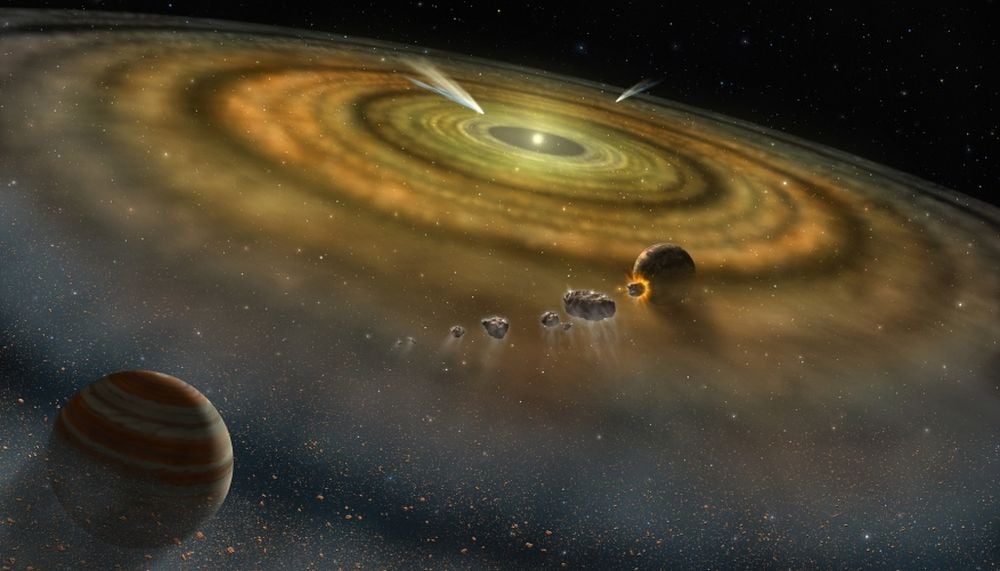 This artist's illustration shows what it may have looked like when Earth was forming. A young star is in the center, and icy comets from the outer Solar System plunge toward it. Planets are carving out gaps in the protoplanetary disk, and in the foreground planets are taking shape. One planet is marked by collisions, a normal occurrence in young Solar Systems. Image Credit: NASA
“Our calculations make it clear: the building material of the Earth originates from a single material reservoir,” lead author Sossi said in a press release.
Co-author Dan Bower, also from the same institute at ETH Zurich, added that “We were truly astonished to find that the Earth is composed entirely of material from the inner Solar System distinct from any combination of existing meteorites.”
What they're really studying is what's known as BSE, the Bulk Silicate Earth, also known as the Earth's primitive mantle. Analysing chondritic meteorites is the established way of studying the BSE, since the mantle itself has changed so much since Earth's formation.
"Our analysis shows that all elements, irrespective of their geochemical character or nucleosynthetic origin, record the same isotopic provenance in the BSE; that of an endmember among the NC (non-carbonaceous) group," the researchers explain. "The composition of the BSE is therefore defined as homogeneous with respect to isotopic anomalies."
The results come from analyzing all of this data with a powerful statistical method usually not employed in geochemistry. “Our studies are actually data science experiments,” said Sossi. "We carried out statistical calculations that are rarely used in geochemistry, even though they are a powerful tool."
This research also benefitted from a recent development in isotope geochemistry. Determining the history of Solar System objects with isotopes was limited to the isotopes of oxygen. But around 15 years ago, it became clear that isotopes of other elements like chromium and titanium could also be used. This development led to a deeper understanding of the Solar System's formation. Scientists figured out that meteorites fit into one of two classifications: non-carbonaceous ones that formed in the inner Solar System, and carbonaceous ones that formed in the outer Solar System, and that also contained more water.
This work shows that Earth may be entirely made of inner Solar System non-carbonaceous rock. Only a very small fraction could possibly be carbonaceous and from the outer Solar System. Why the clear divide?
Jupiter may be responsible. It grew massive very quickly and essentially tore a gap in the protoplanetary disk around the young Sun, the reservoir of material from which planets formed. Think of it as a barrier that inhibited material from the outer Solar System from migrating into the inner Solar System. Scientists know about this "Jupiter barrier" but prior to this work, it wasn't clear how effective it was.
“Our calculations are very robust and rely solely on the data itself, not on physical assumptions, as these are not yet fully understood,” Bower said.
The results also extend to Mars and the asteroid Vesta, one of the largest in the main asteroid belt. They may also extend to Mercury and Venus, though we have no physical samples from those planets that can confirm them. “Based on our analysis, we can theoretically predict the composition of these two planets,” said Sossi. This work shows that Venus and Mercury should have even more extreme isotopic compositions than Earth does.
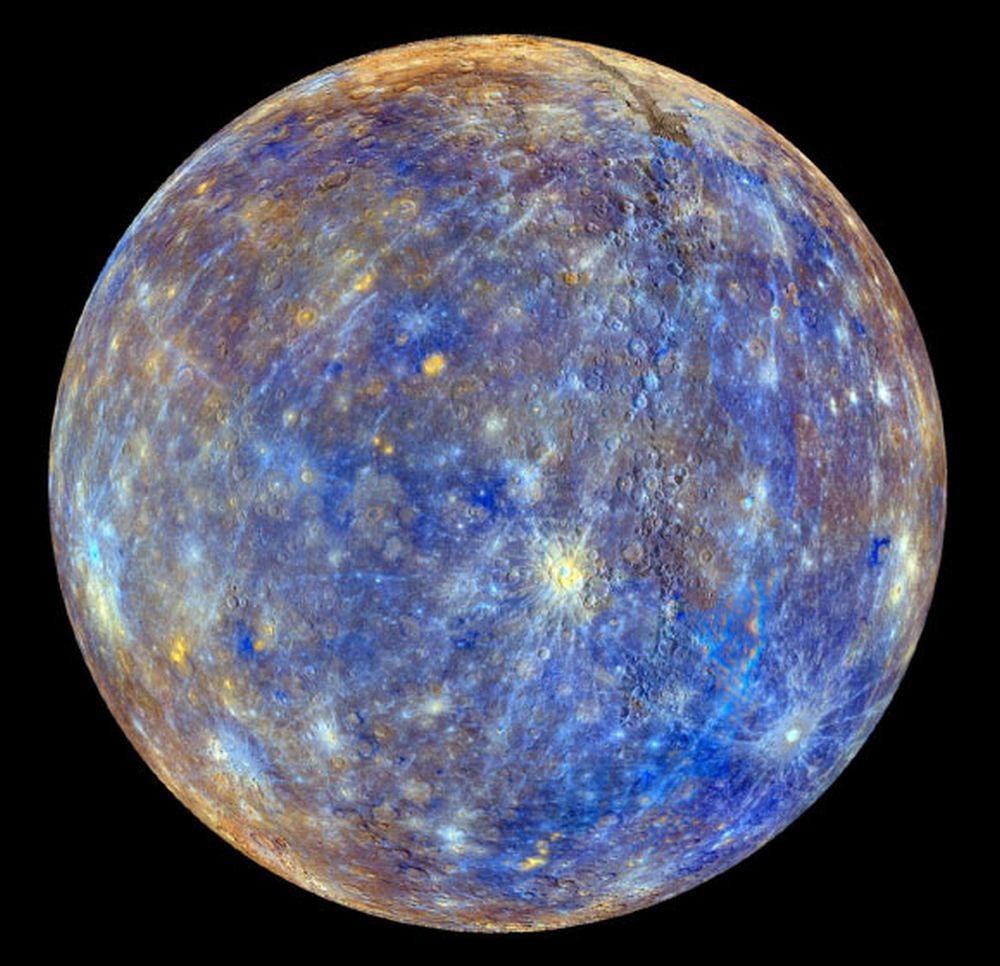 This false-colour image of Mercury highlights chemical, mineralogical, and physical differences in Mercury's surface rocks. We have no physical samples of Mercury, so its bulk composition, along with Venus', isn't known. But these results suggest they may also have extreme isotopic compositions. Image Credit: NASA / Johns Hopkins University Applied Physics Laboratory / Carnegie Institution of Washington
Sossi says that these results shed new light on the formation of Earth, and that's pretty clear. The results also have something to say about Earth's water.
Scientists still debate the source of our planet's water. One working hypothesis says that much of it or some significant portion of it was delivered by comets or other icy objects in the outer Solar System where water ice was abundant. The inner Solar System was too warm for the water ice to persist.
The other broad hypothesis says that water was innate in Earth as it formed. This internal production hypothesis says that chemical reactions between hydrogen and oxygen in the Earth's early mantle created water. These results bolster that idea.
These results also invite new questions, and the researchers themselves hope to address them. At the top of the list concerns water. If it wasn't produced internally, and if it didn't exist in the warm inner Solar System in enough quantities to explain Earth's water, where did it come from? They also want to know if these results are applicable to exoplanet formation in other solar systems.
These important results won't end the ongoing debate over how planets form and how Earth got its water. A single study won't do that. But science is incremental, and this could end up being an important step.
“Until then, however, Dan and I will have to engage in many heated debates about the material composition of Earth and its neighbouring planets, because the scientific discourse over the building blocks of Earth is far from over, despite the new findings,” says Sossi.

