 Universe Today
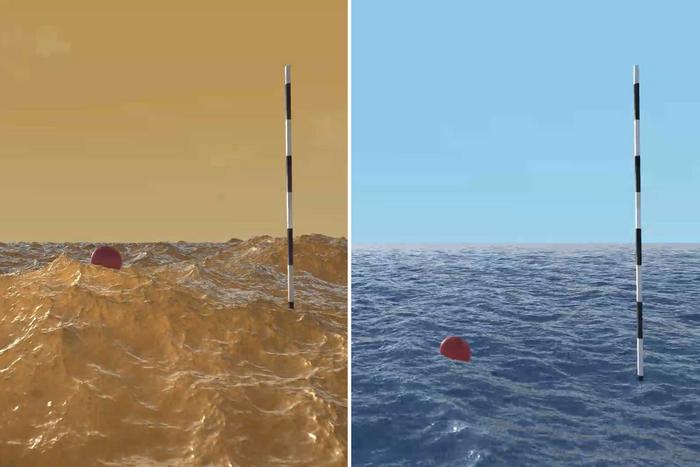
One of the most dramatic and memorable scenes from Interstellar comes from Miller’s planet - and if you don’t want a spoiler for an 11 year old movie, feel free to skip to the next paragraph. When the crew arrives on this potential new home for humanity, they are faced with a literal 1.2 km high wall of water bearing down on them quickly. It’s a great representation of how waves on other planets can act differently than on Earth. Admittedly, according to Kip Thorne, the scientific advisor for that movie, those waves are actually caused by the planet’s proximity to a local black hole rather than the wind that forms our waves here.
However, wind isn’t the same on every planet either. Nor are the oceans and lakes made out of water. Nor is the atmospheric pressure the same. In other words, there are lots of variables that go into determining how waves work on other worlds. A new paper, published in Journal of Geophysical Research: Planets by Una Schneck and their colleagues at MIT, showcases how different waves might be on different types of planets.
To explore the idea, they developed a software model called, appropriately, Planet Waves. It accounts for energy input from wind, and subtracts it based on breaking, turbulence, bottom friction, and liquid viscosity. With this model, they found two “universe” rules of waves. First, the minimum wind speed required to start a wave is lower for liquids with weak surface tension, bodies with high atmospheric pressure, and in low gravity. Second, waves grow taller with less dense liquids, under thick atmospheres, and with lower gravity.
This video goes into details about the water planet from Interstellar - don’t watch if you don’t want spoilers. Credit - Sarom YouTube ChannelThose might seem like obvious truths, but throughout the paper they were applied to a wide range of actual (and theoretical) environments. One obvious candidate was Mars. While the Red Planet doesn’t currently have any liquid water on its surface, it likely did previously, according to our current understanding of its history. On Mars, waves would have started at lower wind speeds due to its lower gravity. They also would have varied significantly in size based on the density of the Martian atmosphere, which ranged from 200 kPa (about twice that of Earth) down to an expected 50kPa before the surface water dried up.
Titan still has liquid lakes to this day - though they’re not made out of water. Liquid methane and ethane predominant on this moon of Saturn, which also has extremely low gravity and an extremely dense atmosphere. These features combine to allow waves to form at a mere 0.6 m/s, and to grow up to 3 meters in height relatively easily. They would also move in slow motion compared to Earth, due to the low gravity on the moon’s surface. However, the model here runs into some observational quandaries. Cassini bounced radar pulses off Titan’s lake, and the returned signals suggested that their surfaces were as smooth as glass, potentially with some “magic islands” of localized wave patches. So if Titan has wind (which it likely does), why weren’t the wave patterns obvious in Cassini’s data? We’ll likely have to wait for Dragonfly to solve that mystery.
We’ll have to wait a lot longer to validate any of the other three models the authors analyzed. First of those was Kepler-1649b. This planet, which is real, is an equivalent to Venus, and they modeled it with sulfuric acid lakes and a thick carbon dioxide atmosphere, though to be clear we’re not sure if there is actually liquid anything on its surface, not entirely sure of what its atmosphere is made up of. In this scenario, stronger winds (5.3 m/s) are necessary to get waves started, but once going they reach the height of Earth’s waves due to similar gravity.
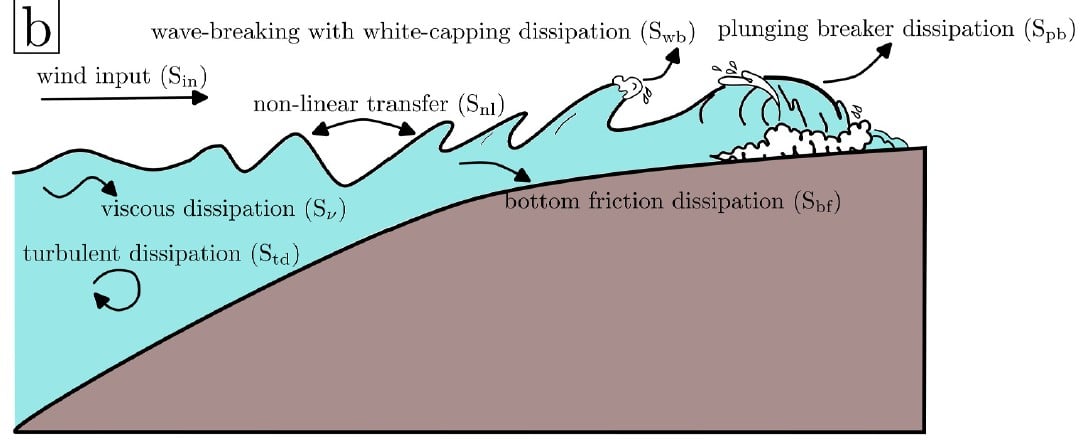 Figure from the paper showcasing the different forces used to calculate wave height. Credit - U.G. Schneck et al.
A second theoretical test case was LHS 1140-b, which was the subject of some close scrutiny by the James Webb Space Telescope recently. It was modeled as a Super-Earth Water World, which is what the current data from JWST suggests it actually is. Because it is more massive than Earth, the wind speed threshold to create waves is higher (2.7 m/s), and the resulting waves are much shorter.
But that’s nothing compared to the last theoretical one they modeled. 55 Cancri-e is a “lava world”, with lakes of molten rock, which, unsurprisingly, are extremely viscous. Combine that with the planet’s massive gravity, and the researchers found that there would need to be near hurricane-force winds of 37.1 m/s to create even a ripple on the surface of the lava. JWST actually recently found evidence for a thin atmosphere of either carbon monoxide or carbon dioxide on the planet, so it is a real possibility that there could be lava waves on 55 Cancri-e.
Ultimately, this study is useful for more than just informing future sci-fi movie advisors. As we begin to study the atmospheres and surfaces of exoplanets in detail, waves will factor into what we will expect to see. In other words, understanding wave mechanics on other worlds will feed into how astronomers study them, and may someday help us definitively prove the existence of alien oceans. While that may be some way off at this point, having a model to compare against is a great starting point.
Learn More:
MIT / EurekaAlert - Waves hit different on other planets
U.G. Schneck et al. - Modeling Wind-Driven Waves on Other Planets: Applications to Mars, Titan, and Exoplanets
UT - Lake Shorelines on Titan are Shaped by Methane Waves
UT - Surf's Up on Titan! Cassini May Have Spotted Waves in Titan's Seas

