Universe Today
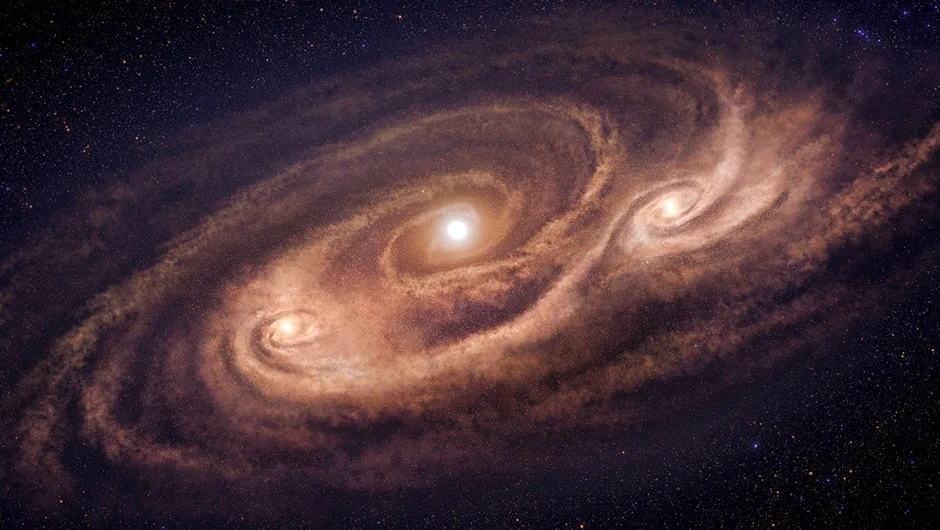
Some galaxies in the early universe were absolute powerhouses, churning out stars at rates that would dwarf the Milky Way's modest stellar production. These "monster galaxies," buried deep in dust between 10 and 12 billion years ago, are thought to be the ancestors of today's giant elliptical galaxies. But what drove them to grow so violently has remained frustratingly unclear.
Ryota Ikeda and his colleagues at Japan's National Astronomical Observatory may have just solved the mystery by discovering there isn't a single answer. Using both ALMA and the James Webb Space Telescope to observe three monster galaxies in the constellation Sextans, they achieved something unprecedented. By comparing exactly where stars are forming now with where they formed in the past, all at the same extraordinarily high resolution of 0.06 arc-seconds. That's the equivalent of having visual acuity 1000 times better than human eyesight, enough to distinguish features just a few thousand light years across in galaxies billions of light years away.
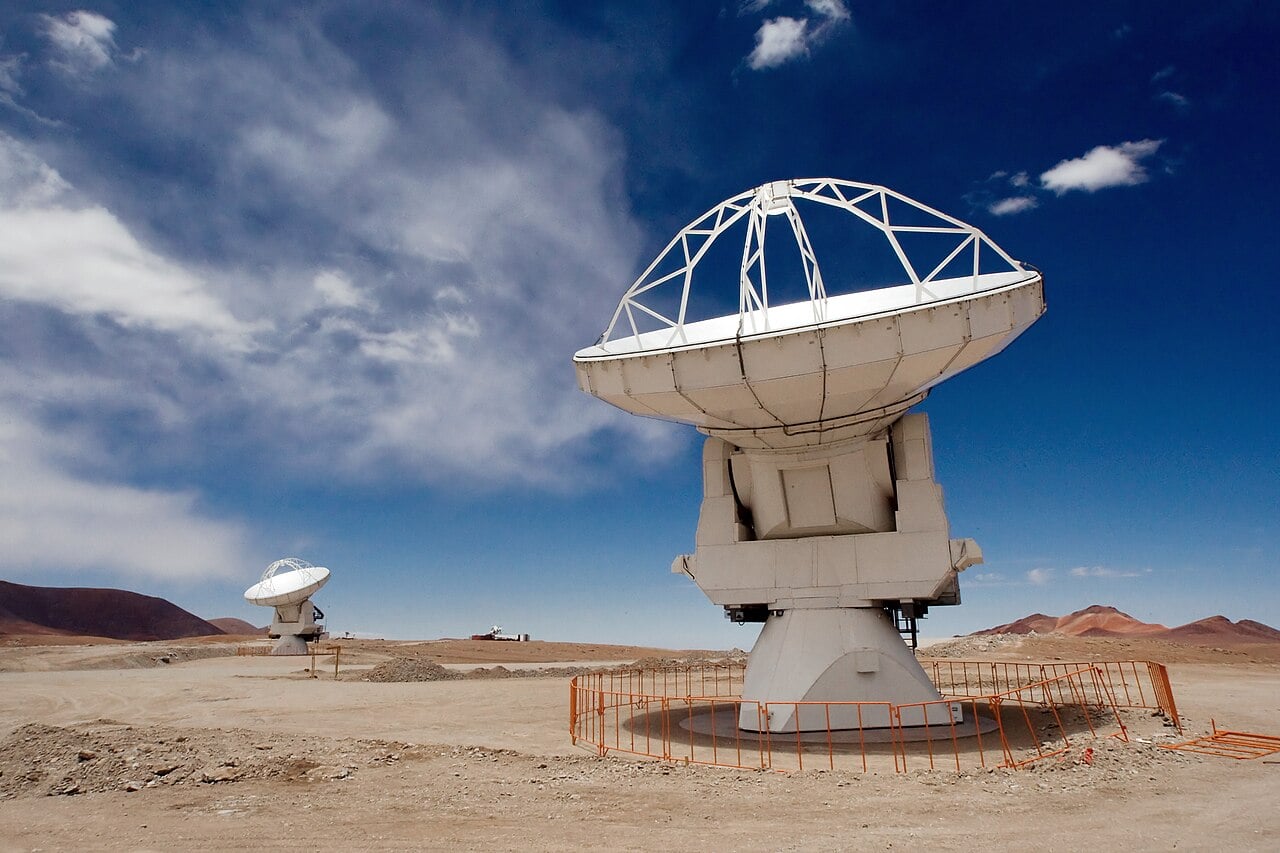 Two of the Atacama Large Millimetre/submillimetre Array (ALMA) 12-metre antennas gaze at the sky at the observatory’s Array Operations Site (AOS), high on the Chajnantor plateau at an altitude of 5000 metres in the Chilean Andes (Credit : ESO)
ALMA excels at detecting ongoing star formation hidden behind thick veils of dust, while JWST traces the distribution of stars already formed. When the team overlaid these complementary views, the three galaxies revealed wildly different architectures.
AzTEC-1 shows star formation spread throughout the galaxy while its existing stars cluster tightly at the centre. This pattern suggests a major collision between two large galaxies funnelled gas inward, triggering an intense starburst while scattering material across the system. The violence of a galactic merger, in this case, acted as the spark.
AzTEC-4 tells a different story. ALMA reveals elegant spiral arms traced by active star formation, yet JWST shows the existing stars distributed in a smooth disk without strong spiral features. This combination points not to an external trigger but to spontaneous star formation driven by the galaxy's own internal gravitational instability.
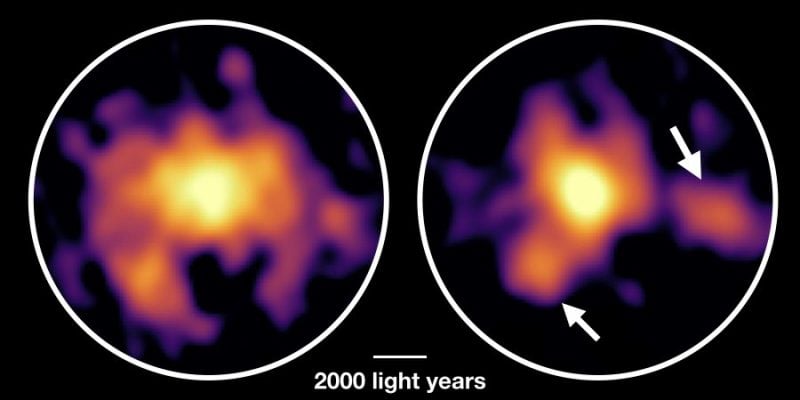 Monster galaxy AzTEC-1 observed with the ALMA telescope in Chile. ALMA revealed the distribution of molecular gas (left) and dust particles (right). In addition to the dense cloud in the centre, the research team found 2 dense clouds several thousand light years away from the centre. These dense clouds are dynamically unstable and thought to be the sites of intense star formation. (Credit : ALMA/ESO/NAOJ/NRAO)
AzTEC-8 presents yet another scenario. Compact star formation concentrates near the galaxy's center in ALMA images, while JWST reveals a much more extended stellar distribution peppered with massive clumps. This architecture suggests a collision with a smaller companion galaxy delivered fresh gas to the centre, lighting the fire of star formation without the wholesale disruption of a major merger.
The discovery overturns the previous assumption that all monster galaxies grew the same way and demonstrates that multiple pathways lead to rapid growth in the early universe. The team now plans to expand their sample significantly, conducting statistical tests on this diversity and exploring what these mechanisms might tell us about the formation of galaxies like our own Milky Way.
Source : Multiple Origins Behind The Extreme Star Formation In “Monster Galaxies”