Universe Today
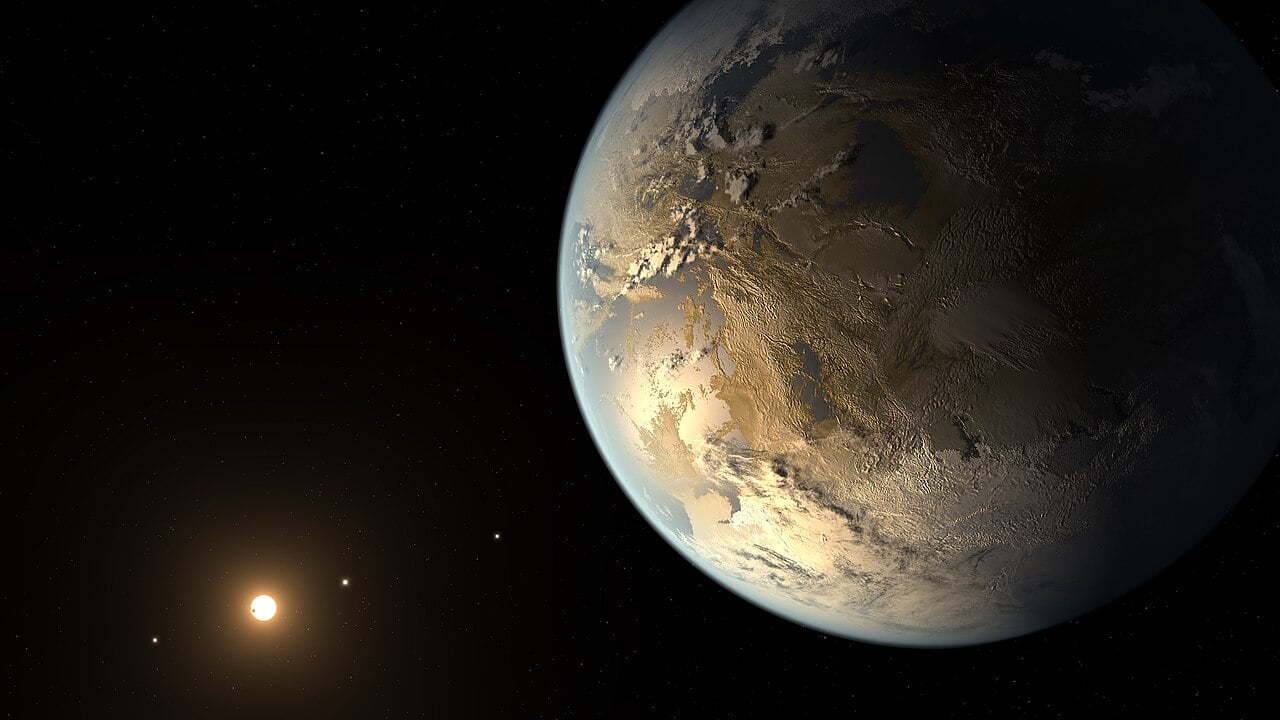
When astronomers discovered the first planet outside our Solar System, it was orbiting a pulsar, one of the most extreme, radiation blasted environments imaginable. Not exactly the kind of place you'd expect to find a planet, let alone a representative one. The first confirmed exoplanet was an oddity, a product of the fact that pulsar timing is extraordinarily sensitive, not a reflection of what planets are typically like.
The same pattern repeats throughout astronomy. The first quasar discovered was the brightest quasar visible from Earth. The first asteroid found was the largest. The first hot Jupiter detected was a gas giant on a four-day orbit, a freakish extreme that represented less than one percent of planetary systems, yet dominated early catalogues simply because it was the easiest thing to spot.
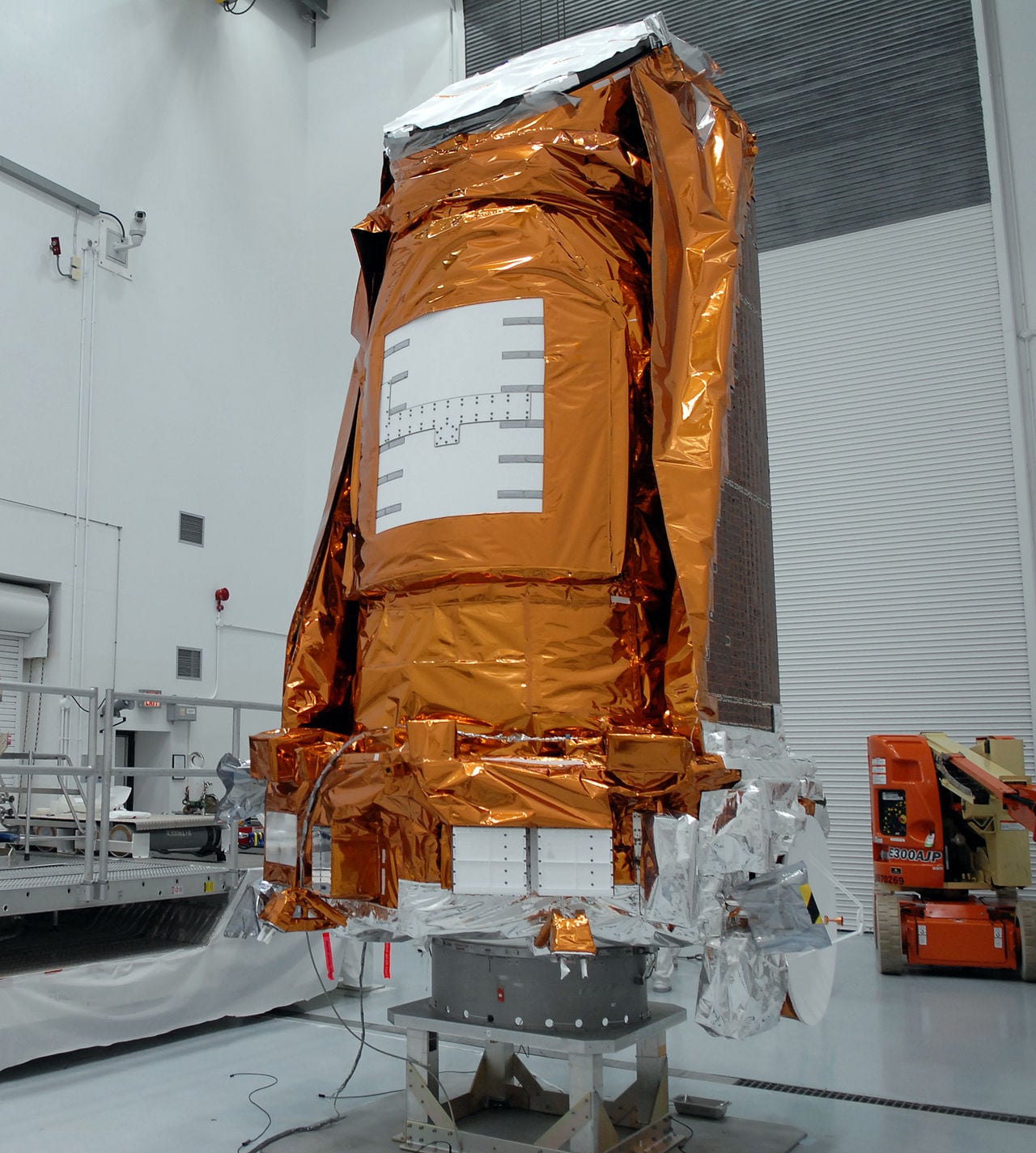 Kepler Space Telescope has discovered thousands of exoplanets and essentially launched the era of biosignature (Credit : NASA/Troy Cryder)
A new paper from NASA's Goddard Space Flight Center argues that the first detection of a chemical sign of life on another planet will follow exactly the same pattern. We won't find the most common form of life in the universe, instead, we’ll find the loudest one.
Any telescope has a detection threshold, a minimum signal strength needed to claim a discovery. The planets that clear that threshold first aren't the most representative ones instead they're the ones producing the strongest signal at the greatest distance. And signal strength in astronomy scales with volume in a brutal way since a planet that is twice as detectable isn't twice as likely to be found first, it's eight times as likely, because it can be seen across a volume of space eight times larger.
For the James Webb Space Telescope, which hunts for these biosignatures by analysing starlight filtered through planetary atmospheres during transits, the loudest targets are sub-Neptunes. These planets are significantly larger than Earth with thick, hydrogen rich atmospheres that produce enormous spectral signals. A planet like K2-18b, a world roughly 2.6 times Earth's size orbiting a dim red star 124 light years away, produces a biosignature signal roughly 32 times stronger than a true Earth analogue would. Run that through the volume calculation and K2-18b's class of planet could be 30,000 times rarer than Earth like worlds and still be more likely to show up first in our searches.
The paper is careful to note that K2-18b may or may not actually be habitable, that debate is very much ongoing. But whether it hosts life or not, it illustrates the point perfectly. It sits near the top of the detectability hierarchy not because it is a typical inhabited world, but because it is an extreme one.
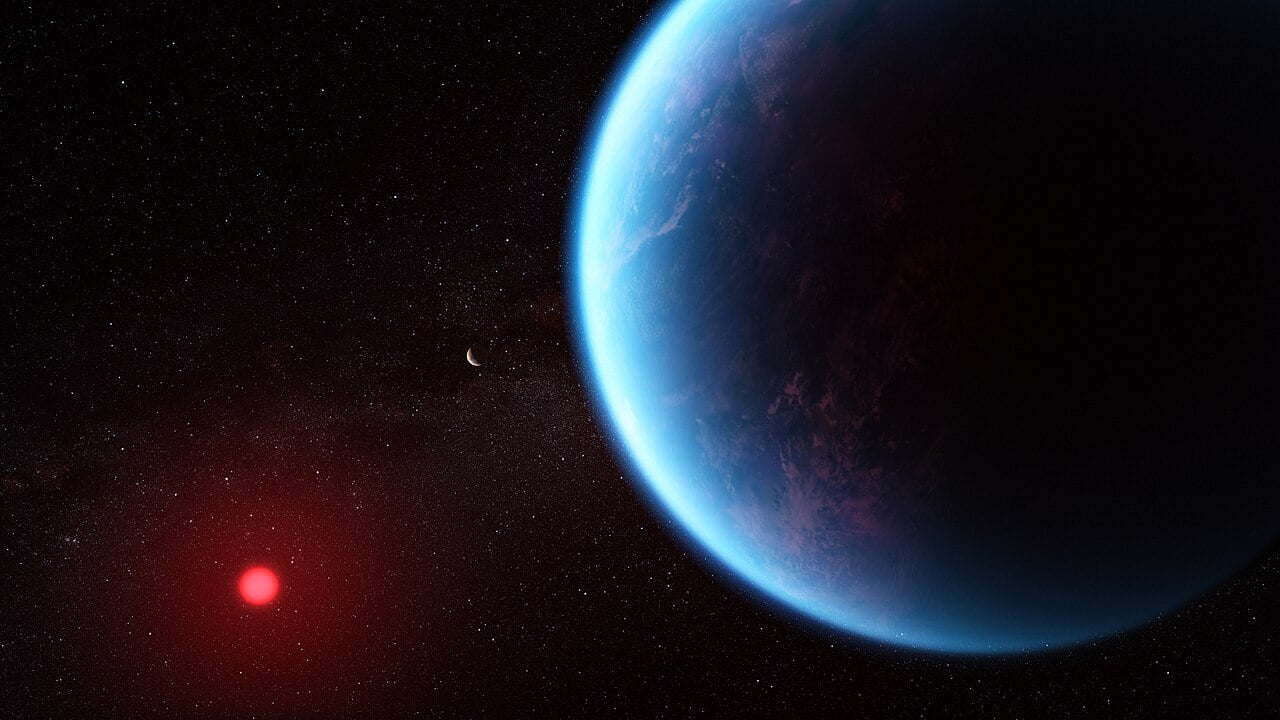 Artist impression of K2-18b (Credit : NASA/ESA/CSA)
The situation for the Habitable Worlds Observatory is more nuanced but the same basic problem applies. Even within a survey targeting Earth sized planets in habitable zones, the first biosignature detected will be the one with the strongest spectral features, not necessarily the most common atmospheric state. Earth itself has worn several different biosignature fingerprints across its history from a methane-rich Archean atmosphere, a low-oxygen Proterozoic one, and the oxygen-rich modern version and these aren't equally detectable. Whichever one happens to produce the clearest signal in the telescope's wavelength range will win the race, regardless of how common it actually is.
Finding any biosignature would be extraordinary. But it does carry an important warning for how we interpret that first discovery. If the first signs of alien life look unusual, unexpected, or unlike anything on Earth, that shouldn't surprise us. And if they look reassuringly Earth like, we shouldn't assume life elsewhere is typically Earth like either.
Source : The First Remotely Detected Biosignature May Not Be the Most Common: Implications for JWST and HWO