Universe Today
Our Sun is a patient rotator. Over its lifetime it has shed angular momentum steadily, swept away on the solar wind, slowed by the invisible drag of its own magnetic field. From birth to death, stars typically spin down to between a hundred and a thousand times slower than their original rotation rate. It's one of the most reliable patterns in stellar physics, and astronomers have long assumed that magnetic fields interacting with the churning plasma inside a star were the mechanism behind it.
But assuming and proving are very different things. The internal rotation of stars has historically been almost impossible to measure directly until a technique called asteroseismology changed the game. By analysing the natural oscillation frequencies of stars, much as a geologist reads earthquake waves to probe the Earth's interior, astronomers can now peer inside distant suns and measure how fast their cores are spinning. What they found suggested the current theory was not telling the whole story.
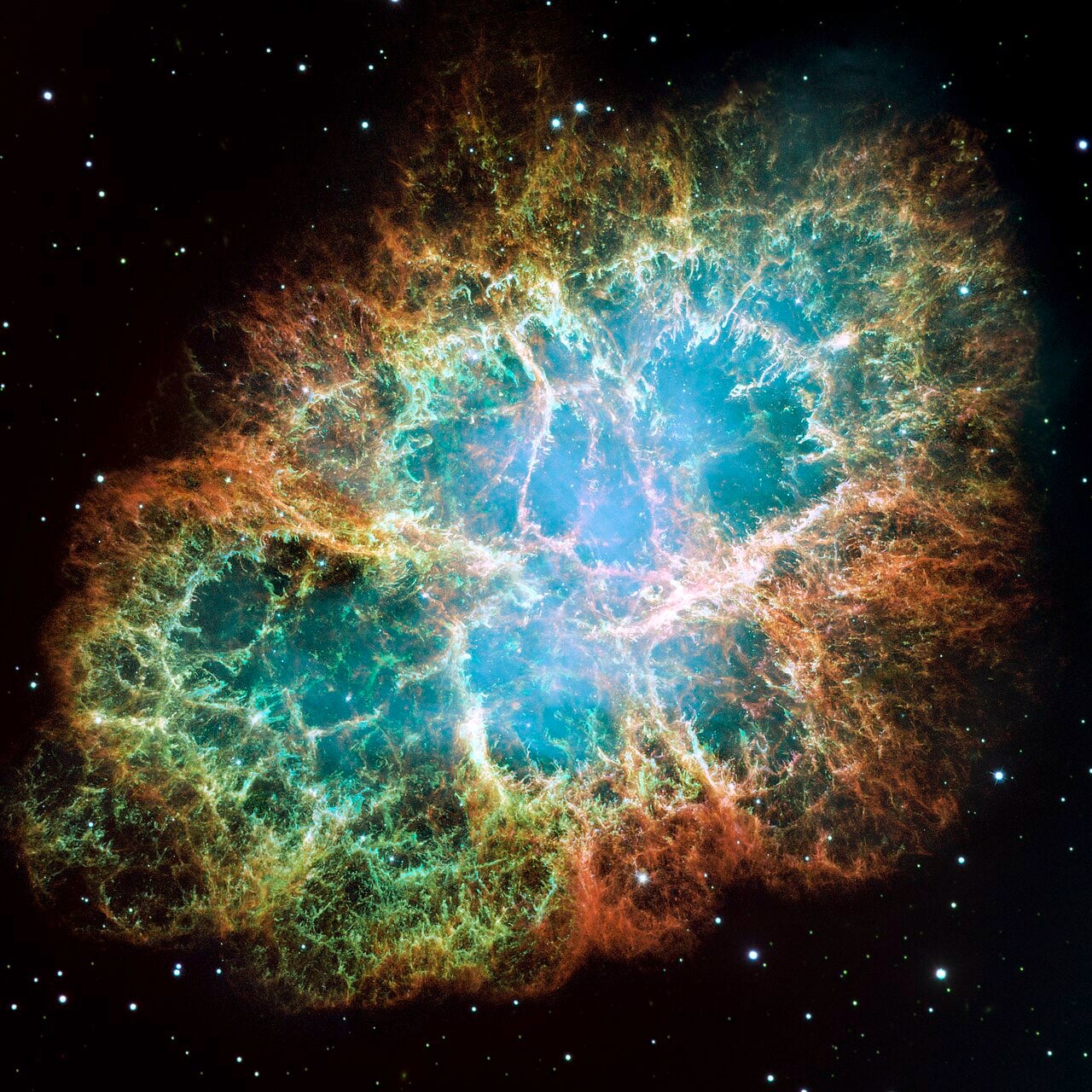 What remains of a star that died in spectacular fashion. The Crab Nebula is the aftermath of a supernova recorded by astronomers in 1054 AD and new research suggests the star's final hours were far more dramatic than anyone imagined (Credit : NASA/ESA)
A team at Kyoto University decided to find out why. Using detailed three dimensional simulations of massive stars in the final stages of their lives which were burning through oxygen and silicon in the last desperate hours before core collapse, they were able to model the complex interplay between convection, rotation, and magnetic fields. What they discovered was both elegant and maybe even a little unsettling.
The magnetic field inside a massive star doesn't simply apply a uniform brake. Its geometry matters enormously. Depending on how the magnetic field is configured, the interaction with the violently churning convective zones can either carry angular momentum outward, spinning the core down as expected or inward, actually accelerating the rotation. In some classes of massive star, slow rotation may not even be possible.
"We were surprised to discover that some configurations of the magnetic fields actually spin the core up, suggesting that the final spin rate will be unique to the star's properties." - co-author Lucy McNeill from Kyoto University.
In other words, the rotational fate of a star at the moment of its death is not a predictable outcome but an individual one, shaped by the specific geometry of its magnetic field during its final burning phases. The deeper significance is that the same basic physics appears to govern rotation across a vast range of stellar masses from Sun like stars to the giants that end their lives in spectacular supernovae. A universal theory of stellar rotation may now be within reach.
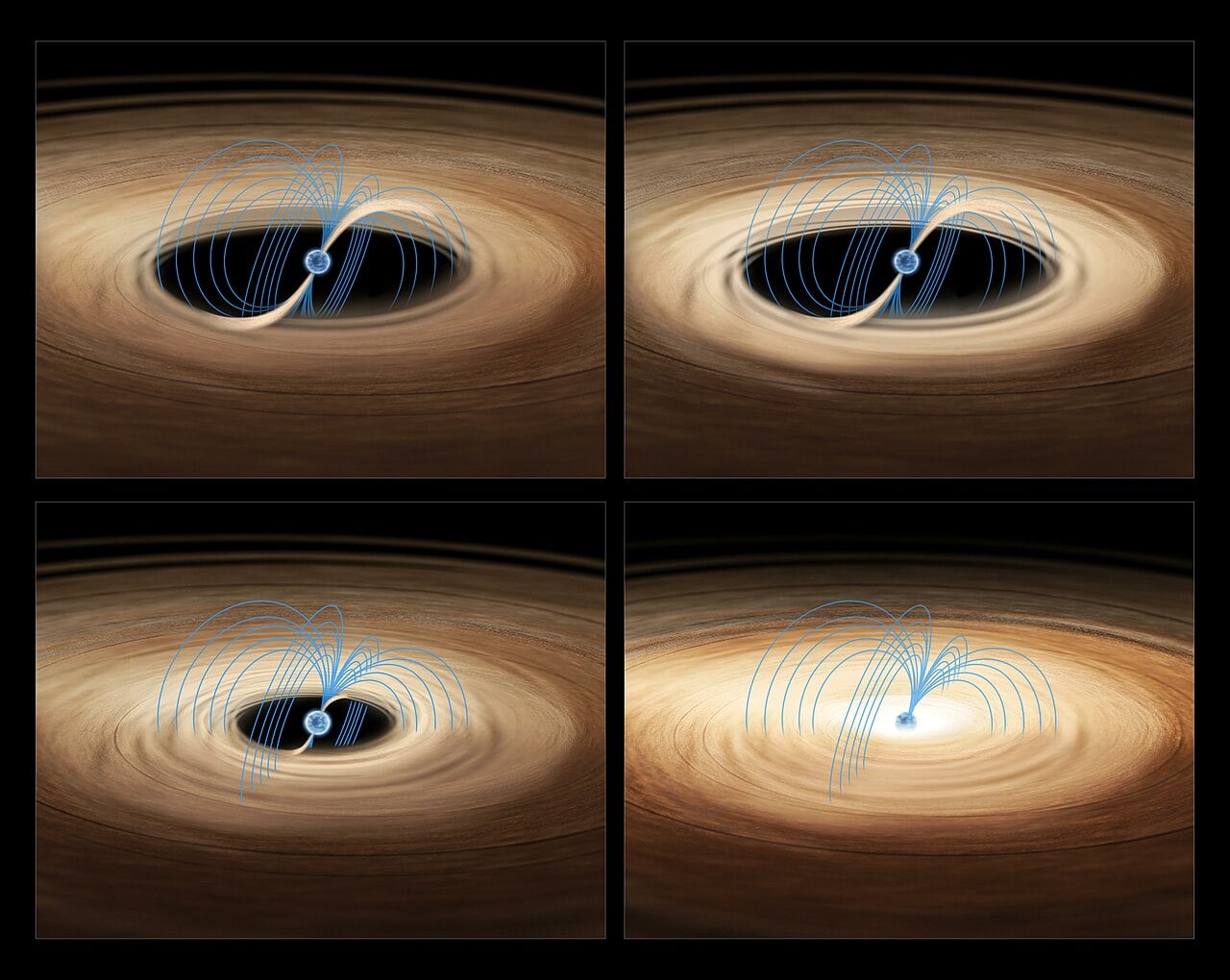 A neutron star and its magnetic field lines, shown across four stages of evolution. The research reveals that it is the specific geometry of these fields, not chance, that determines whether a dying star spins faster or slower in its final moments (Credit : NASA)
The team's next step is to model the full lifetimes of stars across the mass spectrum, tracking how rotation evolves from birth to death. For a field that has long relied on educated guesswork about stellar interiors, that prospect is genuinely exciting.