Universe Today

Wrapped around our planet, invisible and largely unknown by most of the people living beneath them, are two of the most extraordinary structures in the Solar System. They're not mountains, clouds, nor anything you could ever see with the naked eye. They're vast doughnut shaped zones of protons and electrons trapped by Earth's magnetic field and held in place at altitudes stretching from a few hundred to nearly 96,000 kilometres above the surface. They are known as the Van Allen belts, named after the American physicist James Van Allen who discovered them in 1958 using data from America's first successful satellite, Explorer 1.
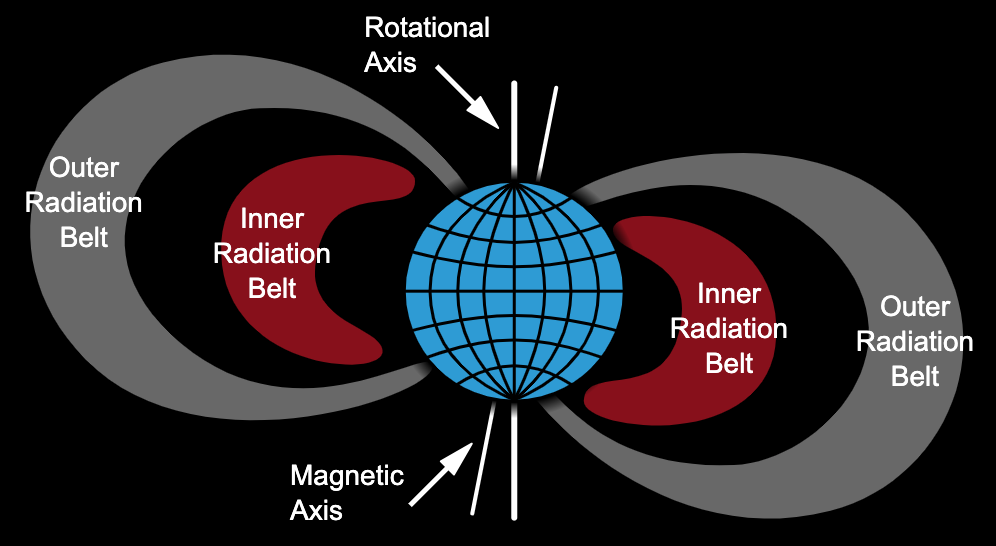 A cross section of Van Allen radiation belts (Credit : Booyabazooka)
These belts are genuinely remarkable things, on one hand they act as a shield, deflecting harmful cosmic radiation and the relentless stream of charged particles blasted out by the Sun. Without them, life on Earth's surface would face a very different and far more hostile environment. On the other hand, they're a hazard in their own right since spacecraft passing through them accumulate radiation damage. Astronauts venturing beyond low Earth orbit must transit them as quickly as possible. And when the Sun misbehaves, injecting extra energy into the belts during solar storms, they swell and intensify in ways that can cripple satellites and disrupt GPS systems across entire continents.
Understanding the Van Allen belts isn't just interesting to science, it’s critically important to how we engineer space craft and satellites in orbit. In 2012, NASA launched Van Allen Probe A and B specifically designed to do that job.
The two probes lifted off together from Cape Canaveral in August 2012, designed for a two year mission. What they found kept scientists busy for nearly seven. Equipped with instruments sensitive enough to detect radiation belt features invisible to any previous sensor, they discovered new mechanisms by which particles are accelerated and lost within these dynamic regions.
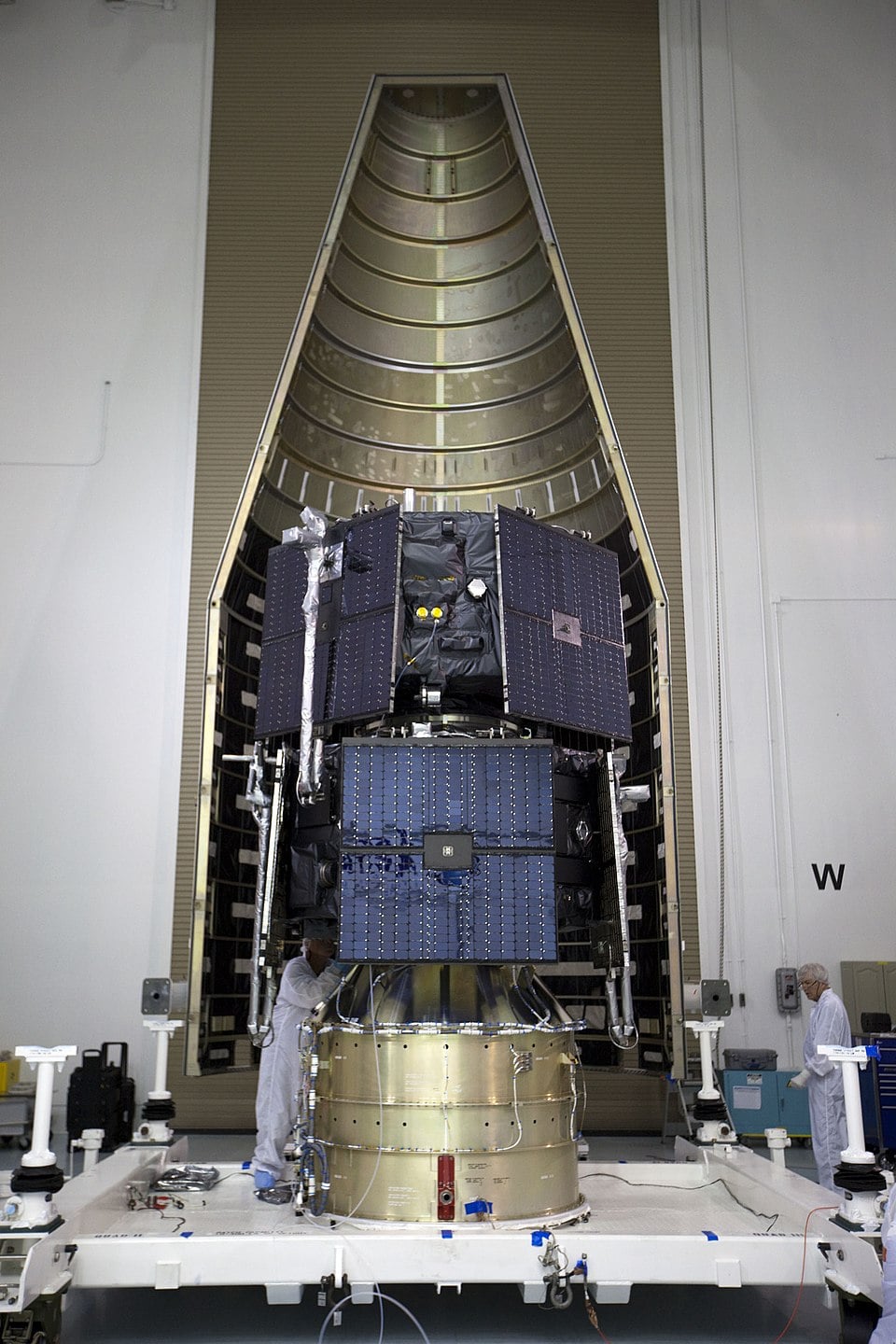 Van Allen Probe in front of the payload fairing (Credit : Kim Shiflett)
Project scientist Sasha Ukhorskiy described the mission as having uncovered things that were "all but invisible to previous sensors."
When the probes finally ran out of fuel in 2019 and were retired, the expectation was that atmospheric drag would slowly pull them down to re-entry, with Probe A predicted to return sometime around 2034. It seems though, that the Sun had other ideas.
The current solar cycle has turned out to be far more active than forecasters anticipated. In 2024, scientists confirmed the Sun had reached solar maximum, the peak of its roughly eleven year activity cycle triggering intense bouts of space weather and dramatically inflating Earth's upper atmosphere. A more puffed up atmosphere means more drag on any satellite skimming through it, and Van Allen Probe A's orbit began to decay far faster than mission planners had modelled. Eight years were shaved off the timeline almost overnight.
By March 2026, the 600 kilograms spacecraft was coming down regardless. The US Space Force tracked its descent in the final days, predicting re-entry on the evening of March 10. NASA knew most of the probe would burn up in the heat and friction of atmospheric entry, but some components were expected to survive. The risk of falling debris causing harm to anyone on the ground was estimated at roughly 1 in 4,200 which is low by the standards of these events, and with around 70 percent of Earth's surface covered by ocean, the overwhelming likelihood was that any surviving fragments would end their journey in deep water.
There's something fitting about the whole story because a Probe A built to study the invisible forces that protect our planet was brought home early by the very star whose behaviour it helped us understand better. Van Allen Probe B, its twin, remains in orbit but is now expected to follow before 2030. The data these two spacecraft gathered continues to help scientists model space weather, protect astronauts on future deep space missions, and build satellites robust enough to survive the radiation environment they orbit within. Not a bad result for a mission that was only supposed to last two years.