 Universe Today
Stars form inside giant molecular clouds (GMCs), vast collections of mostly atomic hydrogen. This happens in the densest, coldest regions of the clouds, where gas more easily accumulates. But the star formation process isn't efficient, and astrophysicists want to know why that is.
When describing star formation in these clouds, scientists work with a concept called "free-fall time." It's a timescale that describes how gas clouds collapse into stars under the influence of their own gravity, without any external forces. It's a theoretical time that a GMC would need to convert all of their gas into stars.
When astrophysicists say that star formation isn't very efficient, they mean that GMCs usually only convert between about 1% and 3% of their gas into stars per free-fall time (FFT). Even in the most active star-forming regions, GMCs struggle to convert more than 10% of their gas into stars. There are some exceptions to this, notably during galaxy mergers or in regions where the gas is under extreme compression like the Milky Way's Central Molecular Zone.
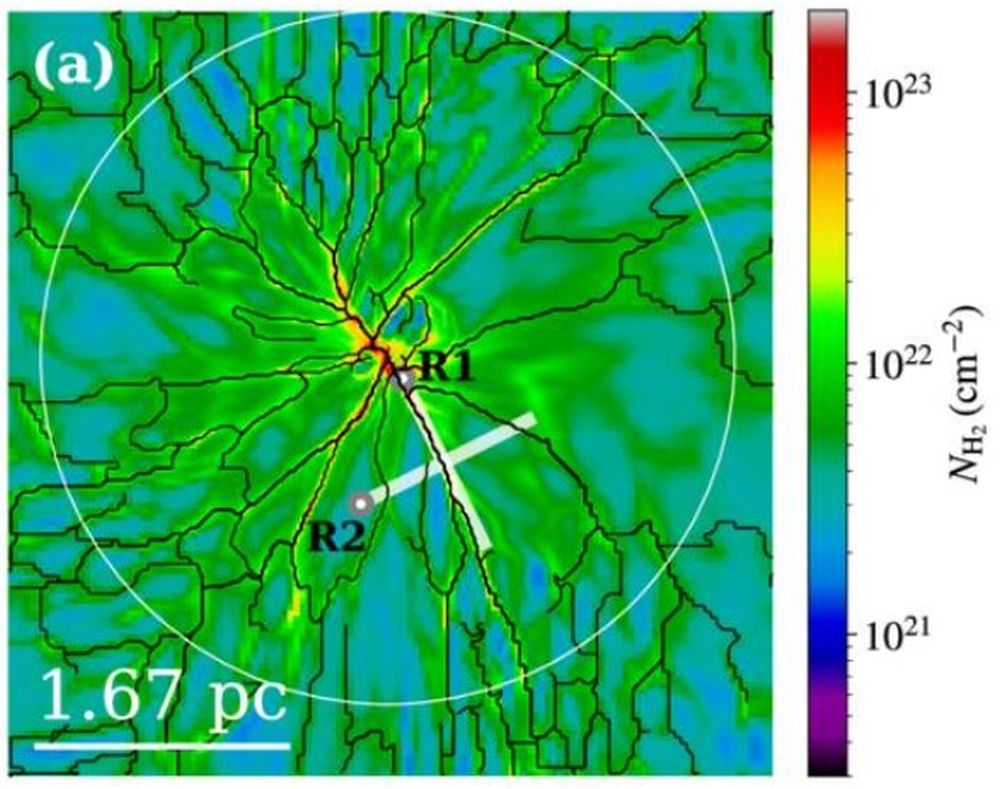
Observations have detected filamentary structures in star-forming GMCs that affect how stars form. New research in The Astrophysical Journal Letters explains how they channel gas into the site of a forming star, helping dictate how efficient the process is. It's titled "An Origin of Radially Aligned Filaments in Hub-filament Systems," and the authors are Shingo Nozaki and Shu-ichiro Inutsuka. Nozaki is a doctoral student at Kyushu University's Graduate School of Sciences, and Inutsuka is from the Department of Physics, Graduate School of Science, at Nagoya University.
"Recent observations have identified hub-filament systems (HFSs) as the primary formation sites of massive stars and star clusters," the authors write. "Some HFSs are characterized by multiple filaments aligned radially toward a central high-density hub." But these radially-aligned filaments are hard to explain.
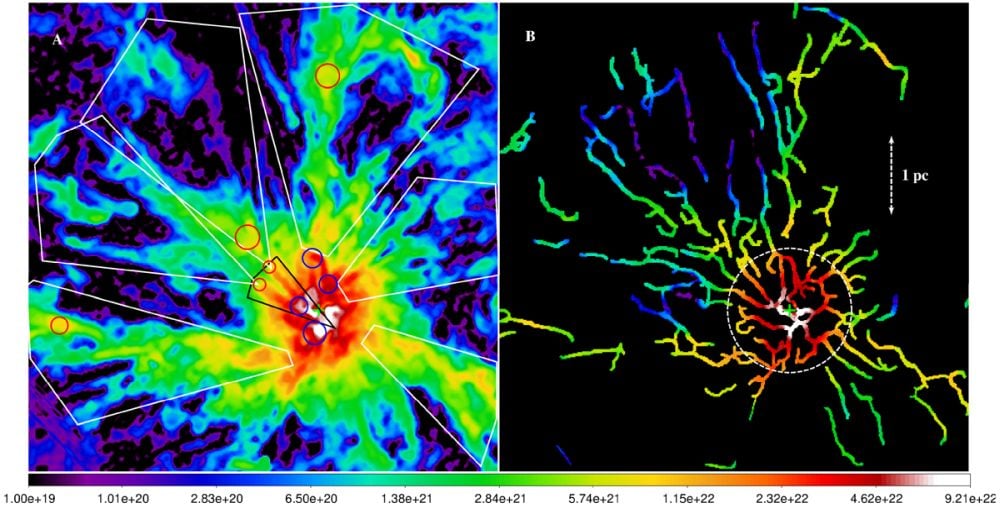 These images show one of the first hub-filament systems found in a star-forming region. They're in the Monoceros R2 SFR about 2700 light-years away. While scientists have theorized about what causes them, a clear answer has eluded them. Image Credit: Kumar et al. 2022. A&A. https://doi.org/10.1051/0004-6361/202140363
Scientists have theorized about the origins of these filamentary systems and have proposed a few mechanisms. The impact of external shocks on the magnetic fields in GMCs have taken center stage."However, the formation of distinct radially aligned filaments converging to a central hub, as observed in HFSs, has not yet been reproduced," the authors explain.
In this work, Nozaki and Inutsuka used ATERUI III, an astronomy-dedicated supercomputer operated by the National Astronomical Observatory of Japan, to run hydrodynamical simulations that show how interactions between gas and magnetic fields in GMCs change over time. They started with an initial GMC that's thick in the middle and thin at the ends. Then they introduced a shock.
"To model the interaction between a molecular cloud and an external shock originating from a supernova remnant, we consider a cloud placed within a cube simulation box with a side length of 10 pc.," the authors explain. "We adopt the initial condition of a cloud that is flattened along the z-direction."
The key insight from the simulations concerns hourglass-shaped magnetic fields, detected in star-forming regions by ALMA. "Before the shock reaches the molecular cloud, the initially uniform magnetic field aligned with the z-axis becomes slightly pinched near the cloud center due to gravitational contraction, forming a weak hourglass-shaped magnetic-field morphology," the authors write.
The pair of researchers ran their detailed simulation for 0.5 million years after the shock to see what happened. It closely produced the hub-filament systems. "The morphology of the radially aligned filaments formed in our simulation closely resembles the HFSs observed in star-forming regions," the authors write. They point out that the filament lengths and densities align with those observations.
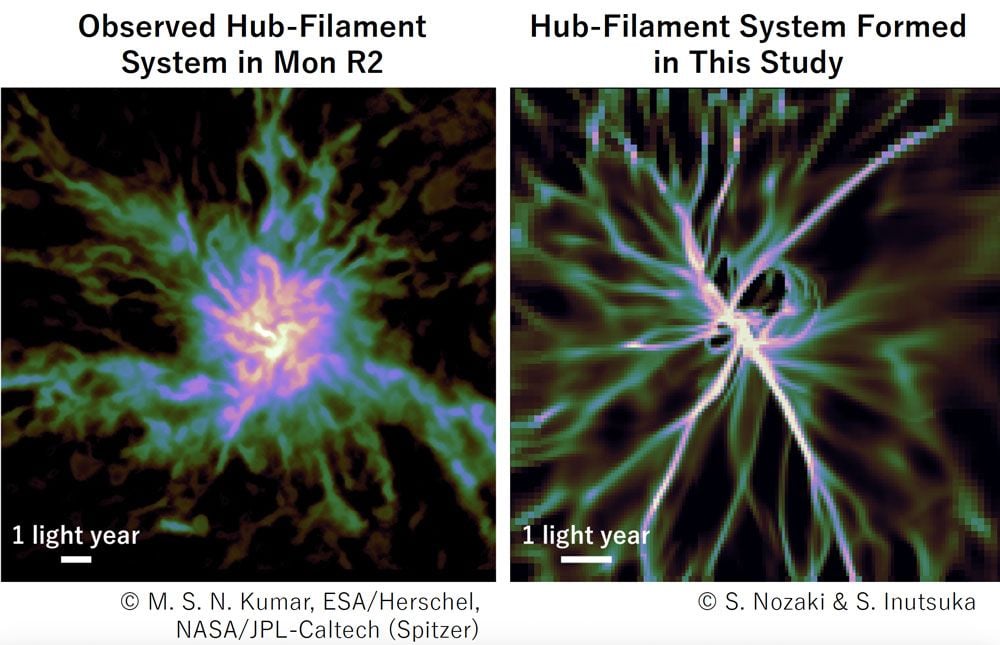 The left panel is an image of the observed HFS in Monoceros R2, compared to a frame from the supercomputer simulation. The simulation closely resembles the image, and along with the simulation's numerical results, is proof that the simulation is accurate. Image Credit: Nozaki et al. 2026. A&A. DOI 10.3847/2041-8213/ae4c84
As the hourglass-shaped magnetic field lines curve, the shock wave strikes different parts of GMC at different times. Some parts of the magnetic field become stronger, forming the filaments. Star-forming gas flows along these filaments, converging into a central hub where a star forms.
Inside the filaments, the gas is denser and flows faster toward the center. Lower-density gas outside of the filaments flows slowly or not at all. "This indicates that mass accretion is channeled through the dense filamentary network," the authors write. And that explains why star formation is so inefficient inside GMCs.
"The estimated SFE (star formation efficiency) is 4%, consistent with observations of nearby molecular clouds, but might be reduced in future simulations with higher spatial resolution," the authors explain. "The potential SFE in filamentary gas is estimated to be only 0.7%." This means that our of all the gas that is inside filaments, only about 0,7% is ever converted to stars.
"These results suggest that the kinematic segregation described above limits the rapid mass supply to the central dense region, thereby preventing an excessively high SFE and naturally regulating star formation," the authors write.
The specific nature of the shock isn't the deciding factor, according to Nozaki. "There are two main sources of these shock waves: radiation-driven ‘bubbles’ from newly formed massive stars, and expanding supernova remnants when a massive star reaches the end of its life, said Nozaki. "There is something almost like a cycle of life in this. What a star leaves behind can go on to shape the next cradle of stars."

