Universe Today
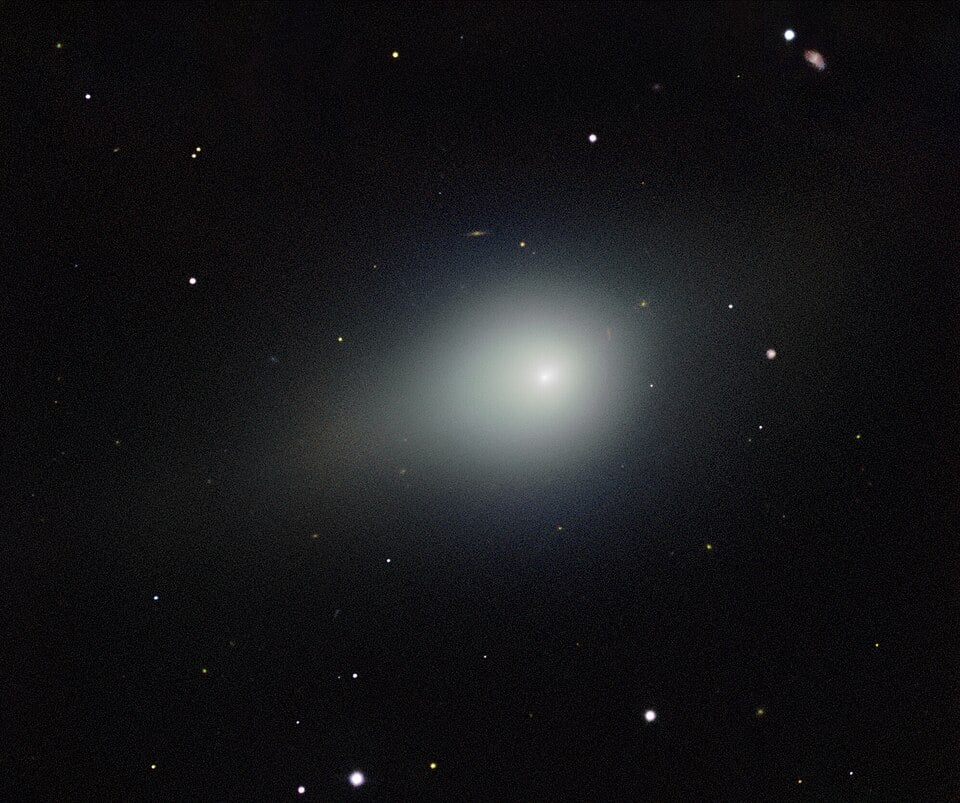
Something arrived in our Solar System last summer that had been travelling for longer than the Earth has existed. It came from somewhere out there in the dark between the stars, possibly from a planetary system that formed billions of years before our own Sun even ignited. We don't know exactly where it came from. We may never know. But for a brief, extraordinary window of time, this ancient wanderer passed close enough to study, and the world's astronomers dropped almost everything to watch.
Its name is 3I/ATLAS. The numbers and letters tell you it's the third interstellar object ever detected, and it was spotted by the ATLAS survey telescope in Chile, a network of instruments designed to scan the night sky for objects that might one day threaten Earth. What it found instead was something that posed no threat whatsoever, but was infinitely more exciting. A comet, travelling at over 240,000 km per hour, on a trajectory that no object born in our own Solar System could ever follow. It had come from somewhere else entirely.
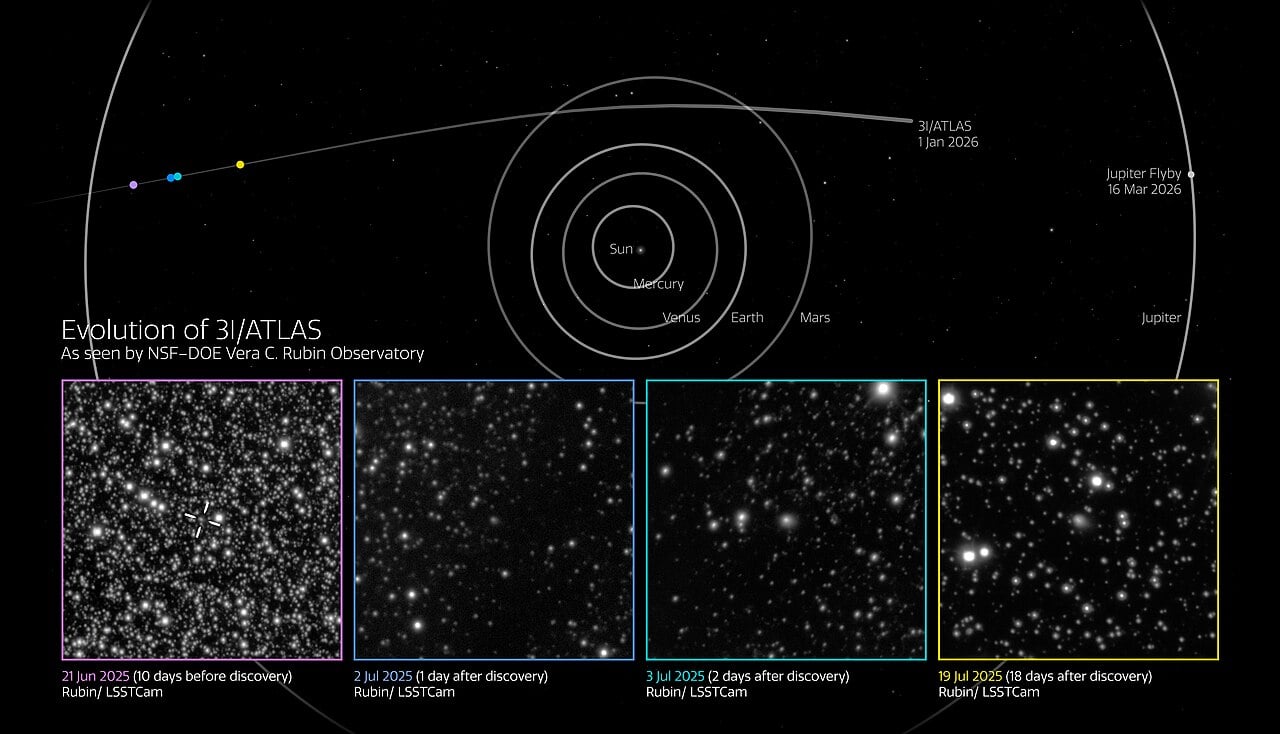 Evolution of 3I/ATLAS as seen by the Vera C. Rubin Observatory's LSSTCam during science validation observations. The four inset images show the comet on 21 June 2025 (ten days before discovery), 2 July, 3 July, and 19 July 2025. The upper portion shows the comet's trajectory through the inner Solar System (Credit : NSF–DOE Vera C. Rubin Observatory)
In the months that followed, a scramble of observations took place. Hubble photographed it. X-ray telescopes caught it glowing in high energy light. NASA's Parker Solar Probe watched it race around the Sun. Infrared observatories detected organic molecules and water vapour streaming off its ancient surface. One researcher described the experience as being like glimpsing a rifle bullet for a thousandth of a second, over before you can quite comprehend what you've seen. But one of the most remarkable images has only just arrived.
ESA's JUICE spacecraft (currently en route to Jupiter to study its icy moons) was in exactly the right place at the right time. Just seven days after the comet made its closest approach to the Sun, JUICE turned its science camera toward 3I/ATLAS from 66 million kilometres away and took over 120 photographs. The resulting image shows something beautiful and slightly eerie, a bright, egg shaped glow surrounded by a halo of gas, with a long tail streaming away behind it, and faint rays and jets just visible in the processed data.
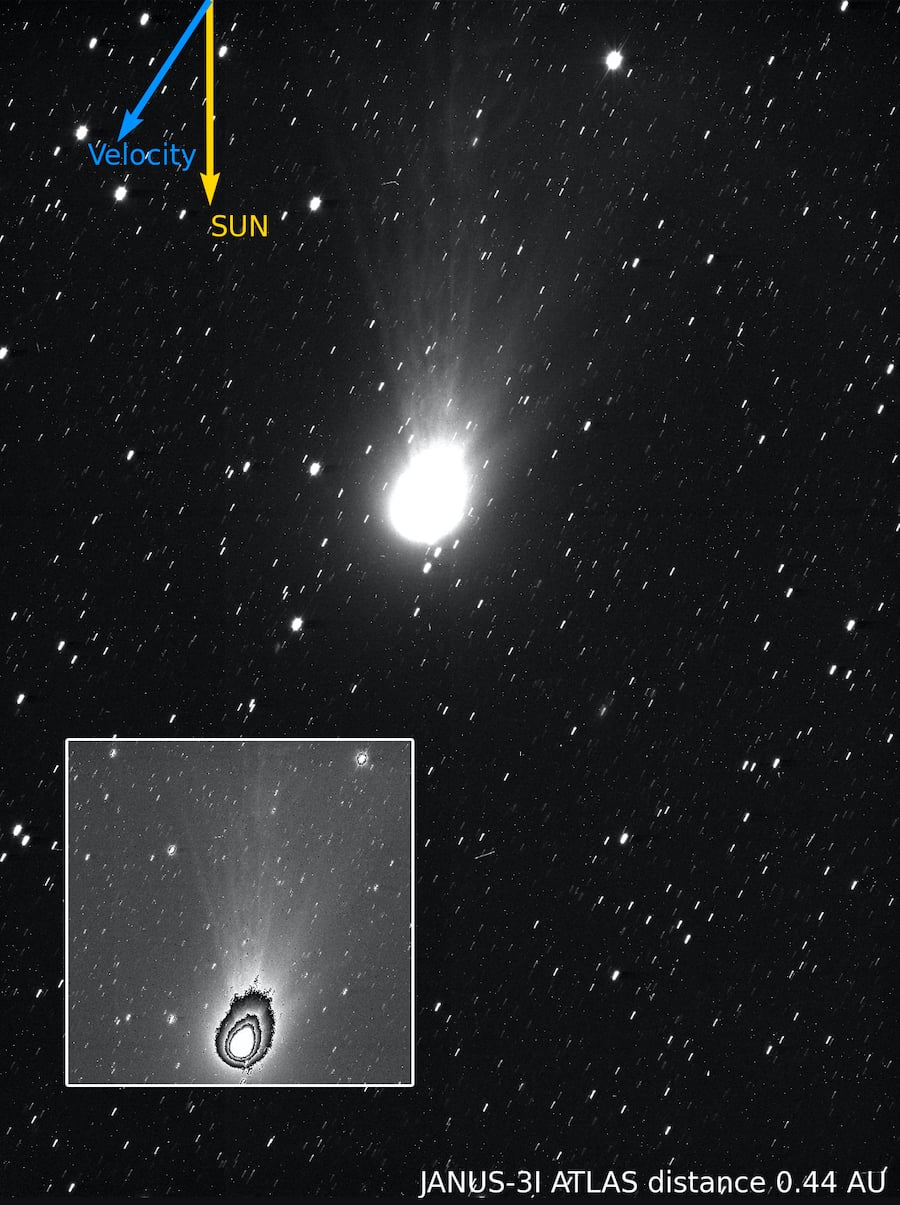 Image of 3I/ATLAS from ESA’s Jupiter Icy Moons Explorer (Juice) shows the tiny nucleus of the comet (not visible) is surrounded by a bright halo of gas known as the coma. A long tail stretches away from the comet, and we see hints of rays, jets, streams and filaments. The inset shows the same data, but processed to highlight the coma structure. The arrows in the top left indicate the direction in which the comet was moving (blue) and the relative direction of the Sun (yellow). (Credit : ESA)
There is something deeply significant in that image, despite travelling unimaginable distances through interstellar space where temperatures approach absolute zero and cosmic rays pummel everything in their path, 3I/ATLAS is behaving exactly like a perfectly ordinary comet. The same ices, the same outgassing, the same familiar structures we see in comets born right here in our own Solar System. The universe, it seems, makes comets the same way everywhere.
And yet it is not quite the same. Scientists probing its chemistry found that the pristine ices buried beneath its radiation baked crust were releasing a cocktail of chemicals; water, carbon dioxide and organic molecules that have been locked away since before our Solar System existed. In a very real sense, analysing this comet means reading a message from another planetary system, sent billions of years ago and only now decoded.
The full scientific results from JUICE are still being processed and the instrument teams meet in late March to compare notes. Whatever they find, one thing is certain, 3I/ATLAS is already gone, accelerating away from the Sun and heading back out into the infinite dark from which it came. It will never return. We had one chance to meet it and hopefully we made it count.
Source : First glimpse of comet 3I/ATLAS from Juice science camera