Universe Today
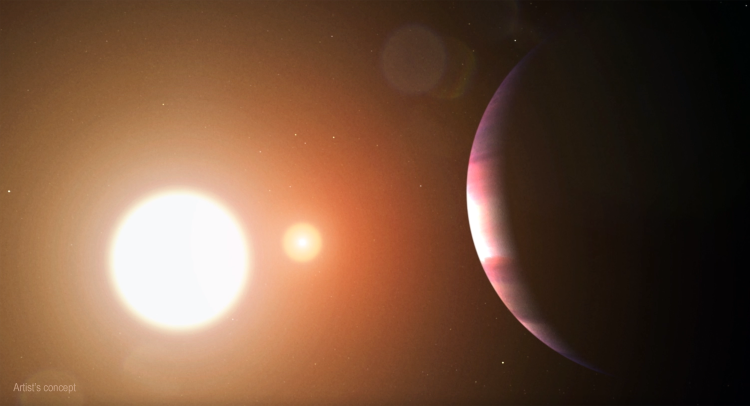
You’re doing some late afternoon work on the habitat as part of humanity’s first exoplanet settlement, but the sun is going down so you’re trying to speed things up. Just as the light dims, everything suddenly starts getting brighter. You look up and see the sun starting to rise again, except it’s your second sun. You kick yourself for not checking the daily sunrise and sunset logs, but you’re happy you get to put in a bit more work before you eat dinner.
This scenario might be centuries away from reality, but it hasn’t stopped an international team of present-day scientists from searching for exoplanets orbiting both stars in a two-star, also called circumbinary planets (CBPs). In findings recently published in the Monthly Notices of the Royal Astronomical Society, a team of researchers from the United States and Australia have brought us one step closer to better understanding these unique worlds and whether they’d be suitable for life beyond Earth.
For the study, the researchers examined new data from NASA's Transiting Exoplanet Survey Satellite (TESS) spacecraft regarding new circumbinary planets. What makes this study unique is it introduces a new method for identifying CBPs, with the longstanding method being the transit method, which involves measuring a dip in starlight as an exoplanet passes in front of its host star. However, this makes finding CBPs tricky since it must pass in front of both of its stars simultaneously. To combat this, the researchers used a method called apsidal precession, which measures the gradual twisting of the orbit’s shape that is produced from the gravitational influence by the planet on the stars.
After analyzing data from 1,590 eclipsing binary stars that exhibit apsidal precession, the researchers discovered 27 new candidate CBPs, but their physical properties like size remain inconclusive. The researchers noted how the radial velocity method, which is common exoplanet discovery method that measures the wobble between a star and planet, could be used to better characterize and confirm these 27 candidates.
“Identifying transits in binary systems clearly is challenging, but we’d like to know more about the range of planets that can form around two gravitationally bound stars,” said Margo Thornton, who is a PhD candidate at the University of New South Wales in Sydney and lead author of the study. “So, we developed a survey to search for planets using stellar eclipses that is not limited to the orientation of the planet’s orbit.”
This study is monumental in several ways, because not only did it successfully use a new method for identifying exoplanets, but the 27 CBP candidates could potentially more than double the total confirmed number of CBPs, which currently stands at 18. While it could take years to confirm these 27 candidates as real exoplanets, this new method nonetheless could open doors to identifying more CBPs faster and more efficiently than long-standing methods like the transit method. As noted, this is due to not requiring the CBP to align with both their stars to measure its transit. Instead, the apsidal precession method measures the orbital twisting that occurs as the planet exerts its gravitational influence on the stars.
Launched in April 2018, TESS was designed to be a successor to NASA’s Kepler mission and its follow-up K2 mission, with the latter being the same telescope just a different type of mission since the telescope’s steering wheels broke. While Kepler/K2 confirmed the existence of more than 3,300 exoplanets over more than 9.5 years, TESS has confirmed the existence of 855 exoplanets, along with more than 7,900 candidates. The primary difference between Kepler/K2 and TESS is the former focused on one patch of sky while TESS conducted an all-sky survey to find its exoplanets.
How many more circumbinary planets will scientists discover in the coming years and decades? Only time will tell, and this is why we science!
As always, keep doing science & keep looking up!