Universe Today
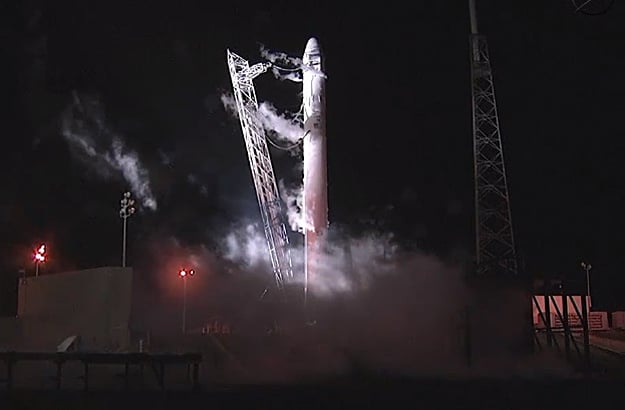
SpaceX's attempt to launch their Falcon 9 rocket with the Dragon spacecraft was aborted by the computer at T-0 due to a high pressure reading on engine 5 of the first stage. The rocket's nine main engines were ignited, but were automaticalaly shut down before liftoff. The vehicle was safed with no apparent other issues. SpaceX and NASA are now looking at the next launch window, which is on Tuesday, May 22 at 0744 UTC, 3:44 EDT. Computer checks all launch components just prior to launch, which is an extra safety feature of the Falcon 9, so the good part of the abort is knowing that all the systems worked as designed to prevent a liftoff that wasn't within the designed parameters. Since this is a test flight, the SpaceX team likely thinks of this a successful launch abort as opposed to a failed launch.
See the video below:
"I have watched and participated in more scrubs of the shuttle than I would have liked, but it's just part of the launch business," said Michael Lopez-Alegria, former shuttle and ISS astronaut and President of the Commercial Space Federation. "I was extremely impressed with professionalism displayed by the SpaceX launch team in the moments after the scrub to safe the vehicle. We will have to wait for the team to perform the technical analysis of what caused the apparent high pressure in one of the engine's combustion chambers and for SpaceX and NASA to decide when the next attempt will occur. This is not the outcome we were hoping for, but far better to detect and react to the problem while still in the pad than to have to deal with it in flight."
When launched, Dragon will be the first commercial spacecraft to go to the International Space Station for cargo resupply.
We'll have more details later, as SpaceX and NASA will have a press briefing later this morning.