Universe Today
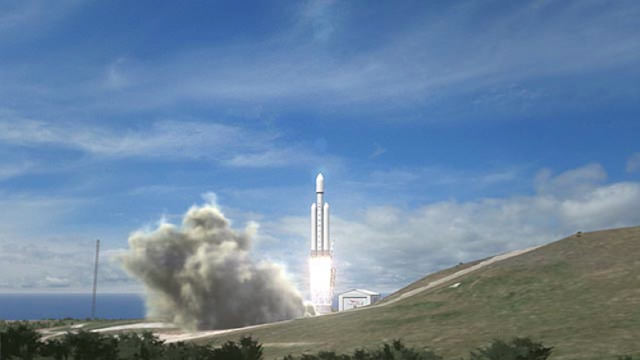
If all goes as hoped, SpaceX will have a very busy 2015. The commercial space company could launch as many as 17 rockets, including a mid-flight test abort of the Dragon capsule to demonstrate its in-flight crew escape system. Then there’s the launch that every rocket aficionado one has been waiting for: the demonstration mission of the 27-engine Falcon Heavy rocket.
Already, SpaceX has launched one mission in 2015, the CRS-5 Dragon resupply mission for the International Space Station that was delayed from December 2014. In addition to successfully hooking up with the ISS, SpaceX also tested out a flyback and landing system for the Falcon 9 first stage, which was deemed “mostly successful” despite a spectacular explosion when it careened off the target, a floating ocean barge. The next test of the landing system will occur with the launch of the solar wind monitoring DSCOVR satellite, which has just been delayed slightly to February 9.
Next rocket landing on drone ship in 2 to 3 weeks w way more hydraulic fluid. At least it shd explode for a diff reason.— Elon Musk (@elonmusk) January 16, 2015
While SpaceX itself does not list upcoming launch dates on its own website, a site put together by SpaceX enthusiast Lukas Davia called SpaceXStats has garnered a list of potential launch dates from NASA and other customers, and they say up to 16 more launches could take place this year. SpaceX will be launching more space station resupply missions, commercial satellite launch missions, and US government science and national security missions.
Delays like the recently announced launch delay for DSCOVR, will greatly impact how many launches SpaceX will be able to conduct this year. Musk has said his company could launch about one rocket per month during 2015, while other sources predict 10-12 launches for the commercial company.
As reported in Spaceflightnow.com, SpaceX had a similar number of flights on its docket in 2014, including the Falcon Heavy’s debut launch and the Dragon abort tests, which has slipped to be on the launch manifest for 2015. Six Falcon 9 rockets ended up blasting off last year.
Most of the missions will take off from Cape Canaveral’s launch complex, where up to 24 launches could take place this year. Along with the launches from SpaceX, United Launch Alliance has launches schedule for satellites for the U.S. military, NASA and commercial companies.
Video: Falcon Heavy
The Falcon Heavy was originally scheduled for its first test flight in late 2012 or early 2013 from Vandenberg Air Force Base, California, but it now will launch from the refurbished pads at Cape Canaveral. SpaceX says this rocket was designed from the outset to carry humans into space and "restores the possibility of flying missions with crew to the Moon or Mars."
The Falcon Heavy will lift over 53 metric tons (117,000 lb) to orbit, about three times the performance of the Falcon 9. It is comprised of three nine-engine Falcon 9 first stage booster cores and uses upgraded Merlin 1D engines.
Here’s a sampling of launches from SpaceXStats, see the full list here.
9 Feb 2015 DSCOVR NOAA Falcon 9 v1.1 SLC-40, Florida 17 Feb 2015 Eutelsat 115W B & ABS-3A Asia Broadcast Satellite Falcon 9 v1.1 SLC-40, Florida March 2015 Dragon Inflight Abort SpaceX / NASA Falcon 9 v1.1 SLC-4E, Vandenberg, California 8 Apr 2015 SpaceX CRS-6 NASA Falcon 9 v1.1 SLC-40, Florida H1 2015 Falcon Heavy Test Flight SpaceX Falcon Heavy LC-39A, Florida
Video: SpaceX's Year in Review, 2014: