 Universe Today
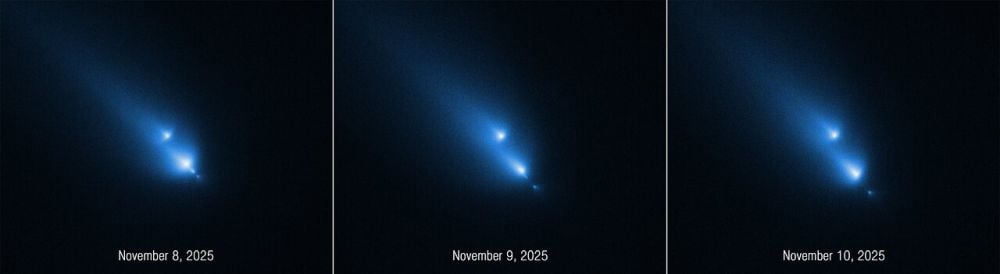
Some observations are the result of years of meticulous planning and cooperation between astronomers, different telescopes and observatories, and even different governments. Others are more serendipitous, and are little more than happy accidents. That's the case with the Hubble's recent observation of Comet C/2025 K1 (ATLAS) as it fragmented.
The observations are the work of a team of researchers focused on comets. The group obtained some Hubble observing time with a proposal to observe a completely different comet. Those plans didn't work out because of technical restraints, so they scrambled to find a different target. They selected C/2025 K1 (ATLAS), and it happened to break apart while they observed it.
The comet, also known simply as Comet K1, is non-periodic and came directly from the Oort Cloud, a reservoir of billions of icy objects in the Solar System's distant reaches. Objects from the Oort Cloud are made of primordial material from the Solar System's early days. But when they approach the inner Solar System, they're subject to heating by the Sun and their surfaces are altered. They've also been hit by cosmic rays.
This creates a scientific conundrum. It's difficult to tell which of their properties are pristine and which have been altered. Scientists would love to see inside one, to observe ancient unaltered material. Studying their tails and coma can provide some insights, just as NASA's Stardust mission did when it returned a sample from Comet Wild 2 in 2006, the first sample of a comet ever obtained. But watching as a comet breaks apart is another opening. That's exactly what happened with the Hubble's observations of Comet K1.
"Because the interior of a comet is rarely exposed, fragmentation events provide valuable opportunities to probe subsurface structure, volatile reservoirs, and short-timescale activation processes," explain the authors of new research.
The results of the Hubble's observations are presented in new research in the journal Icarus. It's titled "Sequential fragmentation of C/2025 K1 (ATLAS) after its near-sun passage," and the lead author is Dennis Bodewits. Bodewits is a professor in Auburn University’s Department of Physics.
"Comet C/2025 K1 (ATLAS) reached perihelion at 0.33 au on 2025 October 8. Daily monitoring by the LCO Outbursting Objects Key Project revealed a major activity increase between November 2 and 4, accompanied by rapid changes in coma morphology," the authors write. LCO stands for the Las Cumbres Observatory, and the Project is a network of observatories trying to undertstand the frequency and the nature of outbursts on small bodies in the Solar System.
"Serendipitous HST/STIS acquisition images obtained on November 8–10 captured the comet only days after this event and resolved five fragments, providing an early high-resolution view of a nucleus in the process of disruption," the researchers explain.
“Sometimes the best science happens by accident,” said co-author John Noonan, also a professor in the Department of Physics at Auburn University. “This comet got observed because our original comet was not viewable due to some new technical constraints after we won our proposal. We had to find a new target — and right when we observed it, it happened to break apart, which is the slimmest of slim chances.”
Noonan looked at the Hubble's images the day after it captured them and realized something remarkable had happened. “While I was taking an initial look at the data, I saw that there were four comets in those images when we only proposed to look at one,” Noonan said in a press release. “So we knew this was something really, really special.”
Using the Hubble to observe a comet breaking apart is a long-term goal for researchers, and they've attempted it more than once. It's difficult to predict when one will disintegrate, though it's most likely to happen close to perihelion. But Hubble observing time is in demand, and no single research effort can monopolize its time. Researchers can only submit proposals and hope for the best.
“The irony is now we’re just studying a regular comet and it crumbles in front of our eyes,” said Bodewits.
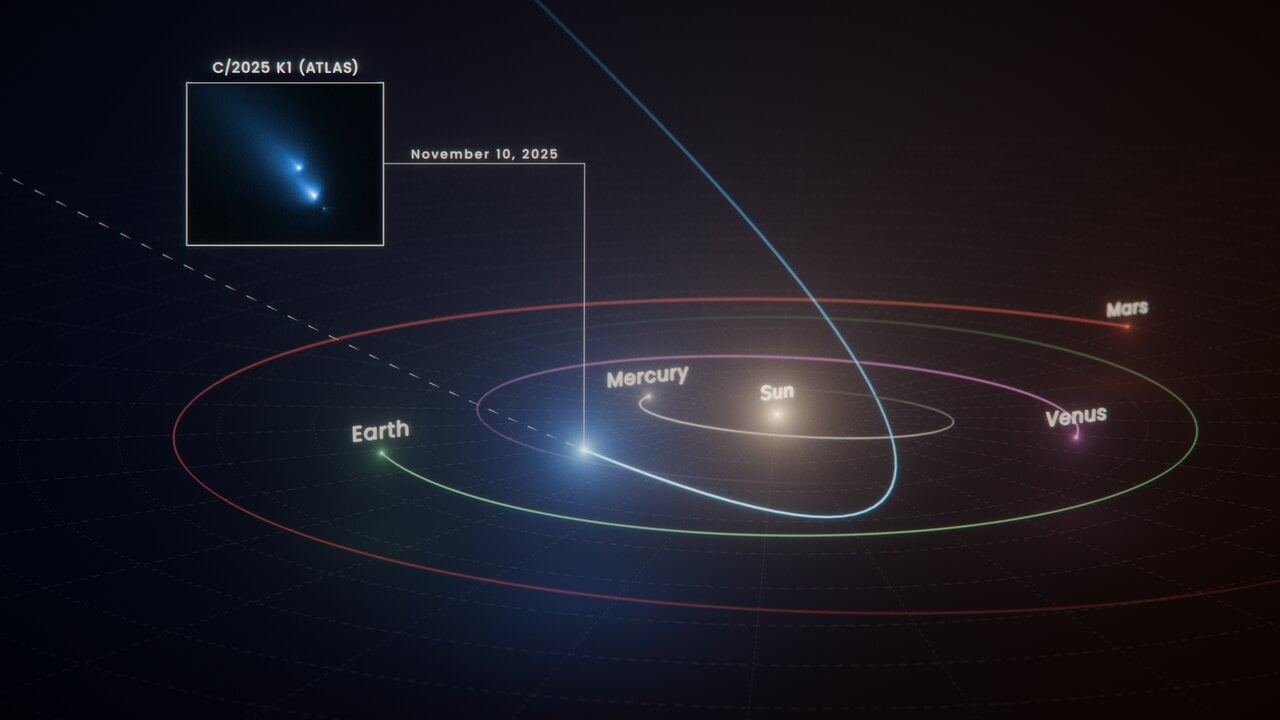 This is the path Comet K1 followed through the inner Solar System. The Hubble captured the images of K1 breaking apart about one month after perihelion, the object's closest approach to the Sun. The comet's perihelion was about 0.33 astronomical units. Image Credit: NASA, ESA, R. Crawford (STScI)
Perihelion puts an enormous strain on comets like K1. The heating is intense and many comets break apart after perihelion. So in that respect the comet's breakup isn't unusual. "Fragmentation is a common evolutionary end state of long-period comets, frequently associated with progressive mass loss, thermal stresses, and rotational spin-up driven by asymmetric outgassing," the authors explain.
Prior to breaking apart into four distinct mini-comets, K1 was probably a little larger than an average comet, about 8 km across, although well-known comets like Halley's comet and comet Hale-Bopp are both larger (11km and 60 km respectively).
The individual chunks look like blobs to ground-based telescopes, but the Hubble's orbital viewpoint is much clearer. By tracing fine details, the researchers were able to piece together what happened and construct a timeline of its breakup.
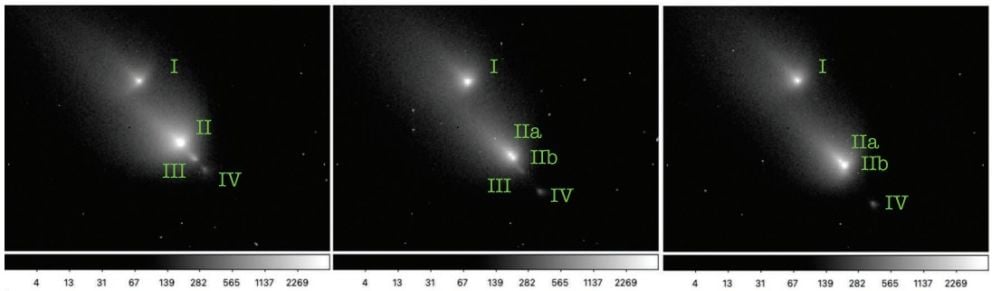 These are HST/STIS MIRVIS images of C/2025 K1 (ATLAS) obtained on 2025 Nov. 8.56 (left), Nov. 9.82, and Nov. 10.54. They show the comet's progressive breakup. Fragment I is intact in the first panel, and has split into IIa and IIb in the second panel. Fragment IIb gets brighter and develops a coma in the final panel. Fragment III gets progressively dimmer until it's invisible in the third panel. Image Credit: Bodewits et al. 2026. Icarus.
That led to questions. There was delay between the break up and bright outbursts that needs an explanation. When comets break up, clean fresh ice is exposed which should appear brighter. But for some reason, there was a puzzling delay.
The delay could be due to dust. It's possible that it's a dust layer on the newly exposed surfaces that reflects more light and creates the bright outburst. If that's true, then it may take time for light-reflecting dust to form on the new exposed surfaces.
“Never before has Hubble caught a fragmenting comet this close to when it actually fell apart. Most of the time, it’s a few weeks to a month later. And in this case, we were able to see it just days after,” said Noonan. “This is telling us something very important about the physics of what’s happening at the comet’s surface. We may be seeing the timescale it takes to form a substantial dust layer that can then be ejected by the gas.”
It's also possible that it takes time for heat to penetrate the pieces of the comet. It could generate pressure inside the pieces that builds up until they eject expanding dust shells.
The breakup of comets like this one can reveal a lot. By observing it as it breaks up, the comet's destruction provides a window into its interior. The period of time between breakup and dust activation is particularly important.
"The empirically constrained 1–3 day window between fragmentation and dust activation therefore implies a brief interval during which coma gas abundances may closely reflect bulk nucleus composition, underscoring the importance of rapid compositional measurements following breakup events," the researchers write.
The authors write that the comet's behaviour indicates "a nucleus-wide mechanical failure that exposed heterogeneously mixed interior ices," they write. This means components like water ice and CO2 aren't well mixed and are instead patchy. That means different components melt and become vapours at different times. It's also a clue that different chunks of the comet formed under different conditions.
"These observations provide rare, time-resolved constraints on the mixing, storage, and release of volatiles in a dynamically new comet near perihelion," the authors explain.
Determining Comet K1's chemical makeup is a priority, just as it is with all comets. It's chemical composition helps paint a picture of the early Solar System. It can also tell scientists if the comet is even from this Solar System. As we know, some comets are interstellar. K1's low carbon content sets it apart from many other comets.
"Pre-perihelion spectra revealed an extreme depletion in carbon-bearing species, yielding one of the lowest CN/OH ratios ever measured, comparable only to a few chemically anomalous comets that have been interpreted as possible extrasolar candidates," the authors write.
Those spectra come from ground-based analysis. A deeper analysis of the gas and its components is in the future.
The Hubble’s STIS (Space Telescope Imaging Spectrograph) and COS (Cosmic Origins Spectrograph) instruments will reveal more detail, but that work is still in progress.

