 Universe Today
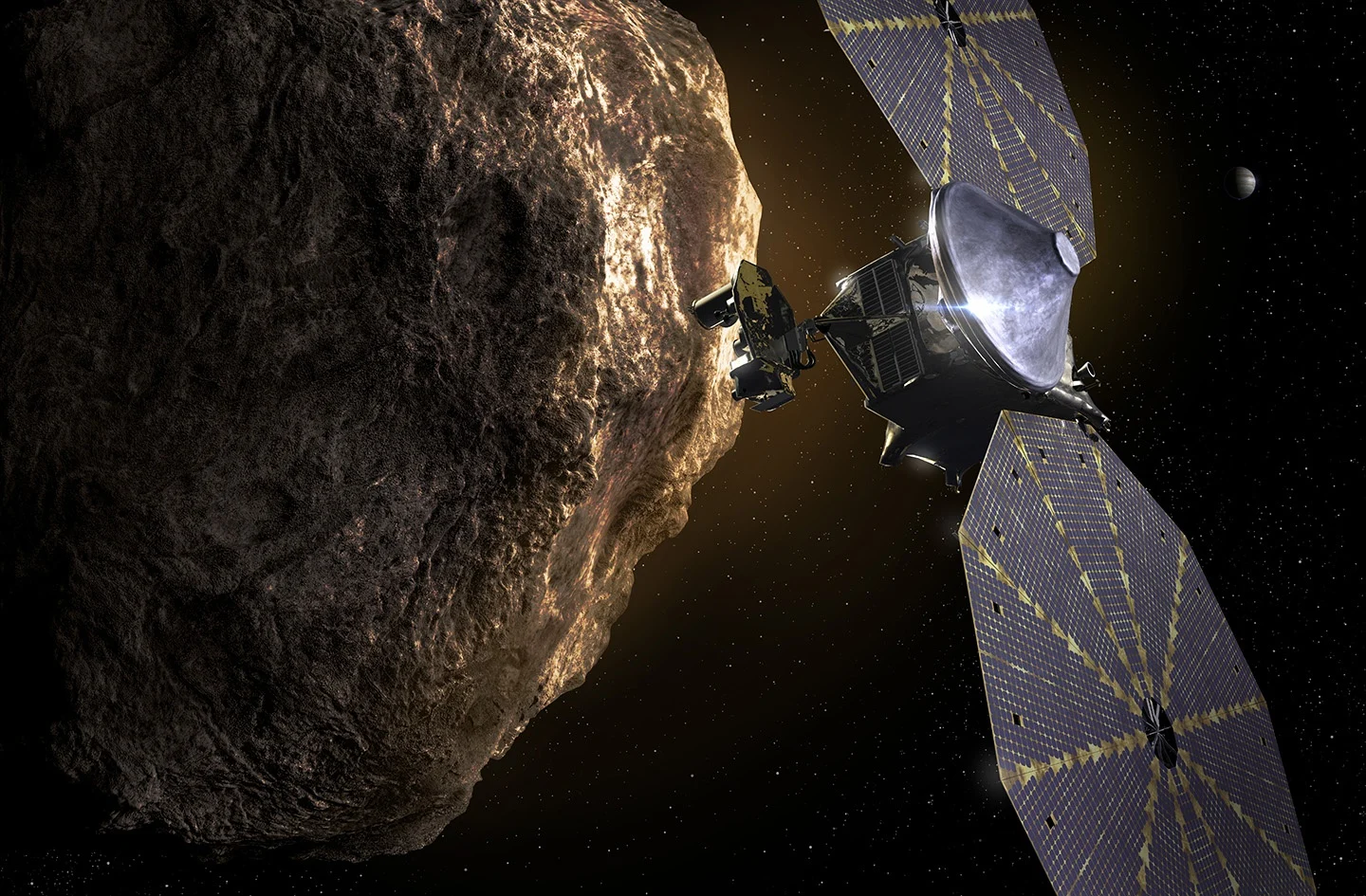
Understanding the beginning of the solar system requires us to look at some very strange places. One such place is at the so-called “Trojan” asteroids that share Jupiter’s orbit in front of and behind it. But for a long time, these cosmic time capsules have held a mystery for astronomers: why are they color-coded? The populations of larger asteroids are very clear split into two distinct groups - the “reds” and the “less reds”, because apparently they’re all red to some extent. A new paper from researchers in Japan tried to solve this mystery by taking a close look at even smaller asteroids, and their findings, published in a recent edition of The Astronomical Journal, actually brings up a completely different question - why don’t smaller Trojan asteroids have the same color-coding?
To be clear, the color coding of larger asteroids typically goes along with their “type” For example, the asteroids in the “red” category are typically D-type asteroids, which are known to be extremely dark, and are thought to be rich in complex organic molecules. “Less red” asteroids, on the other hand, are more likely P-type or C-type, though arguably P-types have more in common with their D-type cousins than the C-types - except for the “slope” of their spectrographic line, which is distinctly “less red” than D-type asteroids.
No matter the size of the asteroid, those categories still apply. But it is much more difficult to properly image a smaller asteroid - especially at a distance. One major reason is because of how quickly they spin. The researchers decided to do so using the last run of the Suprime-Cam on the 8.2m Subaru Telescope in Hawai’i. In doing so, they utilized a major advantage Suprime-Cam had over its successor, the Hyper Suprime-Cam - it had the ability to change filters quickly.
NASA video describing the Trojan asteroids. Credit - NASA YouTube ChannelSince smaller asteroids rotate more quickly, astronomers have to capture several images of them in different wavelengths to average out their spectrographic profile. If they spin too fast, the different filters capture sides of the asteroid that have changed, leaving an inaccurate calculation of what the actual spectrographic signature of the asteroid is. Suprime-Cam’s faster filter changing speed was critical to this particular research simply because it allowed a shorter period of time for the asteroid to rotate between data readings.
The researchers found 120 “small” Trojans, and narrowed those down to 44 unbiased samples ranging from roughly 3 km to around 16 km in diameter. They then cycled through two filter changes in a little under an hour, allowing them to capture all the different sides of those unbiased asteroids.
With that new data, there was one clearly distinct feature. Typical larger Trojans can be categorized into one of two categories - either “red” or ”less red”. The smaller ones showed no such bifurcation. There was a general curve of their spectra that showed an even distribution across the color spectrum. What’s more, they found size didn’t really matter either, with the size distribution being equal for arbitrarily drawn “red” objects vs “less red” objects.
Fraser describes the Lucy mission to the Trojan asteroids.This flies in the face of decades of observed data from larger Trojans. And that has been a mystery for about as long. There are several formation theories about the Trojan asteroids. The two main ones are that they were formed near Jupiter’s orbit and were captured while the planet was being born. The second is that the chaos caused by Jupiter itself “migrating” early in the solar system’s history scattered a bunch of rocks from the Kuiper belt that were eventually captured in Jupiter’s gravity to become the Trojans.
But if either of those theories were true, it doesn’t explain why the larger Trojans are split into two distinct color groups. After all, if they’re coming from the same place, shouldn’t they be the same color? One potential solution to this quandary is known as the “collisional evolution model.” It suggests that, when a red Trojan experiences a catastrophic collision, its volatile-rich surface is blown away, leaving it “less red.”
Unfortunately, this new data flies in the face of that. Red and less red objects exist in the same proportions in small sizes, whereas, according to the theory, there should be significantly more “less red” objects the smaller the objects are. So, as with all good science, it’s time to collect more data.
Luckily we already have a mission that will do so. Lucy is on its way to the Trojans, starting its flybys in 2027. It will visit larger versions of C-, P-, and D-type asteroids during its six year mission, and will hopefully be able to answer some of these fundamental questions about the general population of these windows to the early solar system. But also, I’d be willing to bet, that when Lucy starts to return high-resolution imagery of some of these objects, we as humans will have a hard time distinguishing between the “red” ones and the “less red” ones. But that’s what we have specialized cameras like the Suprime-Cam to do the work for us - it has certainly earned its well deserved rest now that its last results of its 18-year observing mission have been published.
Learn More:
Subaru Telescope - The Subaru Telescope Sheds Light on the "Color Mystery" of Jupiter Trojan Asteroids ― Insights from Suprime-Cam's Final Night of Observations
F. Yoshida, T. Terai, & K. Ohtsuki - Color and Size Distributions of Small Jupiter Trojans
UT - Why are Jupiter's Trojan Regions so Unevenly Balanced With Asteroids?

