Universe Today
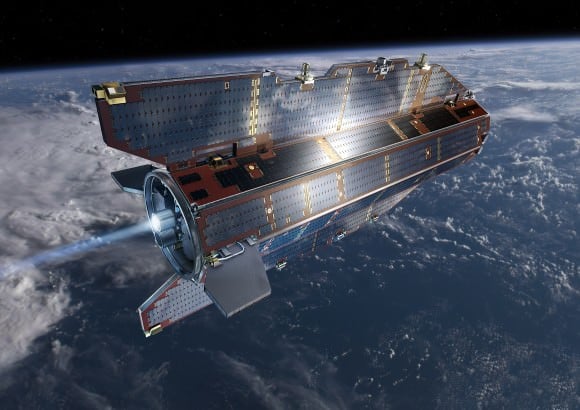
I got some grief for calling the GOCE spacecraft 'sexy' last year, but I'm sticking with that description. What a gorgeous spacecraft! And the GOCE team has stuck with their spacecraft while it had to stand down from launch in September of 2008 when problems were discovered with the guidance and navigation subsystems on the Russian Breeze KM rocket. GOCE had to be de-mated from the rocket and brought back into the clean room last year, but now is back on the launch pad, and is scheduled to liftoff on Monday, March 16 at 14:21 GMT from the Plesetsk Cosmodrome in northern Russia.
GOCE, which stands for Gravity field and steady-state Ocean Circulation Explorer will investigate and map Earth's gravitational field. It will also provide a high-resolution map of Earth's geoid, which is the surface of equal gravitational potential defined by the gravity field. This will greatly improve our knowledge and understanding of the Earth's internal structure, and will be used as a much-improved reference for ocean and climate studies, including sea-level changes, oceanic circulation and ice caps dynamics survey. Numerous applications are expected in climatology, oceanography and geophysics.
The 1 ton, 5 meter-long spacecraft will be in an extra low orbit (260 km, or 161 miles) and will experience drag from Earth's upper atmosphere, so its smooth and lean (and sexy) surface helps reduce the friction. Adding to the sleek design is that the solar panels are attached to the long body of the satellite instead of sticking out and adding to the drag. However, the spacecraft will need a boost to its orbit occasionally, and has state of the art ion engines.
ESA has a great animation of GOCE in flight.
Source: ESA